
Guardians Beyond the Classroom
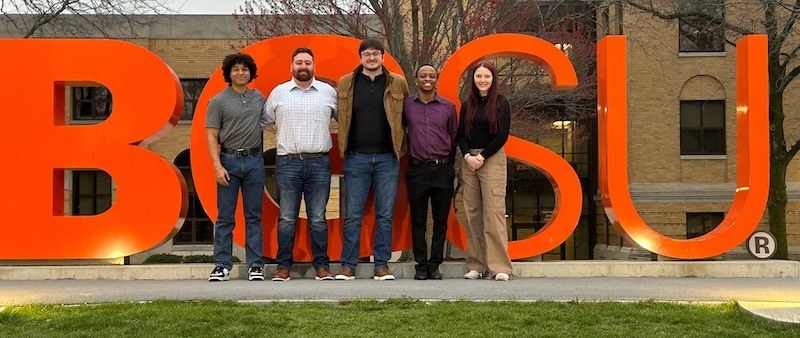
For most students, cybersecurity is a class on their schedule. For Logan Coffey and a group of his peers at Bowling Green State University, it has turned into something much bigger—a passion project that lives outside the classroom and now benefits the wider community.
Logan spent countless evenings in the labs with friends, taking on Capture-the-Flag challenges that tested their skills in cryptography, forensics, and network defense. The competitions became more than just games; they were proving grounds where failure meant learning and persistence led to breakthroughs. Eventually, Logan helped launch BGSU’s Cybersecurity Capture-the-Flag Club, giving students a place to challenge themselves and share knowledge with one another.
“What started as practice for competitions has become a mission to protect real businesses.”
— Logan Coffey, Computer Science
Out of that same drive, Logan and his teammates created The Secure Signals Project, a student-run nonprofit dedicated to providing free cybersecurity testing for small businesses. The group recognized that many local companies simply don’t have the budget for professional penetration testing, even though they’re often the most at risk for cyberattacks. By volunteering their time and skills, the students gain hands-on experience while offering small businesses protections they otherwise couldn’t access.
The project has already made a difference. When one company noticed suspicious activity, the team stepped in. Within a day, they had completed a forensic review—capturing system images, analyzing logs, and scanning for malicious software—before passing their findings to professional responders. For Logan, it was a moment that underscored just how meaningful their work had become. “It was the type of challenge I imagined facing after graduation,” he says. “But we were already doing it as students.”
The experience has given Logan more than technical expertise. Running both a campus club and a nonprofit has tested his leadership and communication skills in ways no classroom exercise could. “It feels like running a startup,” he explains. “You learn fast, not just about the technology but about how to work with people, manage projects, and build something sustainable.”
Looking forward, Logan hopes to grow The Secure Signals Project to include areas like threat hunting and security research. But for him, the most important part of the journey has already been realized: showing how student energy and passion can be translated into real impact. “This has shown me that what we do outside of class can be just as important as what we learn inside,” he reflects. “It’s about taking what we know and using it to help people—right now.”
BGSU B.S. in Computer Science is accredited by the Computing Accreditation Commission of ABET, www.abet.org, under the commission’s General Criteria and Program Criteria for Computer Science.
BGSU B.S. in Software Engineering is accredited by the Engineering Accreditation Commission of ABET, www.abet.org, under the commission’s General Criteria and Program Criteria for Software Engineering.
Updated: 09/18/2025 04:50PM