
Department of Mathematics and Statistics - Bowling Green State Univeristy
Message from the Chair
This year, our university welcomed Dr. Ravi Krovi as our new provost and senior vice president. May 5, 2025, marked his first official day at BGSU. Prior to his work at Weber State University, Dr. Krovi held multiple leadership roles at the University of Akron, including serving as dean of the College of Business Administration for a decade, where he secured more than $32 million in private philanthropy, as well as corporate and other commitments to support business students and programs. BGSU hosted a reception for our faculty and staff to meet Provost Krovi on Thursday, May 8, from 3-5 p.m. in the Dimling Lounge on the third floor of the Bowen-Thompson Student Union. With the participation of Dr. Krovi, our faculty and students are hoping to see the elevation of BGSU!
Within the department, we have been revising the department charter, including the department organization and workload policy, since last year. Time has updated the organization in many aspects, and the faculty have taken more responsibilities in service. It is therefore very necessary and acute to revise the organization changes accordingly. The departmental Advisory Committee met weekly to modify and polish the organization part in AY 2024-25. In Spring 2025, the workload policy guidelines by the Provost were generated. With the direction of the College of Arts and Sciences, the department will continue to work on the workload policy to align with the guidance. The faculty will participate in the departmental charter revisions this year. Although the policy adjustment is a gradual duty, our faculty are ready and will commit more time to ensure this job can be completed early. Our goal is to improve the practicability and applicability of the current draft of the workload policy and the other parts of the department charter.
The Math Emporium faculty has reformed the teaching structure of college algebra since AY 2023-2024. More effective teaching and instruction approaches were adopted last year. Active learning was accommodated in the classroom and has been continuously improved. Led by the Math Emporium Director, Ms. Courtney Wilcox, the faculty had open lab offered in Spring 2025 Monday-Thursday from 12:30-7:00 p.m. and had over 50% of students attend open lab. Most of them attended multiple times, which was a significant increase compared to Fall 2024 attendance, so the students are making full use of open lab. Students have mentioned how beneficial open lab has been. As a result of all these efforts, the performance of students in the college algebra course was much improved based on the grading and passing rate data.
Quite a few faculty focused on curriculum development in Summer 2025. In particular, the faculty developed a new course in mathematics and statistics for the needs of the masters students in Data Science. The College of Engineering and Innovation plans to generate a pure online program for professionals. To this end, our faculty has been working on online courses for MATH 1310 and 2320 (Calculus I and II), MATH 2470 (Math and Stats for Engineering), and MATH 2910 (Applied Engineering Mathematics with Applications). The related faculty members have communicated and met numerous times with the college administrators for ensuring rationality of such development in different courses and obtaining assistance from the Center for Faculty Excellence.
In order to improve our programs, the department evaluated the undergraduate and graduate programs. In Fall 2024, led by the Undergraduate Coordinator, Dr. Mihai Staic, the Undergraduate Committee conducted the assessments for the undergraduate program learning outcomes; led by Dr. Ben Ward, the Graduate Coordinator, the Graduate Committee conducted the assessments for the graduate program learning outcomes. To support student success, the department sponsored various meetings and gatherings for the graduate and undergraduate students to better interact with each other and our faculty.
We are very excited to welcome two new hires in Fall 2025, Drs. Jiajie Yang and Shenghao Xia. They are both assistant professors, Jiajie in Actuarial Science and Shenghao in Data Science/Statistics. As new assets to the department, they will teach and supervise students and play important roles in teaching, research, and service.
Congratulations to Dr. Umar Islambekov for being tenured and promoted to Associate Professor. Also, Umar took over the job of the Assistant Chair in May 2025, mainly managing teaching schedules for our faculty and graduate students and math course transfers.
A new semester of 2025-2026 has begun. The faculty members of the department are ready to welcome new tasks in another new academic year. As always, we will continuously provide quality mathematics and statistics teaching for students across campus!

Dr. Junfeng Shang, Professor and Chair
Department of Mathematics and Statistics
BGSU Math and Stats Staff News
Math and Stats Staff Awarded College of Arts & Sciences Appreciation of 2024
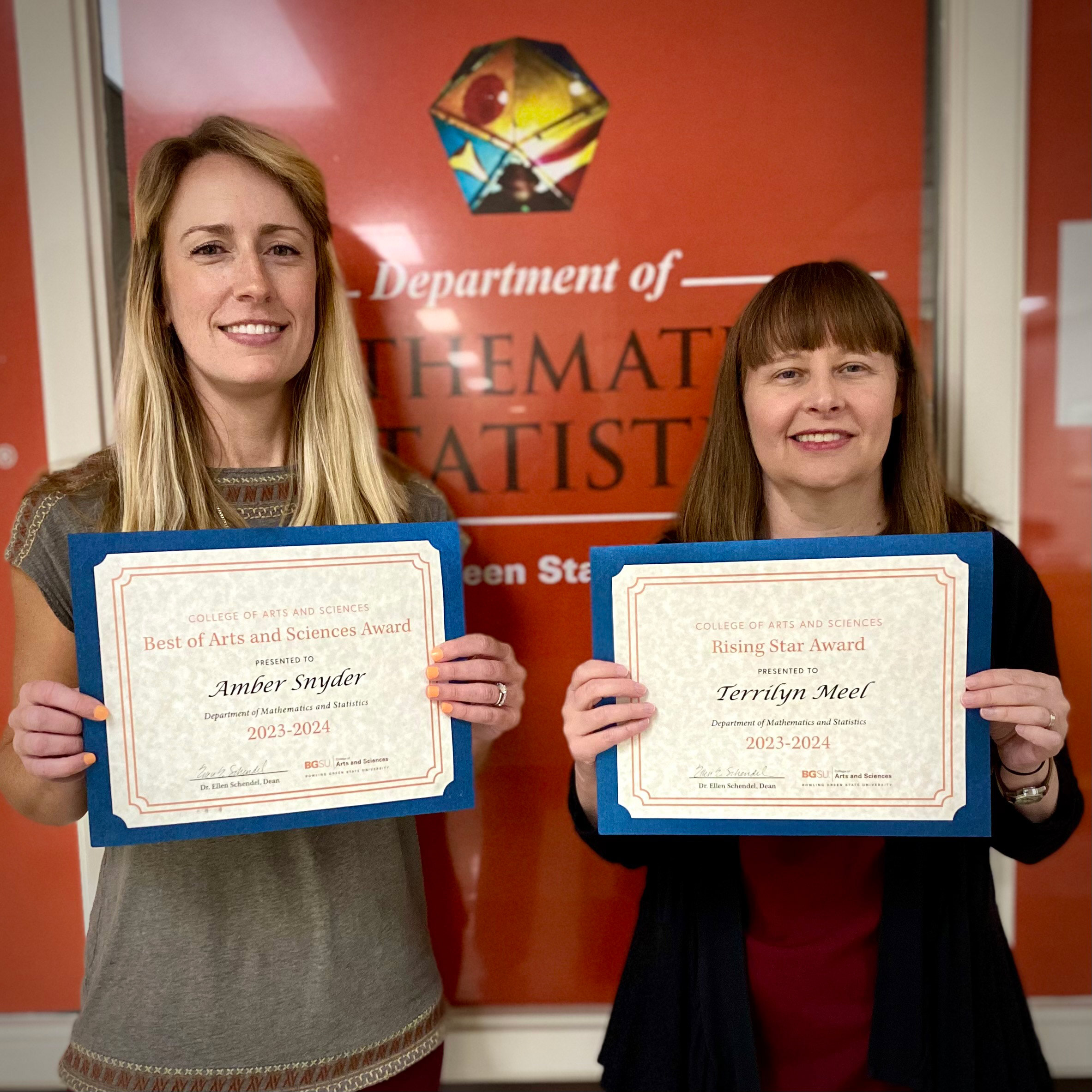
On October 8, 2024, Amber Snyder and Terrilyn Meel were presented the Best of Arts & Sciences Award and Rising Star Award, respectively, at the annual Staff Appreciation Breakfast. Many congratulations and thanks to Amber and Terrilyn for their remarkable and constant support and assistance to our math and stats faculty and students!
The Best of Arts and Sciences Award recognizes administrative and/or classified staff nominee(s) who provide excellent customer service, improve the quality of programs and/or services, implement a new idea or program, and demonstrate exemplary commitment to the core values of BGSU.
The Rising Star Award recognizes individuals who are within their first 3 years of employment with the College of Arts & Sciences and who exhibit exemplary effort in training other employees and students, exhibit an exemplary level of competence in carrying out day-to-day job, performance, including refining job skills, and demonstrate exemplary commitment to the core values of BGSU.
BGSU Math and Stats Faculty News
Kim Rogers Awarded NSF Fund
In January 2025, Dr. Kim Rogers was awarded a National Science Foundation (NSF) collaborative grant: Establishing Networked Improvement Communities of STEM Educators: Actively Engaging Students through Peer Mentoring. Specifically, BGSU is awarded a $1,010,000 total budget and the rest of the award goes to the University of South Carolina through this collaborative work. This project’s focus will build upon a decade of research, local and national grants, and growth within the Department of Mathematics and Statistics at BGSU on how peer mentoring around teaching with graduate students can (1) greatly improve student-centered instruction, (2) lower complaints and concerns (severity and frequency), and (3) improve student success in course completion. With this new grant, we are excited to expand peer mentoring to also include the BGSU School of Media & Communication and the Departments of Physics & Astronomy, Biological Sciences, and Psychology to support professional development for graduate students teaching through network improvement communities using improvement science. Many congratulations to Kim and her collaborators for this great achievement!
Four Math and Stats Faculty Recognized in 2025 for Service
Each spring, our annual Service Awards Ceremony recognizes BGSU faculty and staff for their length of service to the university. On April 16, 2025, in the Lenhart Grand Ballroom of the BTSU, the Office of Human Resources in partnership with the Office of the Provost facilitated the annual Service Awards program and the ceremony which recognized BGSU employees for their length of service to the university. Awards are provided in five-year increments, beginning with the fifth year of regular service. In the ceremony, the President and the Provost each gave a talk to celebrate with the service awardees. Four faculty members in the Department of Mathematics and Statistics were recognized: Konra Holman (25 years), Umar Islambekov (5 years), Tong Sun (25 years), and Ben Ward (5 years). Ben attended the reception.
Congratulations to the service awardees in the Department of Mathematics and Statistics for your service milestone!
Dr. Tong Sun Retired
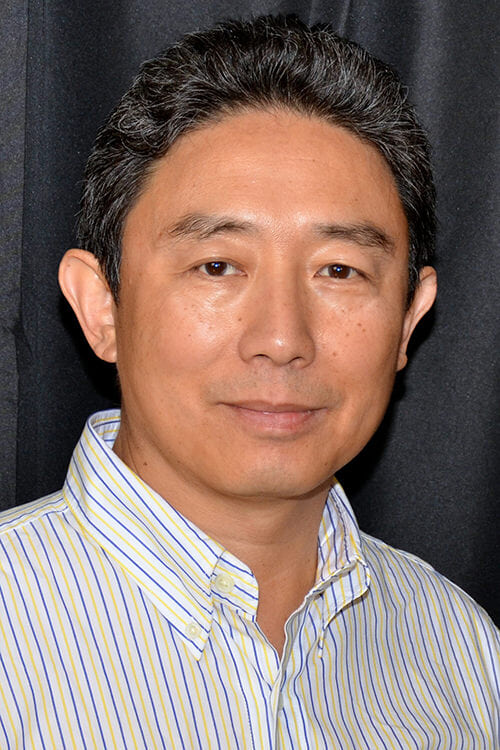
Dr. Tong Sun retired in July of 2025 after 26 years of service to the department and university. In 1999, after three-year post-doctoral and visiting work and earning his Ph.D. from Texas A&M University, he joined the Department of Mathematics and Statistics at Bowling Green State University. Dr. Sun had been the Department Assistant Chair from 2016 until his retirement. During that time, he significantly contributed to the department’s service and administration. The department faculty and students were very pleased with his work in arranging teaching scheduling. He covered courses and supervised graduate students for the applied math programs.
In Remembrance of Dr. Arjun K. Gupta
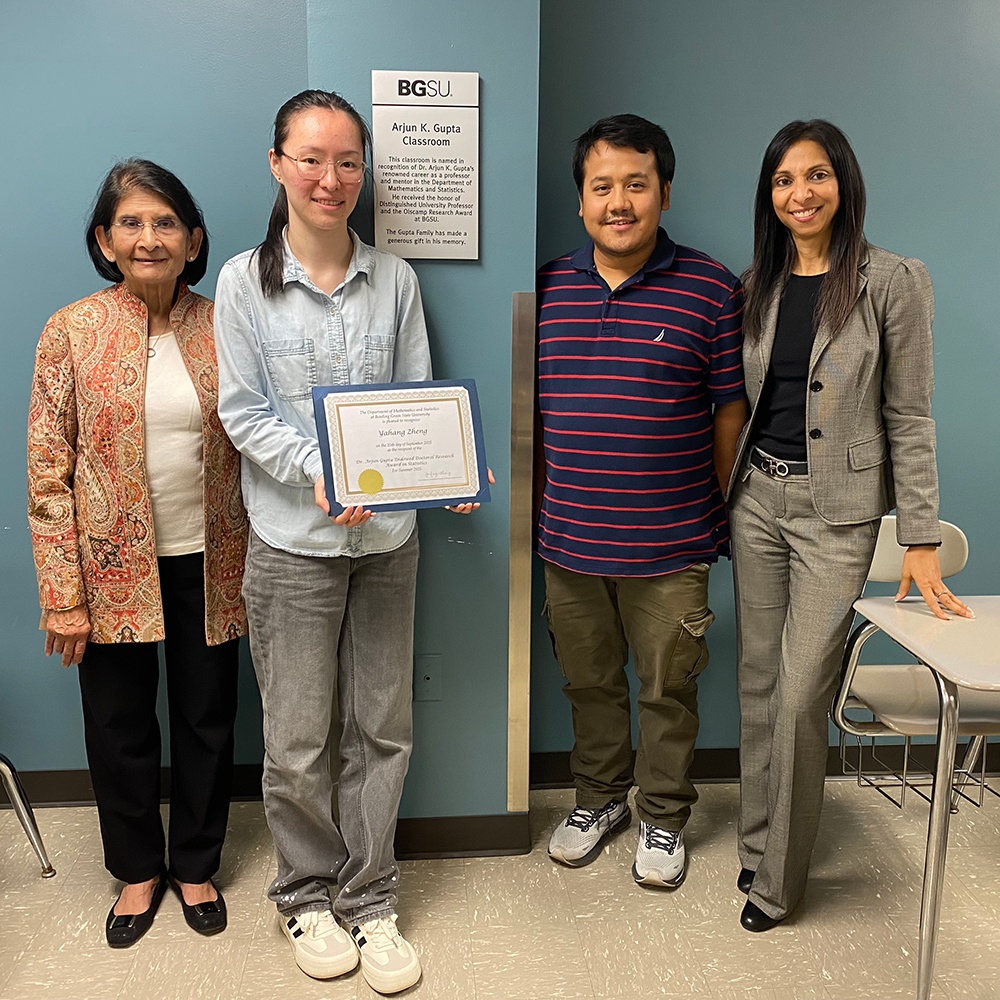
Dr. Arjun K. Gupta worked in the Department of Mathematics and Statistics from 1976 until his retirement in 2015. He significantly contributed to teaching, research and the programs of the department. The Gupta Family, led by the late Dr. Arjun Gupta’s wife, Mrs. Meera Gupta, established an endowed research award in support of international doctoral students in statistics at Bowling Green State University. The first and second award recipients were selected in 2024 and 2025 respectively. Below is a tribute to Dr. Gupta written by Dr. John Tuhao Chen, a colleague and collaborator of Dr. Gupta's.
To the memory of Professor Arjun K. Gupta
Each time we enter the “Arjun K. Gupta Room,” we naturally think about Professor A. K. Gupta, a friendly colleague, a knowledgeable and distinguished mentor, and a genius leader in the Department of Mathematics and Statistics.
A friendly colleague. I remember the first time I met Professor Gupta at the Toledo airport when I came to Bowling Green for the job interview. I was pleasantly surprised to see that Professor Gupta had personally came to the airport to fetch me. At that time, he had already built an excellent professional reputation in multivariate statistics and was a highly esteemed scholar in the field. However, he was so gentle, friendly, and talkative that I almost forgot that the person driving me was an internationally influential figure in statistics. Without the kindness and hospitality of Professor Gupta, I might have taken a job offer from another university.
I am not the only statistician that highly appreciates Professor Gupta’s help. In fact, he helped his colleagues in every way possible. Knowing the uneasiness of international colleagues while settling in Bowling Green, Professor Gupta treated new faculty and graduate students like family members. For instance, we once had a new faculty who got into a dispute with a local rental agent after moving to Bowling Green. When Professor Gupta learned about this, he picked up the phone and called the agent on behalf of the new faculty. With his prowess, Professor Gupta resolved the issue immediately. This is just one of the many occasions when Professor Gupta stepped in and created a supportive and friendly environment in the department. Several colleagues still remember that when their families had a newborn, Professor Gupta and Mrs. Gupta always showed up with gifts of congratulations. These daily details—his kindness and care—made everyone feel at home in Bowling Green.
As a collegiate fellow, Professor Gupta always stood up for other faculty when needed. Once, while I was sitting in his office chatting about statistics research problems, a faculty in algebra passed by his office and informed Professor Gupta that he did not feel well. Professor Gupta immediately arranged to send the algebraist to the hospital and volunteered to take care of his two classes in the afternoon, despite the courses being in algebra, not statistics, the field Professor Gupta taught. That’s who Professor Gupta was as a person. He shouldered the difficulty for other people in need without a moment of hesitation. Really, I do not know how he eventually managed those algebra classes. He might have magically handled the class himself, or he might have asked another algebraist to substitute the class later. Either way, I was deeply impressed by his courage and righteousness to immediately take care of difficulties for colleagues when needed.
A knowledgeable and distinguished mentor. I was lucky enough to have Professor Gupta as my mentor when I joined the department as a junior faculty. At that time, I did not even have the concept of participating in an international conference. It was Professor Gupta who showed me step by step from searching for a suitable conference, to registration, abstract writing, conference presentation, and after-conference paper contribution.
At the time when we started collaboration, the analysis of skew normal data was at its infancy stage. We formed a small research team with three members, Professor Truc Nguyen, Professor Gupta, and me. As the natural leader of the team, Professor Gupta skillfully directed the study on testing the goodness-of-fit to check the plausibility of skew normal models, a critical step before the application of a skew normal analysis. It was very successful! We started with an analysis of stock market data, derived the characteristic function and sample mean distributions of skew normal models, and applied the skew normal model to the disease occurrence time of twins in epidemiology. One of the papers pointed out the important fact that, unlike the normal model, the sample mean of a skew normal model is no longer a skew normal model. From there, Professor Gupta proposed new skew normal models with coherence for sample mean distributions.
After analyzing the univariate skew normal random variables, Professor Gupta guided us to move on to multivariate skew normal models and matrix variate skew normal models. With his expertise and intuition in the field, Professor Gupta orchestrated an incredible amount of research results with many collaborators in the field of skew normal distributions.
Besides the study on skew normal models, Professor Gupta also skillfully directed us to investigate unsolved classical conjectures in statistics. To provide a glimpse of the way Professor Gupta orchestrated collaborative research in statistics, let me describe the work related to the paper, A proof of the conjecture on the positive skewness of generalized inverse Gaussian distributions, by Nguyen, Chen, Gupta and Dinh (Biometrika, 2003).
At the time of the study, one of the open problems in distribution theory was the proof of the positive skewness of generalized inverse Gaussian models. The problem was partially motivated by a consulting project on medical investigation. We observed that, for non-normal models, it would be more plausible to model heavy tail data if the Generalized Inverse Gaussian model is positively skewed. However, searching through the literature, we found that the positive skewness of the Generalized Inverse Gaussian model had been an open question since it was conjectured in 1973. Organized by Professor Gupta, we investigated possible methods for the proof of the conjecture. The project was so thorny and tricky that several times we almost wanted to terminate it. After many meetings, discussions, arguments, failures, and computer simulations, finally, we created a novel method to prove this 29-year-old open conjecture in distribution theory. It should be mentioned that at the time when we felt it was impossible to prove that conjecture, Professor Gupta, with his discernible intuition on sampling distribution theory, kept encouraging us to drill deeper into the problem. Without his significant effort, the project toward the proof of the conjecture would have been impossible. We were glad that eventually we overcame various difficulties and proved the conjecture. The result has strong impact on modeling heavy tailed skew data including stock prices in a bull (or bear) market, as well as in medical study investigating adolescent suicide data. The proof was published in Biometrika, one of the most prestigious journals in statistics.
A genius leader. Professor Gupta devoted his energy and time in the development of the statistics program at BGSU. From the name change of the department, to the establishment of the Ph.D. in statistics program, Professor Gupta led the statisticians in the department to strive, one step at a time, toward their goals at each stage.
Before the department had a Ph.D. in statistics program, there was only the option for a Ph.D. in mathematics with a concentration in statistics. There was also a significant number of students in the M.A. in statistics program, which produced many excellent graduates each year. However, many of them left BGSU to pursue Ph.D. in statistics programs at other universities, since students with Ph.D. in statistics tended to have an easier time finding well-paid positions at that time, compared with graduates with a Ph.D. in mathematics. Given this situation, Professor Gupta initiated a proposal of a Ph.D. in statistics program in the department. However, issues related to the proposal soon became quite complicated because it involved core courses in pure mathematics, co-courses with the Department of Applied Statistics and Operation Research (ASOR) in the College of Business, and additional administrational challenges.
But instead of giving up the proposal, Professor Gupta rallied statisticians in the department to tackle these difficulties one-by-one. He made appointments with the university President, the Dean of the College of Arts and Sciences, and other administrators to emphasize the importance of the Ph.D. in statistics program. Professor Gupta convinced the Chair (Professor Neal Carothers, a mathematician) and the Graduate Coordinator (Professor Steven Seubert, a mathematician) about the need for the Ph.D. in statistics programs. He formed a small group to discuss with the Dean of the College of Business and faculty of ASOR for collaborative courses and their support. To create a platform for statistics Ph.D. students to practice theoretical skills, Professor Gupta timelessly addressed the importance of the Statistics Consulting Center during program reviews. With the significant efforts of the statistics group led by Professor Gupta, we eventually constructed the Ph.D. in Statistics program. Without the great effort of Professor Gupta, the thriving Ph.D. program we have today would only be an idea.
When it came time for teaching and course proposal, I was always impressed by the rigorousness of Professor Gupta. At every step, he insisted on maximizing the quality of Ph.D. courses and statistical research. When I met BGSU statistics Ph.D. graduates in conferences, I often heard the story that though students felt Professor Gupta’s classes were theoretically challenging, they were very helpful once students had to start their own research projects after graduation. It is after graduation that students deeply appreciate Professor Gupta’s teaching, which led to the current rigorous teaching style of theoretical courses in the Ph.D. statistics program.
It is impossible to exhaust the long list of stories about the great goodness of Professor Gupta. Two years after his passing, his kindness, academic spirit, and rigorous leadership style remain in the department. On a quiet Saturday night, when everything is calm, one can always feel his soul or hear his voice echoing in the hallway: “Working hard, for the future of the statistics program.”
Math and Stats Faculty and Student Attended RUME
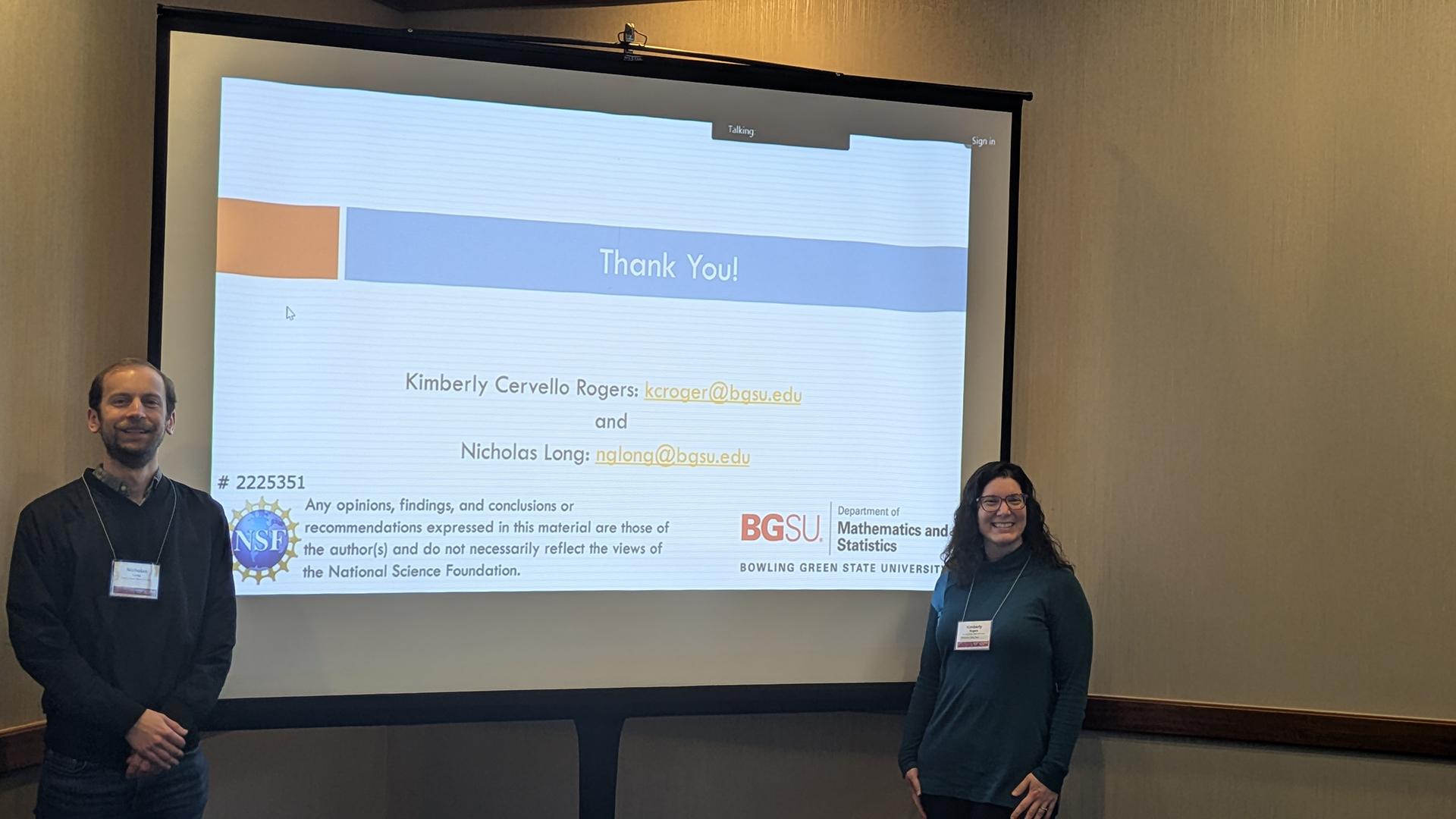
At the 2025 Research in Undergraduate Mathematics Education (RUME) Conference, research assistant Nicholas Long and Dr. Kim Rogers had the opportunity to contribute to important discussions about undergraduate mathematics instruction. RUME, organized by the Special Interest Group of the Mathematical Association of America (SIGMAA on RUME), serves as a premier venue for sharing research on the teaching and learning of collegiate mathematics. Bringing together educators, researchers, and practitioners, the conference highlights current findings, theoretical perspectives, and innovative methodologies that shape the field. This year’s event, hosted in a hybrid format by Virginia Tech, took place in Alexandria, Virginia, fostering rich dialogue and collaboration. Nicholas and Dr. Rogers attended RUME in person.
During the conference, Dr. Rogers had the exciting opportunity to present two talks that included collaborative and independent research, each shedding light on different facets of teaching and learning in undergraduate mathematics. Through these presentations, they suggested ways to enhance future professional development opportunities for math graduate student instructors and emphasized the challenges and opportunities in structuring effective mathematics instruction at scale. Participating in RUME 2025 was an invaluable experience, allowing them to engage with leading scholars and practitioners dedicated to advancing undergraduate mathematics education. Both of their presentations were well attended and well received. This work contributes to ongoing conversations about how they prepare and support both novice and experienced college math instructors—critical elements in shaping the future of mathematics teaching and learning.
BGSU Math and Stats Student News
Nicholas Long Awarded 2024 Outstanding Doctoral Student Teaching Associate
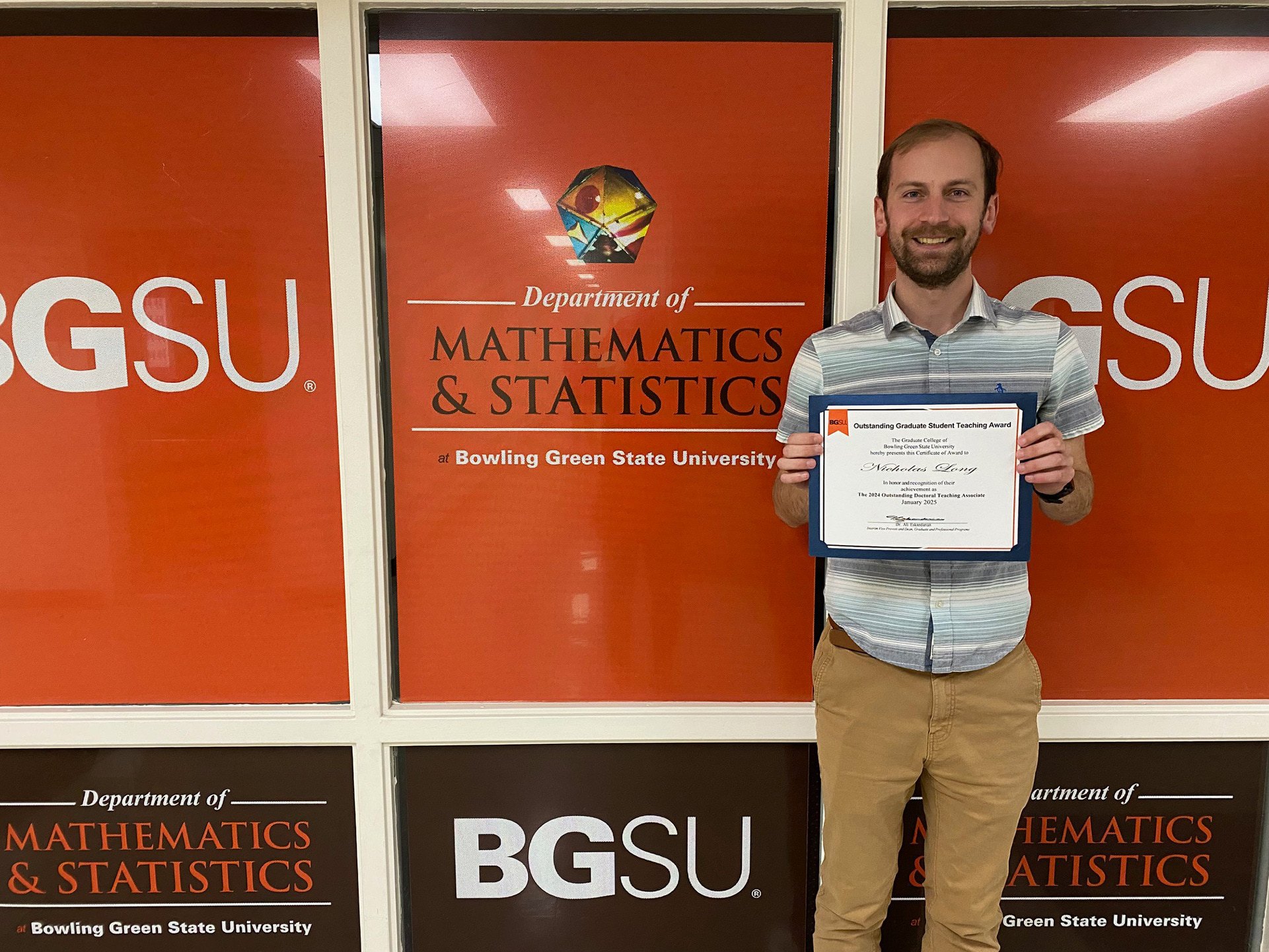
In January 2025, the Graduate College of BGSU awarded Nicholas Long the 2024 Outstanding Doctoral Student Teaching Associate (TI) Award. The nomination and selection for this award is quite an honor. There are approximately 1,200 graduate assistants at BGSU. This demonstrates that Nicholas is respected and thought of highly by his students and his peers and is among the very best graduate assistants who are teaching on campus. The purpose of this award is to encourage and reward excellence in undergraduate teaching and to recognize teaching associates as valued colleagues. An honorarium in the amount of $500 was awarded. The department and faculty are very proud of Nicholas’ accomplishments. Congratulations to Nicholas Long for a beautiful job in his teaching!
2025 Math and Stats Department Scholarships and Awards
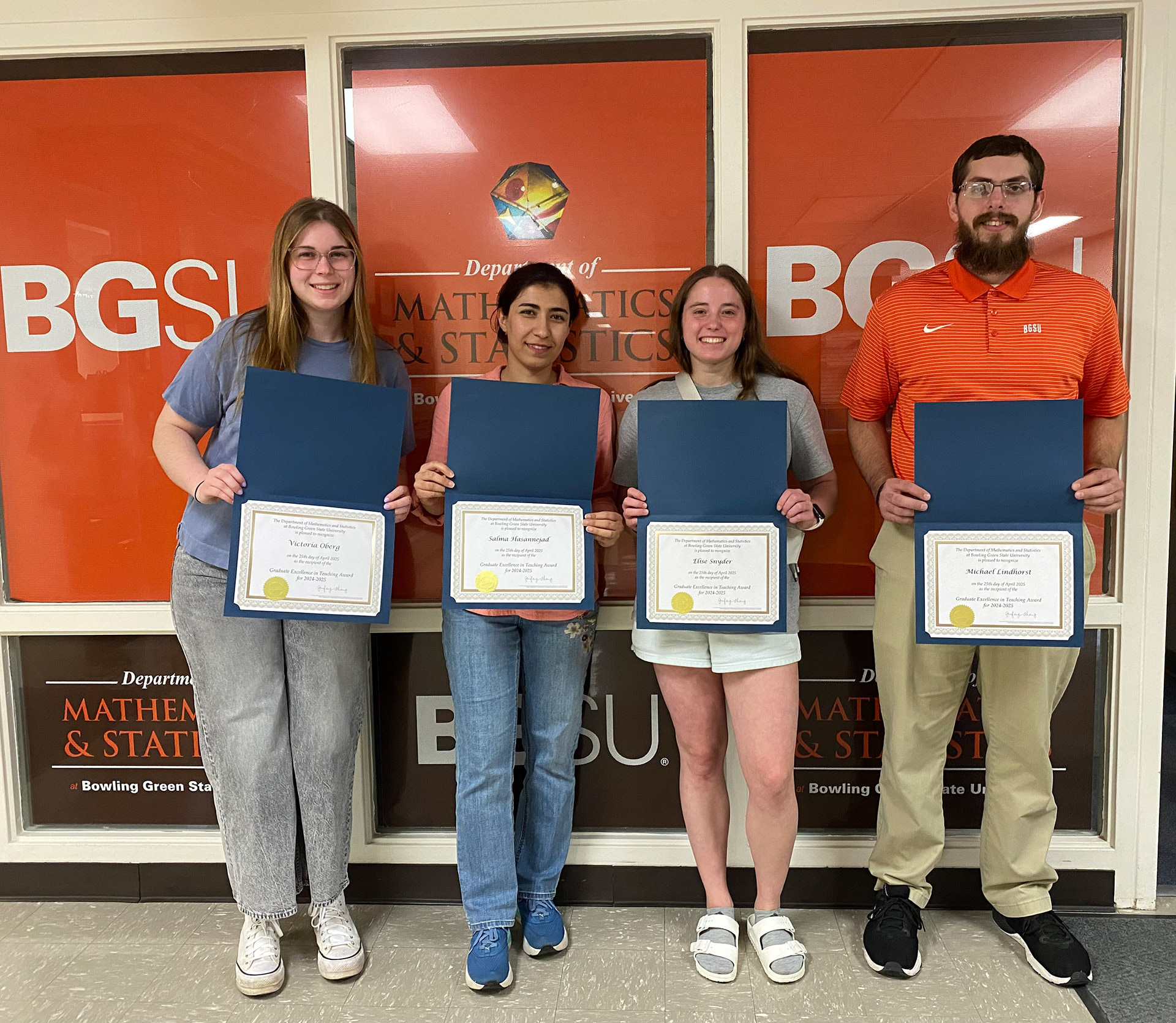
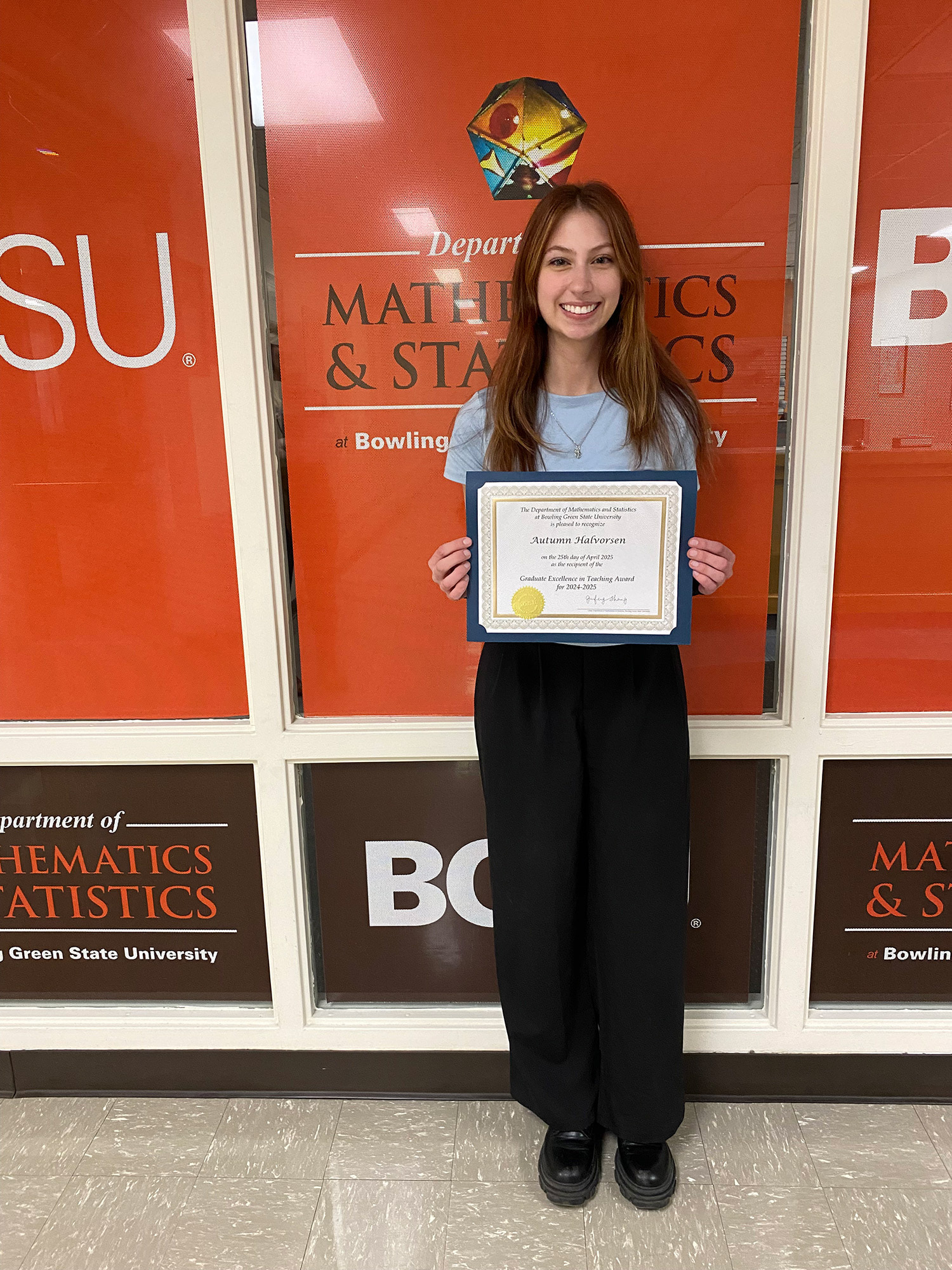
Graduate Excellence in Teaching
- Autumn Halvorsen
- Michael Lindhorst
- Elise Snyder
- Salma Hasannejad
- Victoria Oberg
Dr. Arjun Gupta Endowed Doctoral Research Award in Statistics
- Deep Sagar Karki (2024)
- Yahang Zheng (2025)
Outstanding Seniors
- Grayson Tvrdik
- Samantha Johnson
- Kayla Fruth
- Rebecca Johnson
10th Edition BGSU Competition
Beginner section
- Phu Khang Van
- Habiba Islambekova
- Alice Essinger
Advanced section
- Jack Campbell
- Max Kuenzler
- Sylvia Nguyen
Undergraduate Scholarships
Humphrey Fong Distinguished Undergraduate/Math
- Jack Campbell
- Lavender Moraa
- Hailey Gottschalk
- Skye Aycock
- Aurora Conner
Frank C. and Florence S. Ogg Memorial Scholarship
- Jack Burke
- Kojak Valentine
Kenneth B. Cummins Scholarship
- Joshua Pellegrin
- Sophie Henderson
- Mariam Abouheaf
- Austin Hernandez
- KaraLynn Sweinhagen
- Finnegan O’Connor
John L. and William and Maxine Hayden Award
- Alessandra Sebastiani
- Rebecca Lander
- Kyle Rabe
- Taylore Rethmel
- Nathan Carpenter
J. Robert and Gretchen Overman Scholarship Award
- James Saracene
- Gabriela Walker
- Amelia Dennis
- Griffin Salyer
- Andrew Palte
- Heather Baden
Anna N. Gryting Mathematics Scholarship
- Lydia Hablitzel
- Adam Nabozny
- Chase Gilmore
Graduate Scholarships
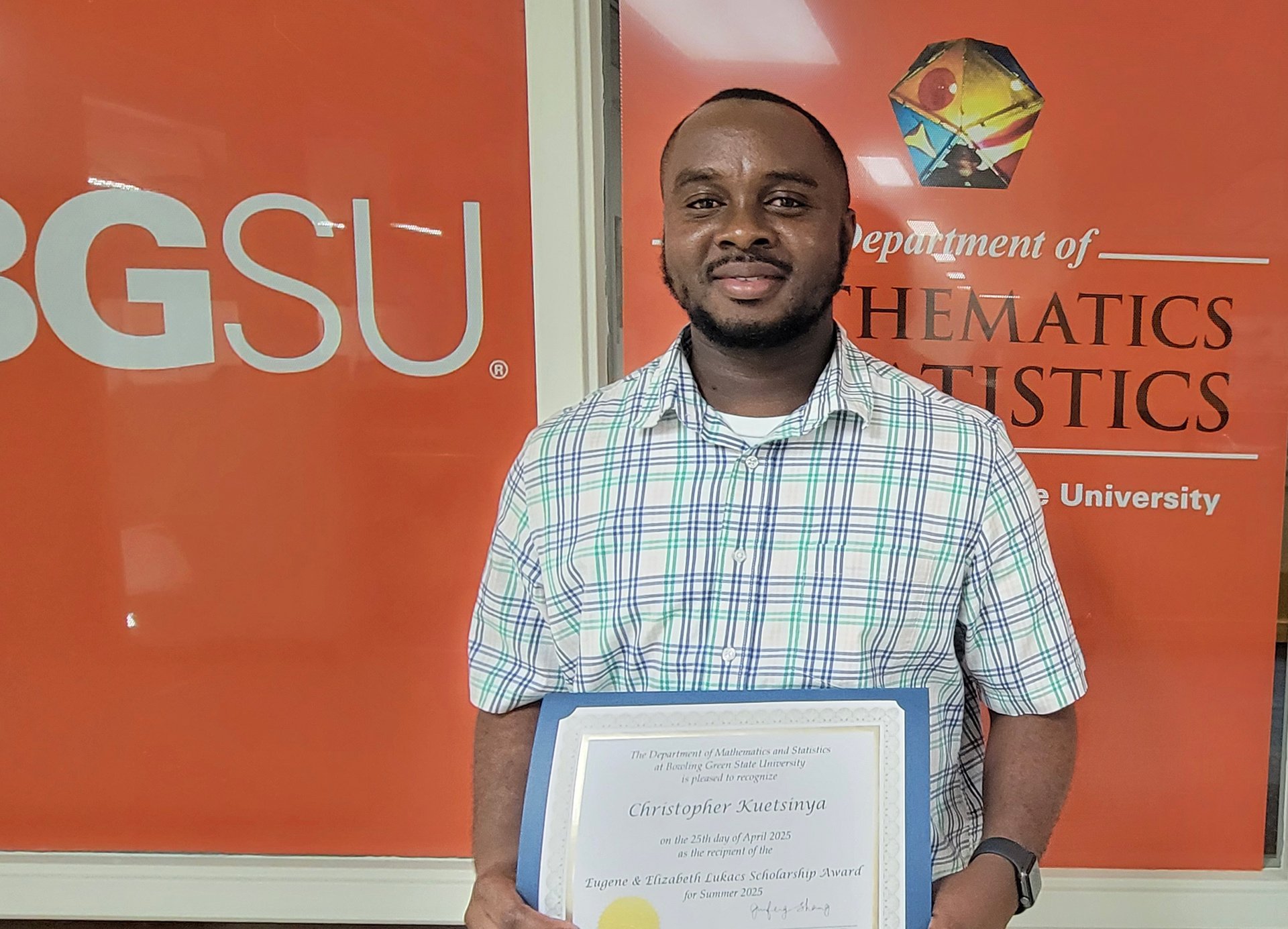
Eugene and Elizabeth Lukacs Scholarship
- Christopher Kuetsinya
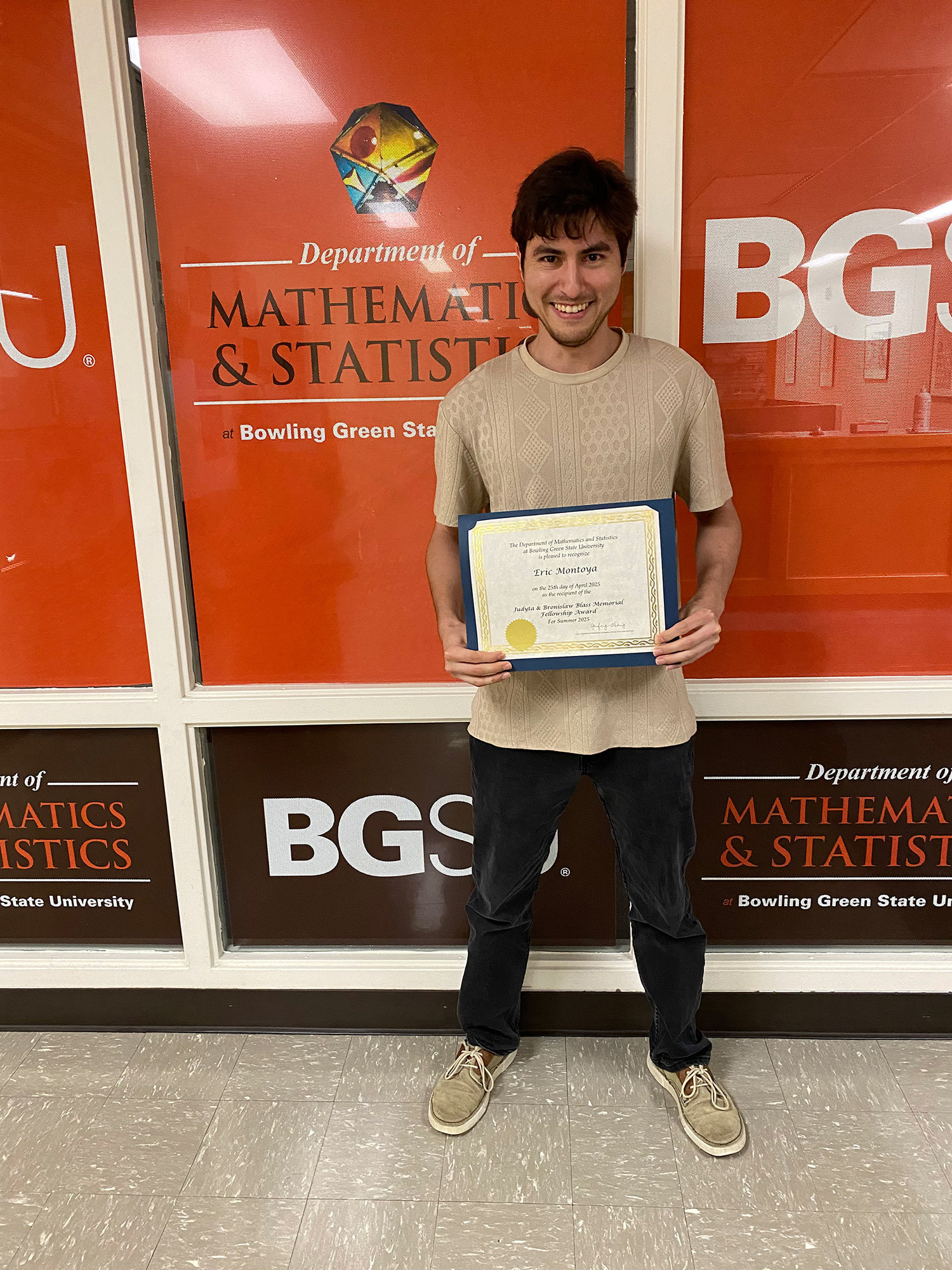
Judyta and Bronislaw Blass Memorial Fellowship
- Eric Montoya
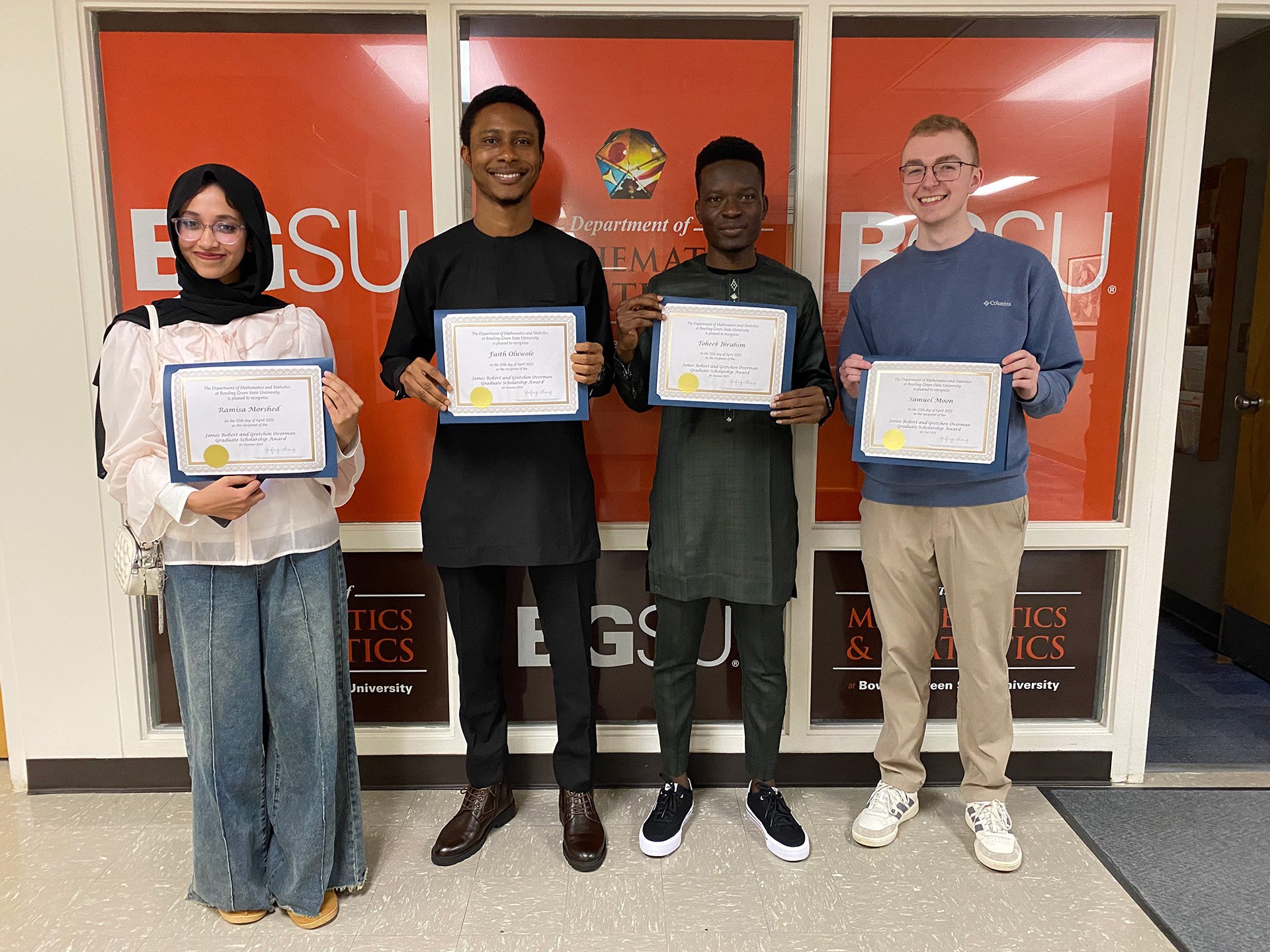
J. Robert and Gretchen Overman Scholarship
- Faith Oluwole
- Kadir Yucel
- Sam Moon
- Ramisa Morshed
- Ayako Carter
- Jason Turk
- Toheeb Ibrahim
- Jiajie Xu
Updated: 09/30/2025 12:34PM