
Climate Action Plan
This web page is a version of the Climate Action Plan optimized for accessibility purposes. As this is is not the original document it shall not be used as a reference in any academic setting. The original document can be acquired by reaching out to greenbg@bgsu.edu
What is the Climate Action Plan?
The BGSU Climate Action Plan provides a vision of a sustainable institution operating as as economically and efficiently as possible. the goal is to eliminate all greenhouse gas emissions by 2040. Realizing this vision requires participation and cooperation from the entire university community and will transform BGSU into a healthier and safer place to work and study. It also positions us as a leader and role model in the reduction of emissions, and shaping tomorrow's leaders aimed with combating worldwide issues that threaten the planet.
Once the vision described in this plan is realized, BGSU will no longer be contributing to harmful emissions being released into our atmosphere, achieving carbon neutrality. We will accomplish this goal through a multi-pronged approach of implementing and expanding upon our current use of renewable sources of heating, cooling, and electricity; installation of highly efficient lighting systems; continuation and expansion of our zero-emission vehicles; as well as other sustainable practices and policies. In addition, all students will be provided profession-relevant and cutting-edge opportunities for training and growth in sustainable practices.
While this vision seems ambitious, research shows that the technologies needed to achieve this goal already exist. As time passes, they will continue to become more affordable and more efficient. Additionally, we anticipate unforeseen new technologies will become available to accelerate the pace at which this vision can be achieved.
Introduction
Bowling Green State University has a long history of engaging students, faculty, and staff on issues of environmental stewardship both in, and outside the classroom. The Department of the Environment & Sustainability is one of the oldest programs of its kind in Ohio. In 2008, further formalized institutional efforts at sustainability with the creation of the Office of Campus Sustainability, within Campus Operations. In November, 2011, President Mary Ellen Mazey convened a committee of faculty, staff and students and expressed her desire to join the signatories of the ACUPCC. She charged that committee with developing a preliminary plan that, when approved by the BGSU Board of Trustees, would allow her to sign the commitment, thereby moving BGSU toward the goal of climate neutrality.
In October 2012, BGSU became the 661st signatory to the ACUPCC take a stand on climate change and the production of emissions responsible for it. This was done, fittingly, on National Campus Sustainability Day. As a premier institution of higher education in Northwest Ohio and nationally, BGSU recognized an obligation to be at the forefront of its own emissions reduction, as well as the education of both students and the community, in becoming change agents for this worldwide problem.
Signing the ACUPCC was a decisive move by our institution’s President, and the beginning of a journey towards significant and comprehensive reduction of waste and carbon output. It is now time, after an assessment/study of BGSU’s contribution to Greenhouse Gases on an annual basis, to present a preliminary plan to reach carbon neutrality in the future, in an effort to involve the entire university in solving the problem. As will become evident after review of this plan, there are a variety of actions BGSU can take which will not only begin to reduce its emissions of carbon, but will also ultimately result in financial savings as a result of the use of less energy, or the use of renewable energy sources.
The original Committee also divided up into several subcommittees to review specific areas. The “Immediate/Tangible Actions” subcommittee, composed of students and staff made the recommendation that BGSU select four tangible actions from a list of seven possible actions provided by the ACUPCC. These four actions represented twice the minimum number of two required of ACUPCC signatories to put into action immediately after signing it.
Tangible actions were to be realistic and capable of being accomplished, with a goal of energizing and uniting the University community towards common sustainability goals, and were to provide an appropriate level of challenge to the institution. BGSU’s diverse and comprehensive tangible actions, which covered a number of its emissions sources included:
- Participation in the “Waste Management” category of the national “Recyclemania” competition and adopting 3 or more associate measures to reduce waste;
- Encouraging the use of and providing access to public transportation for all faculty, staff, students, and visitors at BGSU;
- Establishment of a policy that all new campus construction be built to at least the U.S. Green Building Council’s LEED Silver Standard, or the equivalent; and
- Adopting an energy efficient appliance purchasing policy requiring the purchase of Energy Star certified products in all areas where such ratings exist.
In the fall of 2013, BGSU engaged the services of Sightlines, Inc. to assist in the completion of a Greenhouse Gas Inventory (“GHG Inventory”), as required by the ACUPCC for all signatories within two years of executing the document. Accordingly, a comprehensive assessment of BGSU’s carbon emissions, compiled from the careful collection and review of five successive fiscal years of data was completed and submitted to the ACUPCC in January, 2014.
As the GHG Inventory was being compiled, a working group of staff, faculty and students was created, and began meeting regularly during the Fall Semester, 2013, (the “Working Group”). This Working Group was charged with reviewing the GHG Inventory upon its completion, and thereafter creating BGSU’s Climate Action Plan (“CAP”). The Working Group reviewed the GHG Inventory prior to its submission, and was also provided a more formal in-person presentation of the data by Sightlines representatives in February, 2014. BGSU’s original ACUPCC Committee had done an initial GHG inventory in 2011 as part of the original research into the feasibility of the institution’s signing of the ACUPCC. That inventory was significantly expanded upon and updated for the January, 2014 filing.
The GHG Inventory divided BGSU’s carbon emissions into three standard categories/scopes, based on the source of these emissions:
- Scope 1 Emissions/”Direct GHG’s”: These emissions are from the direct burning of fossil fuels on campus and include the BGSU natural gas-powered heat plant, transportation (BGSU’s vehicle fleet usage), fertilizer usage, and refrigerants.
- Scope 2 Emissions/”Upstream GHG’s”: These emissions are produced in the production of the electricity purchased by BGSU (off campus or “upstream”) for use on campus. BGSU does not produce its own electricity. As indicated in detail below, BGSU is required by local ordinance to purchase its electricity from the City of Bowling Green. That electricity comes from the American Municipal Power, Inc. (AMP) co-operative and is primarily generated from coal-fired power plants. While that source profile is relatively stable, there are portions of it that are changing every year, and which may result in lower emissions for BGSU.
- Scope 3 Emissions: These emissions are from a variety of sources and include student/staff/faculty commuting to and from campus, directly financed air travel and study abroad travel, the disposal of solid waste and waste water, and energy losses from the transmission and distribution of Scope 2 power.
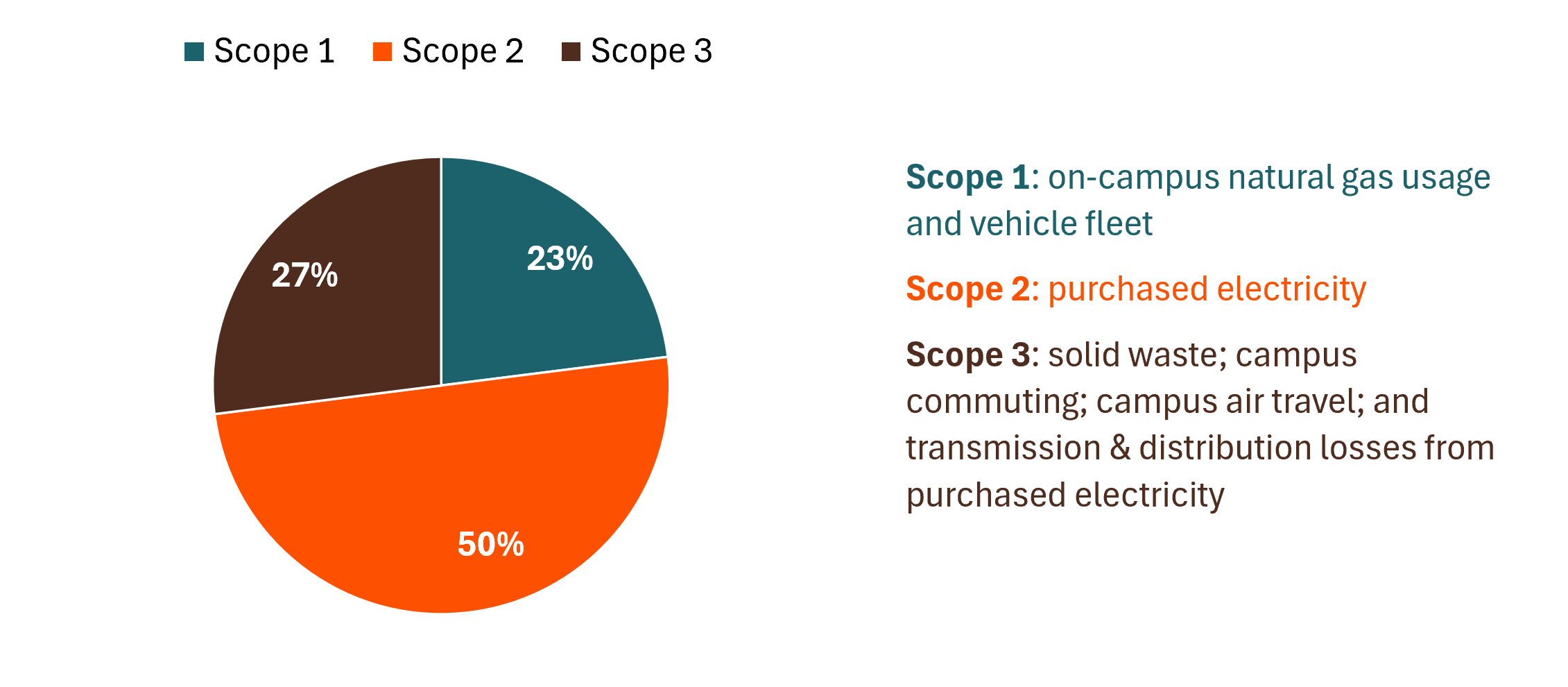
The breakdown of the sources of BGSU’s carbon emissions measured in metric tons of carbon dioxide equivalent, as illustrated below, provides insight into the limitations on possible resolutions, both short and long term, for future carbon reductions and neutrality.
- On-campus use of natural gas and vehicles (scope 1) contributes to 23% of total emissions.
- Energy purchased for campus usage (scope 2) is the main contributing factor of greenhosue gas usage at 50%.
- The remaining 27% of emissions arise from the following; 6% solid waste, 14% campus commuting, 2% campus air travel, and 5% losses from transmission and distribution losses from purchased electricity from scope 2.
Figure 1. BGSU Gross Carbon Emissions by Scope, FY 2013
Source: Sightlines, INC. analysis of BGSUs Greenhouse Gas Inventory data, 2013
Total Carbon Emissions from fiscal year 2013, the most recent year in the inventory, were 113,309 MTCDE.
BGSU Purchased 81,099,968 kWh's of electricity in fiscal year 2013, used 467,690 cubic feet of natural gas, and 24,753,007 gallons of water.
Scope 1 Breakdown:
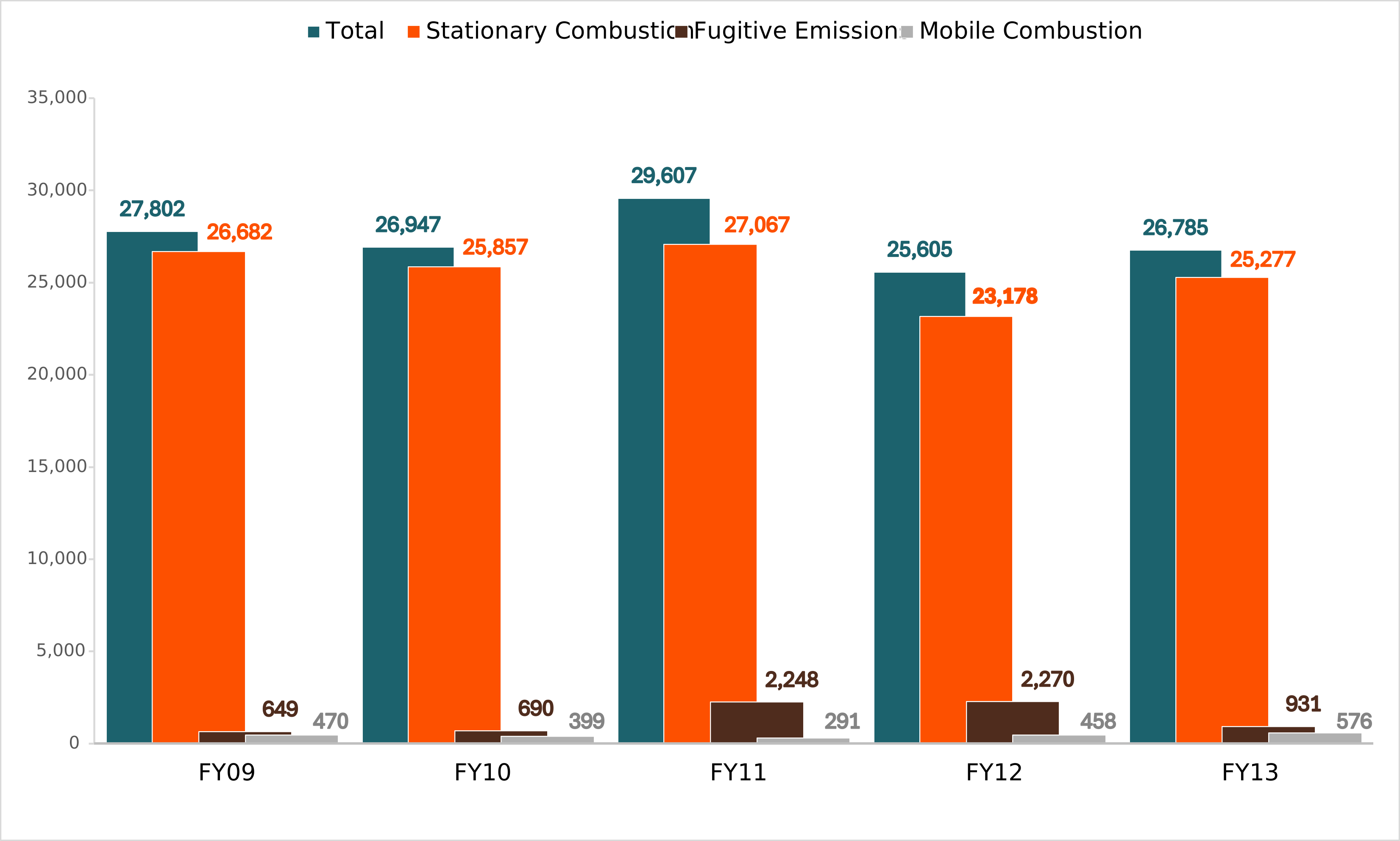
The majority of Scope 1 emisisions are from stationary combustion; largest contributor is natural gas for heating.
Figure 3: BGSU Scope 1 Emissions
Source: Sightlines, INC. analysis of BGSU's Greenhouse Gas Inventory data, 2013
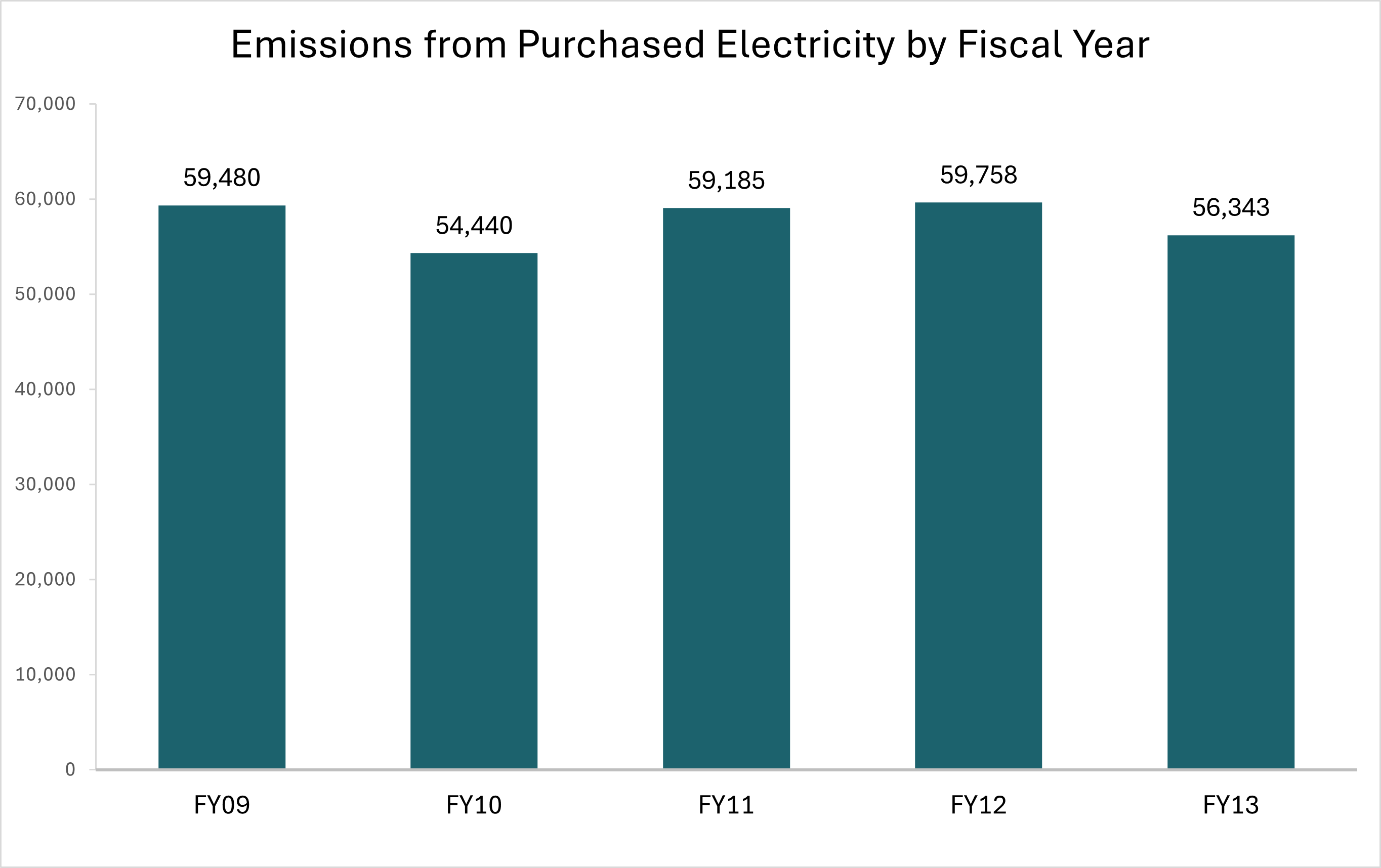
Figure 4: BGSU Scope 2 Emissions Totals
Source: Sightlines, INC. analysis of BGSU's Greenhouse Gas Inventory data, 2013
Scope 2 Breakdown:
Scope 2 consists entirely of purchased electricity; any losses from distribution are denoted in Scope 3 below.
Scope 3 Breakdown:
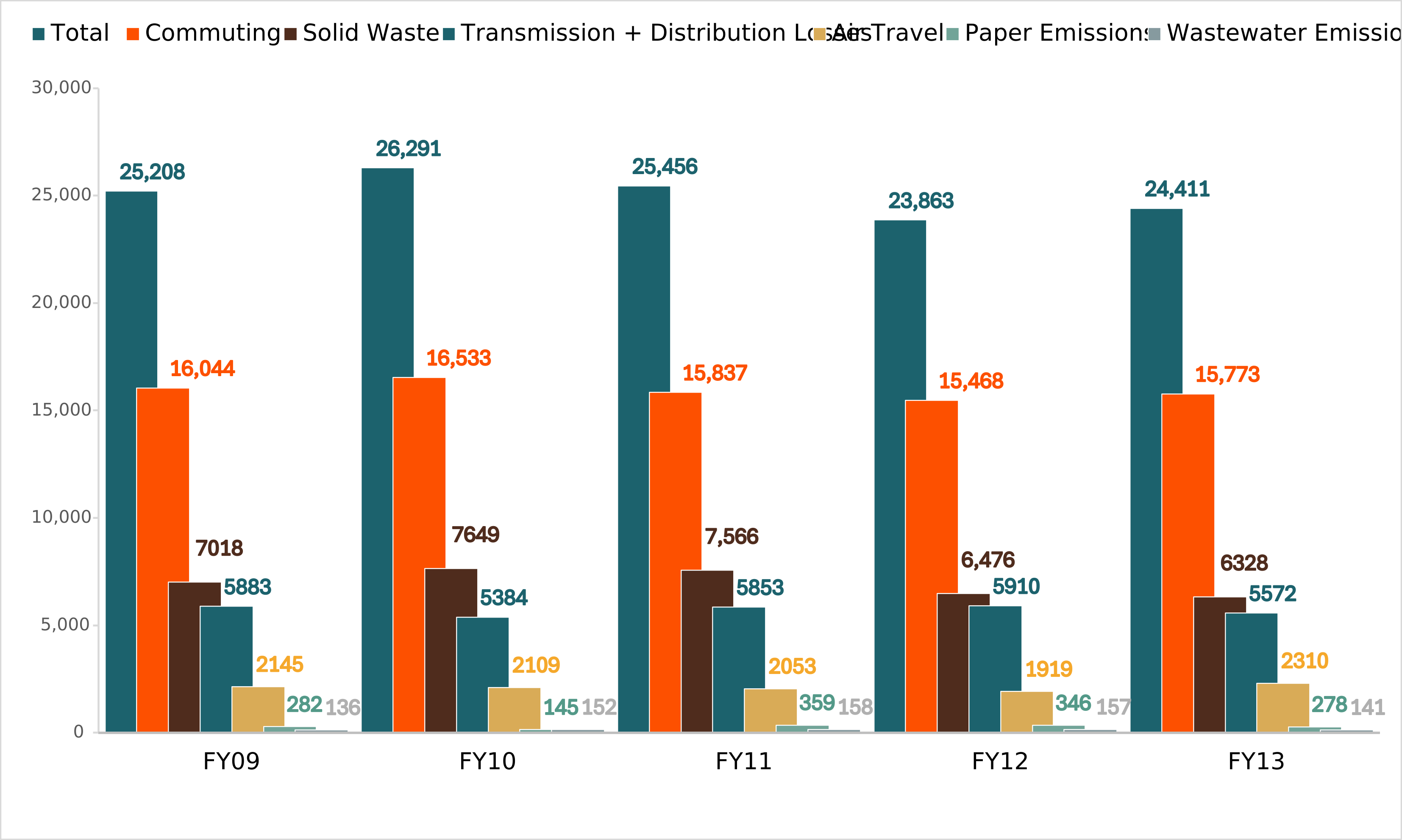
Commuting consists over half of the total percentage of Scope 3 emissions
Figure 5: BGSU Scope 3 Emissions Breakdown
Source: Sightlines, INC. analysis of BGSU's Greenhouse Gas Inventory data, 2013
The PCC Working Group began meeting in February, 2014 and met regularly throughout the spring semester, 2014, dividing into subcommittees consisting of Energy, Transportation, Solid Waste, Dining & Purchasing, and Academics/Research. Subcommittee creating was centered around the contributions of each area to the emissions profile. The Working Group began meeting again in September, 2014 at the beginning of the fall semester to consider the details of the CAP.
Much discussion took place regarding BGSU’s projected institutional goal for carbon neutrality, which included review of other Ohio university signatories to the PCC, the need for aggressive action and example, as well as the realistic barriers both legal and administrative to carbon neutrality by any particular date. Neutrality dates of other Ohio university signatories to the ACUPCC range from 2025 to 2080, The Working Group discussed the importance of BGSU aggressively pursuing carbon neutrality and the importance of setting an example and being a true leader in this area, and thus concluded on a goal of carbon neutrality by 2040.
While subject to revision after GHG emission updates, reaching a goal of carbon neutrality by 2040 (25 years from commencement date of CAP in January, 2015) requires an average annual reduction in MTCDE as currently measured of 4%.
Energy
Introduction
The vast majority of emissions derive from scope 1 and 2. While the university already engages in a number of measures to reduce said emissions, a further action must be set in place to further reduce our impact.
- In 1997 the heat plant shifted from burning coal to natural gas to heat the entire campus. This reduction of emissions are due to natural gas producing around half the amount of Carbon Dioxide as coal during the combustion process. Due to ever-improving energy efficient processes an incremental reduction in emissions continue to be achieved year after year.
- The plant also received new boiler controls and repaired the steam traps which reduced both natural gas and electricity usage.
- Ohio House Bill 251 helped drive BGSU to develop Energy Conservation Measures (ECM), with the goal to reduce energy consumption by 20% by 2014. 2004 was used as a baseline for this goal.
- Included with ECM were
- Unoccupied setback of HVAC systems
- Implementation of demand control ventilation control strategies
- Conversion of constant volume systems to variable volume
- Installation of variable flow kitchen exhaust and make up air hoods
- Retro-commissioning
- Replacement of T-12 linear fluorescent lamps with T-8 lamps
- These measures were deployed in 23 buildings on campus, organized by need.
- The emissions goal set in place by HB 251 was reached by BGSU
- The university achieved the LEED certification for energy efficient structures for the following buildings
- Stroh Center (Gold)
- Wolfe Center for the Arts (Silver)
- Carillon Place Dining Center (Silver)
- The Oaks Dining Center (Gold)
- Student Recreation Center renovation (Silver pending)
- Ohio Attorney General's Office Bureau of Crime Investigation Building (Gold pending)
- A new position was created under Campus Operations titled Coordinator of Energy Management in fall, 2023
- A series of initiatives for student involvement were created. The goal was to educate students on sustainable/energy saving practices. These programs were
- Friday Night Lights: Weekly program tasked with turning off lights in designated buildings and calculating energy savings.
- Campus Conservation Nationals: An energy savings contest in residence halls
- Power Down: Saving Energy at BGSU campaign
Recent lighting efficiency upgrade projects:
- LED pilot project installation in Campus Operations parking lot – Spring, 2014
- Installation of LED lighting in College of Technology parking lot and Lot K
- LED installation in Turf Room of Field House – Summer, 2014
- Creation of a scheduling system for building use that focuses on energy savings in unoccupied buildings and concentration of use in lower number of buildings when possible.
- Participation in the Bowling Green Municipal Utility Demand Response Program commencing in the spring of 2014.
- Solar panels on Ice Arena roof (installed in 2004) as an educational tool, the power generated being used in the building.
- Installation of small solar panel on Oaks Dining Center south awning and monitored by EnPhase, with data available online as educational and demonstration tool.
- Contracting with MEP, Inc. to carry out a Geothermal Feasibility Study. MEP, Inc., engineering firm retained for geothermal systems installed at Miami University, Ohio State University, Ball State University, and other institutions during fall, 2013 and spring/summer, 2014. The study indicates that BGSU is not a prime candidate for a cost-effective campus-wide geothermal system at this time as a result of high electric costs, among other reasons.
- BGSU began preliminary discussions/exploration of the potential for the construction of a solar array on campus, bringing the City of Bowling Green Utilities, AMP, and other entities into these broad, general discussions in spring, 2014. No conclusions have been drawn or further plans have been made at this time.
- In the spring semester of 2009, BGSU students proposed the creation of a “Student Green Initiatives Fund”, consisting of an optional $5 per student, per semester fee to be applied to energy and other sustainability projects to make the university more sustainable. The proposal was approved by the Board of Trustees in June, 2009 and the Green Initiatives Fund first became available for students during the spring semester, 2010. The fund has assisted with a number of the energy efficiency projects referenced in this plan.
- BGSU’s required purchase of electricity from the City of Bowling Green, Municipal Utilities, presents a challenge and limitations on the ability to generate or purchase power from another more renewable source and thus hampers efforts to reach carbon neutrality, as well as requiring the purchase of power at significantly higher than market rates for the foreseeable future.
- The renewable component of the portfolio purchased from Bowling Green Municipal Utilities (coming from AMP) is set to change over time, (see projected 2015 sources below), however a major component will continue to include coal-fired power plants (specifically, Prairie State) for at least the next 45 years, and beyond the timeline created by this plan.
- While the potential for review/change of this contractual obligation exists and is being pursued by citizen groups in Bowling Green, at the time no change in that contract is foreseen nor is being accounted for in the current CAP.
- As such, it is clear that BGSU’s short term actions in the Energy area at a minimum should focus heavily on energy conservation; using less energy can reduce BGSU’s emissions from Scope 1 and 2 sources immediately and significantly. BGSU can reach its short-term goals for emissions reduction through energy conservation. At the same time, exploration into the feasibility and review of the potential for renewable energy sources and purchases can and should be pursued.
- Additionally, BGSU will be adding to/subtracting from its building footprint substantially over the next 10 – 20 years, which presents difficulty in estimating net changes in carbon emissions. Renovations, including South Hall, Eppler complex, Moseley Hall, University Hall, Hanna Hall, and the construction of a Greek Village, and a new Business Administration Building, as well as many demolitions are just part of the proposed changes reflected in the BGSU Master Plan.
- This makes policy changes regarding new building construction and renovation that focus on and prioritize energy efficiency and sustainability absolutely critical to the success of this CAP.
Overall Goal
In the short term, BGSU’s goal is to reduce Scope 1 and Scope 2 emissions through the conservation of energy. This includes reducing fuels used on campus (natural gas for heating, and fleet fuel), and reducing purchased electricity, (which currently carries a significant amount of emissions with it due to its primary source being coal-fired power plants. While conserving these non-renewables, we will begin to determine all options available for purchase or creation of renewable energy, with a long-term goal, ultimately, of transitioning to complete use of renewable energy sources
Transportation
Introduction
Since commuting makes up 52% of BGSU's Scope 3 emissions reduction of greenhouse gas emissions from this source will require significant changes in the way students and employees get to campus. This will require policy changes to provide alternatives to individual commuting in the form of viable public transit systems, as well as changes in behaviour, which will require a combination of education and incentives. The purchase of electric vehicles should also be encouraged and incentivised, for example through the provision of additional charging stations in parking lots
- A shuttle service operates daily on the BGSU campus and extends to a number of off-campus locations including downtown, various grocery stores, and Wood County Hospital.
- Via a grant from Clean Fuels Ohio, BGSU obtained and installed three EV charging stations on campus to help promote electric vehicle use. The City of Bowling Green obtained the same grant and installed three additional charging stations downtown.
- The BGSU Bike Rental Program, operated by Campus Sustainability, promotes sustainable everyday travel by offering affordable rentals for students, faculty, and staff.
- BGSU owns and operates a hybrid bus alongside the more traditional desil-powered busses in the university shuttle system
- In 2010-2012 BGSU Campus Operations utilized biofuel mowers, powered by used fryer oil from BGSU Dining Centers. This initiative was initially funded through a grant from the ODNR. Due to complications however, this equipment was removed and sold fall 2013.
- There are some isolated areas of electric vehicle purchases in the Campus Operations area, but no other EV's are present (other than electric golf carts).
- An increase in the purchase of vehicles with greater fuel economy has taken place in the past two years as the size of the BGSU fleet decreases and the purchase of vehicles becomes more centralized.
Proposed actions, both short and long-term include both those that reduce the impact of
current practices and those that are targeted towards reducing the amount of
commuting to campus in a single occupancy vehicle which produces greenhouse gas
emissions.
- Develop and impliment a no idle policy for on-campus vehicles
- Develop and implement a no idle policy for University busses and vans
- This would only be in effect while on field trips, and any other university programming
- Develop and implement a rental car policy that requires the rental of fuel efficient vehicles and carpooling
- Survey commuters as recommended by the Sightlines proposal to gain a more
realistic understanding of who commutes, how far, how frequently and why. - For example, students travelling off campus on weekends were not included in
the original greenhouse gas calculations. - Publish bus schedules for each bus line and work to make sure buses run on
time.- The current App is very useful and highly praised by students, but it does
not allow them to plan to use the buses on a regular basis to get to campus in
time for class.
- The current App is very useful and highly praised by students, but it does
- Promote the use of bikes for transportation on-campus and throughout the
community.- Develop bicycle etiquette to reduce pedestrian/bicycle accidents.
- Develop a ride-sharing program on campus for faculty, staff and students.
Toledo Metropolitan Area Council of Governments (TMACOG) has a good
model. - Give preferential parking to those who choose to carpool.
- Reserve LEED parking spaces for fuel efficient vehicles.
- For example, consider
free parking for fuel efficient vehicles in designated spaces at Stroh Center and
other LEED certified buildings that earned that point.
- For example, consider
- Survey students who are taking the shuttle to the Cleveland airport and consider
increasing connectivity to major cities via public transit to cut down on single
vehicle commuting. - Coordinate a transportation plan with apartment complexes that currently offer
van services. Students report a need to have more service in the evenings. This
could be done by coordinating the BGSU bus service with private operators.
- Convert BGSU bus fleet to fuel efficient vehicles that emit significantly less
greenhouse gases than current fleet. - Investigate and evaluate the potential of a program using BGSU sourced biofuel
for selected equipment, utilizing upgraded technology that would avoid the
maintenance and mechanical issues experienced in the past with the lawnmower
biofuels program. - Transition to electric vehicles for Grounds and Maintenance
- Eliminate use of 4-stroke engines on campus. Transition to electric machines for
grounds crews such as electric trimmers. - Promote teleconferencing for University business that would previously require
travel. - Restructure the parking fee program for faculty, staff and students to encourage
carpooling, walking and bicycling. - Work with the City of Bowling Green to make Wooster, Mercer and Thurstin
Streets more pedestrian-friendly. The lack of crosswalks on Wooster is a major
deterrent to walking to campus from the southeast neighborhoods of Bowling
Green.- Bicycle lanes throughout the City would encourage bicycle use.
- Provide parking options that promote sustainability while at the same time move
toward having drivers pay more of the environmental costs of their commutes.- Examples include a parking structure similar to the one at the Toledo Museum of
Art which is covered and has solar panels. Examine the option of building a
parking garage with differential fees depending on number of individuals per
car, or other incentivising alternatives. Develop a program with Student Affairs
to promote staying in Bowling Green on weekends.
- Examples include a parking structure similar to the one at the Toledo Museum of
- Extend the BGSU bus system to residential areas where faculty and staff live.
Solid Waste
Introduction
Solid waste represents 21% of BGSU’s Scope 3 emissions and is also an area with tremendous potential for quick reduction, unlike the current status of Scope 1 and Scope 2 emissions sources. During a typical week of a semester during fiscal year 2013, BGSU produced over 100,000 pounds of waste, representing (not including waste/debris from construction, demolition, or special projects). This represented a significant increase in waste from the prior fiscal year, and is a trend that needs to and can be reversed. Waste sent to a landfill is responsible for the production of methane, a greenhouse gas which is many times more powerful and damaging than any of the other greenhouse gases assessed for this CAP, as it has 13 times more heat trapping ability than carbon dioxide.
An increased diversion rate of waste, and thus decreases in overall waste weights and improved conservation of resources are very realistic and within the purview of this CAP, provided appropriate changes in policy and practice take place.
- BGSU has had a well-established recycling program for standard commodities, (aluminum cans, plastic bottles, cardboard, office paper, and newspaper) with collection containers in nearly every university building. This program has a long history of success, and was established by Undergraduate Student Government in the late 1980’s, as a result of student interest/demand.
- BGSU was an original participant, in 2000, in the “Recyclemania” national recycling contest which promoted and educated about recycling at universities and which is now an international competition lasting 8 weeks. BGSU has participated in Recyclemania every year since its inception.
- The recycling program was outsourced to Waste Management, Inc. at the beginning of the fall semester, 2014, and the repertoire of commodities collected increased to include glass (which had been eliminated in 2007), steel cans, and additional grades of plastic (3 – 7). Scrap metal continues to be recycled/handled by BGSU. It is hoped that this outsourcing will significantly increase the waste diversion rate.
- Electronics, batteries, inkjet cartridges, and other less standard recycling takes place at BGSU through several providers, (AIM, Inc., ComDoc, etc.).
- The Green Game Day program is a partnership between Campus Sustainability and BGSU Athletics which aims to reduce waste during home football games at Doyt Perry Stadium and was actually one of the first programs of its kind in Ohio, now in its fourth year. The program operates both inside the stadium and suites as well as in the tailgate and all surrounding areas.
- An active surplus inventory re-use program operates out of the Park Avenue Warehouse, which makes furniture and other inventories assets available to other offices on campus and which sells unusable items online.
- “WYMO”, (When You Move Out, Don’t Throw It Out) program that has been operated for 13 years which collects donated items of all kinds from students each spring and provides them to over 3 dozen charities as well as BGSU students.
- Once Upon A Desk is the office supply counterpart to WYMO for non-inventories assets and provides an outlet for the donation of surplus supplies from offices/departments, which are then made available once a month to faculty and staff.
- The “re Store” is a second hand store which has been operated through Campus Sustainability for 4 years on campus and which also sponsors special sales/giveaways during the year.
- The Green Office Certification program, administered by Campus Sustainability attempts to reward/educate offices on how to reduce waste, among other sustainable features and provides them with certification once they have achieved certain goals.
- BGSU’s first composting program to attempt to divert organic waste from the landfill was piloted in the spring semester, 2014 at the Oaks Dining Center and continued into fall semester, 2014, collected pre-consumer produce from the kitchen. An average of 1000 pounds of produce per week is collected.
- Several waste reduction initiatives and practices of BGSU Dining as well as partnerships with Campus Sustainability include:
- Local food purchases
- Low Waste Welcome Back Picnic for first year students
- Love Food Not Waste program aimed at educating students on decreasing food waste in dining centers
The overall goal in the solid waste area is to reduce emissions by continuing to decrease landfill waste each year, increasing our diversion rate through and combination of recycling as many commodities as possible and composting of organic waste, re-using materials and items when possible, thus cutting down on purchasing.
- Expand/improve recycling methodology and infrastructure/services through improved training of custodial, moving, and recycling staff to tighten collection procedures, lessen contamination and add consistency between buildings.
- Assessment of recycling in all buildings, in an effort to improve the recycling rate and decrease waste, starting with those buildings known for large sources of waste and low recycling rates such as Bowen-Thompson Student Union, Campus Operations and athletic/recreational facilities.
- Improve staffing of recycling and transfer responsibility for program to Campus Sustainability area.
- Establish strong policy on recycling required by contractors on construction and renovation projects.
- Create a system for providing recycling for large university events such as Blood Drives, Preview Days, STEM, Career/Job Fairs, large sporting events, concerts and community events taking place in campus facilities.
- Develop policy for re-use/sale of fixtures and/or commodities and other items which are in profusion in buildings being renovated or demolished rather than wasting/giving to contractors.
- Focus on specialty recycling initiatives such as carpeting, pallets, etc.
- Expand Green Game Day program to create a Zero-Waste program at Doyt Perry Stadium as a pilot for other programs and expand Green Game Day to other sports venues.
- Review policies to reduce use of disposable items on campus
- Expansion of pre-consumer composting to Bowen-Thompson Student Union and Carillon Place Dining Center and research potential for on-campus composting equipment that may meet our needs such as BioBin, Orca or similar initiative.
- Create policy to encourage paperless transactions on campus.
- Expand presence/use of hydration stations (water bottle refilling stations or retrofits to existing water fountains) across campus.
- Manage water resources and expand the use of “smart” irrigation techniques to conserve water use as much as possible.
- Create a “sustainability purchasing policy” which considers sustainable models/offerings of equipment, materials, supplies, and other items to move beyond the purchase of Energy Star appliances (which was one of BGSU’s “immediate tangible actions” pursuant to the ACUPCC.
- Pursue sustainable campus landscaping that uses less water and features native plantings.
- Re-examine Pouring Rights contract with aim of elimination of use of plastic water bottles.
- Create re-usable cup/mug and shopping bag programs on campus with meaningful incentives for participants to make significant impact on reduction of disposable coffee/drink cups and plastic bags
Education & Research
Introduction
Colleges and universities are in a prime position to take leadership roles in their communities by modeling and teaching ways of addressing the threats posed by global climate change to the viability of the world. BGSU should take such a leadership role. Not only must we as an institution aspire to be climate neutral through this CAP, but we also have an obligation to provide our students with knowledge and skills needed to address the unprecedented challenges of climate change. Our approach in achieving this goal is through a combination of curricular, co-curricular, outreach, and research activities that weave climate change and sustainability together.
Sustainability is an essential step to the achievement of climate neutrality, and having a student body that is educated in sustainability is essential to the achievement of climate neutrality. In order for BGSU to reach its goal of reducing greenhouse gas emissions, a major change in how we currently view sustainability is required. This particular part of the CAP is not connected specifically to a projected decrease in BGSU’s greenhouse gas emissions. However, the potential impact of education, awareness and research on the actions of the university community and thus indirectly and eventually on the decrease of emissions is exponential. Thus, this is a critical part of the university’s overall plan to become carbon neutral.
- BGSU was one of the first universities in the State of Ohio to have a Center for Environmental Programs, now known as the Department of the Environment & Sustainability. While issues relevant to climate change and sustainability are taught within this curriculum, there are a number of other departments across campus that also touch upon these topics both in the classroom as well as a part of research. A full assessment of the current state of the curriculum and research in this regard will be completed as a part of the actions listed below.
- BGSU created a full-time position to coordinate campus sustainability (Office of Campus Sustainability) in August, 2008, located in the Campus Operations area. In addition to a number of administrative functions and duties, the Sustainability Coordinator is also an adjunct faculty member of the Department of the Environment & Sustainability.
- One of the major parts of the Sustainability Strategy put forth by the Office of Campus Sustainability is “Education and Outreach” in the area of sustainability. This strategy has been carried out thus far in the form of programs, initiatives, service opportunities, collaborations with academic departments, partnerships external to the university, and internship opportunities for students among many other things.
- Increase awareness of climate change, its causes, and its impact on the natural and built worlds;
- Provide the knowledge needed to address this challenge, including both short and long-term and small and large scale solutions;
- Increase the participation of the campus and external communities in creating and implementing these solutions.
- Add a course to Bowling Green Perspectives (BGP) requirements focusing on climate change and sustainability in order to develop, in every student, a basic understanding of climate change, its challenges, and the opportunities in their chosen profession to contribute to possible solutions.
- Undertake a survey of faculty to build an inventory of suitable current courses that include sustainability and/or climate change, the capacity of these courses, and the programs served.
- Survey academic units for their interest in contributing additional courses to the curriculum.
- Develop a proposal to the BG Perspectives Committee to replace the “one additional course in any of the four knowledge domains” to “one course approved for sustainability and climate change from any of the four knowledge domains.”
- Update, organize and strengthen the Sustainability Minor to provide an opportunity for students from a variety of majors across BGSU to acquire integrated knowledge of sustainability.
- Review the current requirement of the Sustainability Minor and solicit input from faculty who teach relevant courses that are not currently part of the minor.
- Meet with advisors from the Colleges that are currently participating in the minor: Arts & Sciences, Education & Human Development,Technology, Architecture & Applied Engineering, and Business Administration.
- Submit Sustainability Minor revisions to relevant University committees for approval
- Work with Colleges to develop a suitable marketing and advisor plan for the Sustainability Minor.
- Create Living/Learning community to foster an understanding of and commitment to teaching about climate change and sustainability topics.
- Survey faculty for interest in participating in the Living/Learning community.
- Develop a proposal for a new community with appropriate groups and submit to Office of Residence Life.
- Implement a campus-wide “Eco-Literacy” competency requirement for all undergraduate students to prepare them for sustainable living and civic engagement.
Inventory current curricular and co-curricular activities related to sustainability, climate change, and carbon neutrality and identify those student organizations with an interest in programming and activities related to those areas.- Integrate eco-literacy into the common reading program and the Honor’s College theme of the year.
- Add a climate neutrality and sustainability component to the first year student orientation program.
- Provide additional service learning opportunities in sustainability as part of the eco-literacy component.
- Foster undergraduate research and creative projects in climate change and solutions through an annual student conference, funding for student research and scholarships.
- Develop and promote research expertise, both basic and applied, in climate change and sustainable solutions so that BGSU faculty and staff will serve as resources for the development and application of new knowledge about climate change, its causes and solutions.
- Revive and promote the Center of Excellence for Sustainability and the Environment.
- Promote University expertise in sustainability and climate change to local communities.
- Designate a portion of the “Building Strength” grant program funds to research on climate change and sustainability.
- Re-brand BGSU with an emphasis on commitment to achieving climate neutrality and sustainable practices, resulting in an image that will be attractive to student, faculty and staff recruitment and will distinguish BGSU from other universities in Ohio and nationally.
- Create a dialogue with Marketing & Communications on the need for this university brand and work with them to create it.
- Collaborate with Office of Admissions to develop a recruitment plan around the new brand.
Updated: 09/20/2026 06:44PM