
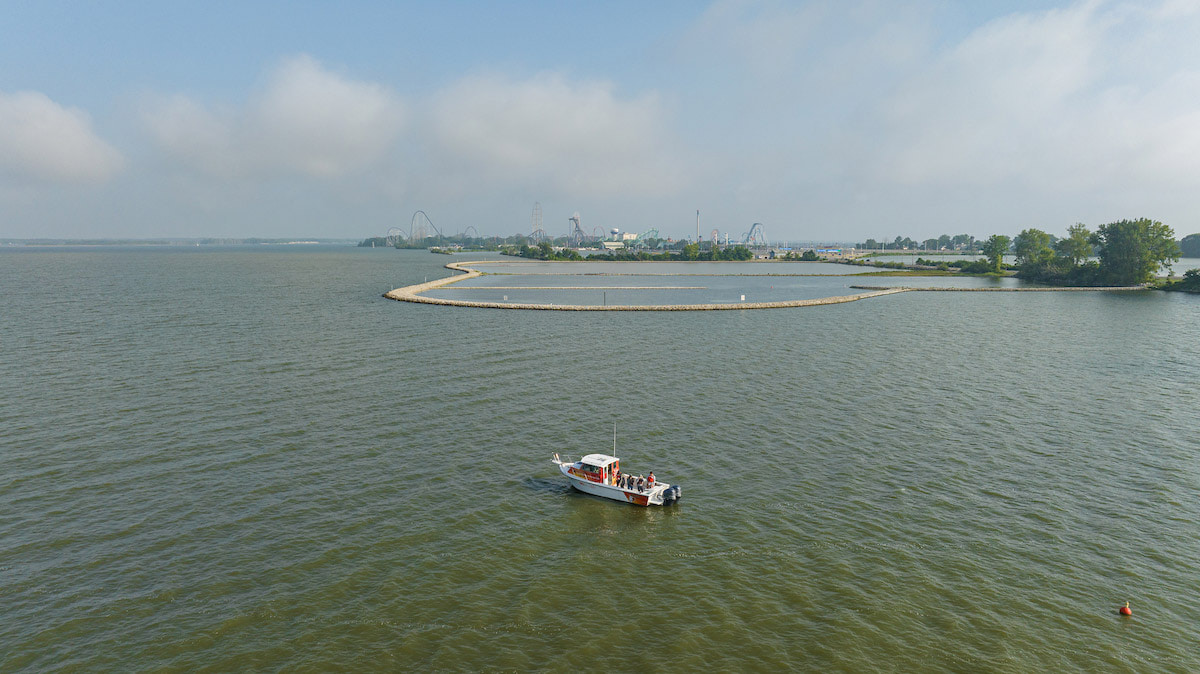
Farming practices drive significant progress in Lake Erie water quality pilot project
Estimated Reading Time:
More than 80% of acreage in pilot watershed has implemented a farming practice that can reduce agricultural runoff into water systems
By Nick Piotrowicz
Three years into a pilot project that could dramatically aid water quality in the Lake Erie watershed, researchers at Bowling Green State University are seeing highly encouraging results for the “win-win” farming practices that mitigate algal blooms while also benefiting farmers.
The Shallow Run Watershed Pilot Project, based in highly agricultural Hardin County, is implementing and monitoring farming practices in a water system that is part of the larger Maumee River watershed, which empties into Lake Erie.
In 2014, agricultural runoff contributed to a harmful algal bloom that temporarily rendered the city of Toledo’s water unpotable – leaving the state with a daunting question: how can farming, one of the state’s most important industries, coexist with our most important natural resource?
Funded by the Natural Resources Conservation Service, an agency within the U.S. Department of Agriculture, and led by principal investigator Dr. Jay Martin at Ohio State University, the pilot project is a group effort aimed at answering that question by bringing together farm organizations, researchers at multiple universities, officials in Hardin County, including pilot watershed coordinator Doug Deardoff, and local landowners to implement farming practices that can reduce nutrient runoff.
Just three years after its start date, the project has seen extraordinary collaboration pay dividends: four-fifths of all acreage is using at least one farming practice designed to mitigate nutrient runoff – cutting off the fuel that can lead to harmful algal blooms.
"It is exciting that the Pilot Watershed Project has had such great participation from the farming community,” said Dr. Kevin McCluney, an associate professor of biological sciences at BGSU. “Over 60% of farmers and 80% of the acres are implementing at least one practice likely to reduce nutrient runoff.”
Researchers are monitoring the effects of best management practices, namely subsurface fertilizer injection and wintertime cover crops – which already are being used on more than a third of cropland and more than half of cropland, respectively – in the watershed.
Even with heavier-than-normal spring rainfall this year, scientists have observed reduced levels of dissolved phosphorus making its way into Lake Erie, a clear sign improved farming practices are having the intended effect.
Subsurface injection can solve two problems, said Dr. Angelica Vazquez-Ortega, an associate professor of geochemistry at BGSU. Injecting fertilizer rather than traditionally spreading not only reduces runoff, it also keeps valuable nutrients within farms, giving farmers more value from an expensive purchase.
“If you have any rainfall event, the fertilizer can wash out very quickly,” Vazquez-Ortega said. “What we did in this project was buy the big piece of equipment that can be lent to farmers so they can inject fertilizer a few centimeters below the surface. That way, nutrients are being trapped by soil minerals, which can be accessed by the roots of their plants.”

Prior research demonstrates about half of all dissolved phosphorus comes from surface runoff, with some subsurface phosphorus reaching water systems by traveling from the surface through cracks in soil, so the slight tweak to fertilizer application is beneficial to all parties.
“We believe that this practice, where you inject fertilizer under the soil, reduces that runoff problem greatly,” McCluney said. “If the fertilizer is trapped by the soil matrix, that’s where plants can use it — which is exactly what the farmer wants anyway. They don’t want their nutrients to be dissolved in a rainstorm and flow away, which doesn’t help them at all.”
Cover crops, which are planted during typical farming offseasons, act as a barrier for the soil during rainfall events and also incorporate organic matter into the soil, which contributes to soil health, crop growth and nutrient retention.
Through the study of isotopes, McCluney’s team at BGSU is monitoring the efficiency of each best management practice to give the overall team an idea of which practices make the biggest difference in mitigating nutrient runoff.
By taking water and soil samples to study oxygen at the molecular level, scientists can determine the source of phosphate and the rate at which nutrients are being recycled, two critical pieces of information as scientists seek to determine which farming practices are most effective.
“When we take water samples, we can then say, ‘OK, did this phosphate we detected come from fertilizer that was just applied to the field, or is it from another source?’” McCluney said. “With soil samples, we can monitor how quickly that recycling is taking place and whether cover crops are changing that rate.”
The project, which includes financial incentives for farmers, has steadily seen more participation each year.
One farmer donated a notoriously wet, hard-to-reach 10 acres of his land to become a wetland, another best management practice that scientists believe can act as a buffer between farm runoff and Lake Erie. Another is using 17 acres to plant trees — also a cash crop — in an area that has not performed well for farming, another method that can reduce fertilizer application and also act as a barrier between crops and streams.
Further, the pilot has seen a reduction in tilling. For 2025 crops monitored by the project, nearly half did not till.
“Every time you till, you are increasing erosion, but also breaking down the soil,” Vazquez-Ortega said. “The decomposition of organic matter is huge, and fields that are tilled produce incrementally higher levels of carbon dioxide. You are decreasing the soil health exponentially.”
The current project is funded for two more years, though researchers are hopeful that these farming practices and the research into them will continue well into the future.
Though improved farming practices are just one piece of the puzzle, the willingness of many entities to work together to solve a problem has been an encouraging step that could provide part of the blueprint for keeping freshwater lakes healthy, McCluney said.
“This provides our soil health team with a great opportunity to explore which combinations of practices are most effective for both nutrient runoff and soil health, and it allows us to examine how this influences overall nutrient output from the watershed,” McCluney said. “Overall, this can serve as an example of what is needed to reduce algal blooms by reducing nutrient inputs."
Related Stories


Media Contact
Michael Bratton | mbratto@bgsu.edu | 419-372-6349
Updated: 04/30/2026 09:14PM