
Tree Care Plan
Bowling Green State University maintains over 4,600 hundred trees throughout campus consisting of over 296 varying species. Campus landscaping and tree maintenance play an important role in the overall success of our campus community by creating outdoor educational and entertainment spaces that are healthy, diverse and sustainable. Our work in tree care and maintenance is outlined below in our Tree Care Plan.
The plan is regularly reviewed and updated as needed and in coordination with the BGSU Tree Committee. We also track and maintain our trees throughout campus via our ARCGIS dashboard that showcases our tree program and provides educational information pertaining to the location and varieties of trees across campus. This dashboard includes the location, age, species, size and other identifying information for every single tree currently on campus or that has been removed for some reason. A special category has been created for our “Century Trees”, which are a minimum of 100 years old. We take great pride in having trees on our campus that are well past the century mark and incorporate these into our educational programming to the community on tree history. We also keep track of our memorial trees, which have been planted in honor of loved ones of alumni, staff, students, or friends of the university, which is a program operated in partnership with the BGSU Alumni & Development office.
Purpose, Goals & Targets
The purpose of the BGSU Tree Care Plan is to create and provide/share comprehensive policies for the planting, care, and management of trees on the BGSU campus. The goals and targets of the BGSU Tree Care Plan include:
- To create a continuous and comprehensive increase in the campus tree canopy.
- To create an aesthetically pleasing campus.
- To maintain a diverse population of trees, maximizing resistance to pests/diseases and focusing on Ohio native species.
- To fulfill a role in BGSU's published Climate Action Plan of reduction of carbon dioxide and assisting in the university goal of carbon neutrality.
- To maximize the natural benefits provided by trees when selecting planting locations and tree species including but not limited to stormwater diversion and flood minimization, erosion prevention, creation of shade and natural habitat.
- To continue to maintain and expand the BGSU GIS tree map and inventory and means of sharing information with the university community.
- To involve as much of the university community as possible (students, faculty and staff) in appreciating understanding, and respecting trees on campus and in the community and the need for tree care, and to provide regular service opportunities in fulfillment of these goals, furthering BGSU's role as a Public Institution for the Public Good.
- Specific goals/targets for 2025-26:
- Continue to offer multiple tree planting volunteer projects for students in both the spring and fall semesters that provide service hours as well as tree and Arbor Day education.
- Evaluate the Callery Pear removal pilot project completed in fall, 2024 and apply for additional funding for the Student Green Initiative Fund to assist in implementing the next phase of the initiative.
- Work closely with Planning & Construction on tree care standards for construction projects in preparations for next phase in the BGSU Master Plan implementation.
- Pursuing and obtaining Tree Campus Higher Education recertifications for the Arbor Day Foundation.
- Creation and implementation of a Century Tree recognition and education program for April, 2026 (Earth Month and Arbor Day)
Responsible Authority/Enforcement
- The Grounds Department in Campus Operations is charged with responsibility for the day-to-day implementation and enforcement of the Campus Tree Care Plan.
- The BGSU Tree Committee provides input, recommendations and decisions which are implemented by the Grounds Department after approval by the Director of Campus Services or the AVP for Planning, Construction & Campus Operations, depending on the level of decision.
Tree Care Plan Communication
- The Tree Care Plan will be made available on the Campus Operations website.
- There will also be a link to the Tree Care Plan on the Campus Sustainability website.
- The Tree Care Plan is part of staff training for all Grounds staff, as well as staff in Planning, Construction and Campus Operations.
- The applicable policies of the Tree Care Plan are made available to all contractors, subcontractors and vendors engaged in outdoor projects on the BGSU campus.
- Questions regarding the Tree Care Plan, requests for agenda items or appearances before the BGSU Tree Committee should be referred to 419-372-9949 or greenbg@bgsu.edu
New Tree Plantings
- Newly planted trees are to have a minimum of a 2 inch trunk diameter measured at 4.5 feet above root-flare (DBH - diameter at breast height). Any plant material smaller will be rejected.
- Root-ball will be placed into a hole no less than 12 inches wider than the root-ball itself and the root-flare level with existing grade. If root-flare is deeper than existing grade the tree will be pulled back up and replanted properly.
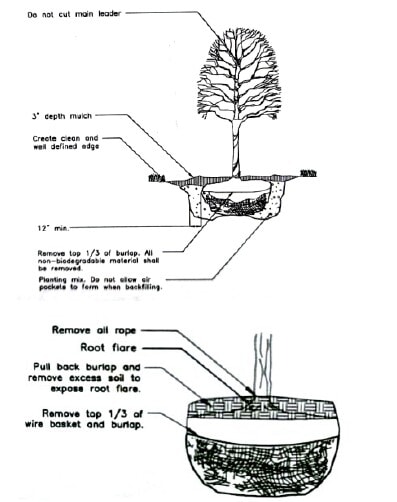
- Remove top 1/3 of wire basket and pull back burlap and twine.
- Backfill with loose soil incorporated with a 50/50 mix of compost and topsoil. Gently pack soil down and finish off by watering in the tree to remove any air pockets that may have formed in the backfill.
- Mulch tree with a natural hardwood double processed mulch at 3 inches thick and a 3 foot diameter ring around the trunk for a 2 inch tree. Adjust mulch ring accordingly with larger caliper trees.
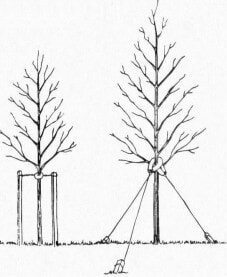
- Stake tree by using a double T-post method or a 3 short stake method using wire and hose chunks. Larger caliper trees may require additional staking.
- Stakes will remain on the trees for minimum of 1 year.
Post Planting Care
- A Tree Gator bag will be installed on all newly planted trees. Gator bags are 15-20 gallons of water to be filled once a week for the first growing season.
- Tree will be assessed the second growing season to see if a Gator bag needs to be re-installed.
- Once a month the Gator bag will be filled with a liquid soluble fertilizer to help with tree establishment. After first growing season the tree will be assessed to see if further fertilization is needed.
Plant Restrictions
- Trees shall not be planted any closer than 10 feet of sidewalks, street parking lot curbs or tunnels.
- Exception for small ornamentals and medium sized trees if being installed within a mulched landscape bed.
- Trees shall not be planted any closer than 15 feet to light poles.
- Trees shall not be planted next to buildings and other structures to certain minimums depending on type of tree - Large trees 25 foot minimum, medium trees 15 foot minimum, small ornamental trees 5 foot minimum.
- a. See the City of Bowling Green, Ohio Landscape Guide for Developers, Businesses, and Home Owners for Definition and species of large, medium, and small trees.
Prohibited Trees
- Willow - All varieties
- Mulberry
- Tree of Heaven
- Walnut
- Callery Pear
- Russian Olive
- Red Maple (restricted areas, needs approval)
- Fruit trees - All varieties
- Norway Maple (exception purple leaf Norway maples)
- Large evergreens within campus - Spruce, fir, pine
Pruning
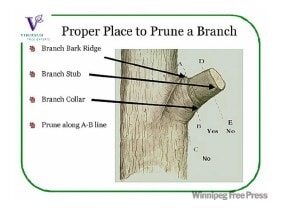
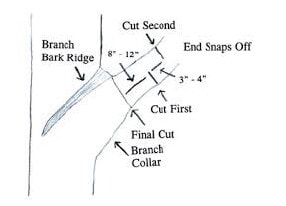
- Newly planted trees of 1-3 years will only need pruning of dead or damaged limbs.
- This will be performed by Campus Operations Grounds Department staff.
- Trees from 4-15 years will be pruned using proper pruning methods to remove dead/damaged limbs, thinned out to promote growth and to maintain a good shape, along with limbing up lower branches so equipment will not cause damage to the tree.
- This will be performed by Campus Operations Grounds Department staff.
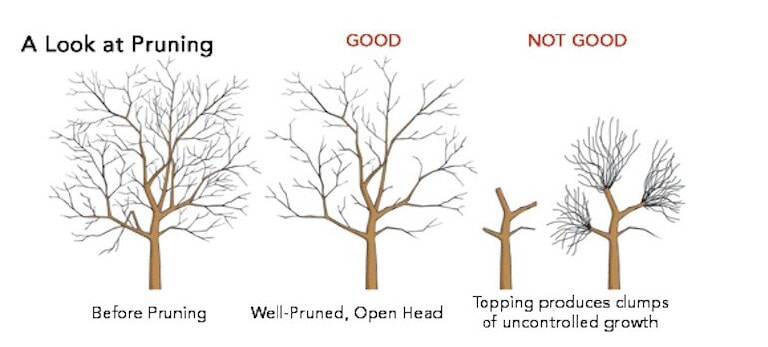
- Trees from 16 plus years will be maintained by a certified International Society of Arboriculture (ISA) arborist.
- All University trees will be evaluated by Campus Operations Grounds Department staff and recommendations will be given on which trees will need to be assessed.
- Trees will be assessed by an ISA certified arborist and ISA certified arborist will perform the work of dead wooding, thinning, and shaping of larger mature trees to maintain a safe and healthy tree canopy.
- ISA arborist will also manage the removal of dead and diseased trees.
- Trees that are marked as dead or diseased will be given a "Tree Risk Assessment" through the Tree Risk Assessment Manual, Second Edition, ISA 2017 by an ISA certified arborist.
- Once the Assessment is made the University will evaluate the assessment and make the decisions based on the assessment.
- Tree Risk Assessments of the old grove century trees in the University's Tradition Quadrangle will be performed every 5 years to track the health and safety of those identified trees.
Disease, Insect and Fertilization Management
- All University trees will be evaluated by Campus Operations Grounds Department staff and recommendations will be given on which trees will need to be assessed and treated.
- An ISA certified arborist will perform the assessment, and recommendations will be given on treatment if possible or removal if to far advanced disease or insect infestation.
- Yearly treatments for Diplodia (disease) and Zimmerman Moth (insect) on all University pine trees will be performed.
- Yearly treatments of an insecticidal systemic on all University locust trees to control tent caterpillar and web worm.
- Locust trees have had historically severe infestations but the systemic treatments in the last couple of years have controlled populations.
- Yearly inspections of Norway and Sugar maples to trach the advancement of Verticilium Wilt (disease) and decisions will be made for removal on how advanced the disease is.
- Other insect populations that are present on campus include scale, bag worm, Japanese beetles, spider mites, etc.
- These populations are usually on a smaller scale and treated as needed.
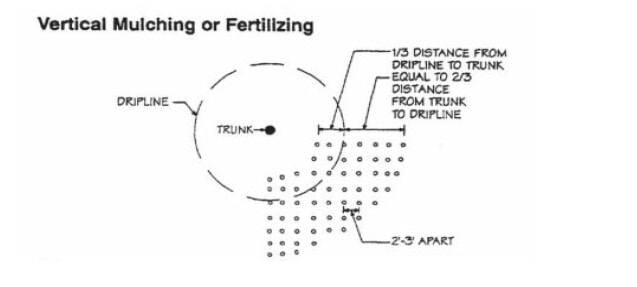
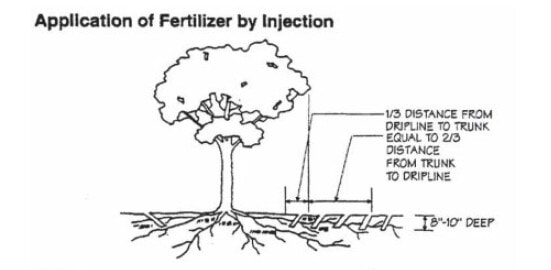
- Every 3-5 years the old grove century trees in the University's Tradition Quandrangle will be given soil fertilizer injections depending on an assessment by a certified ISA arborist.
- The Injections will be performed by a certified ISA arborist.
- Transplanted trees will also be given soil injection fertilizer at the time of transplant to ensure good tree establishment.
- Trees showing other nutrient deficiencies will be assessed by a certified ISA arborist and the proper micro or macro nutrients will be injected.
- All newly planted trees will be given a monthly dose of a water-soluble fertilizer when Gator tree bags are filled.
New Construction Practices
Preservation
- In accordance with the International Society of Arborist (ISA), American National Standards Institute (ANSI), and the Tree Care Industry Association (TCIA) the following is a set standard for tree care and preservation for Bowling Green State University.
Pre-Construction
- Walk site with a certified ISA arborist to create an onsite tree inventory of all trees to be preserved.
- List tree species, size, caliper, diameter, crown size, critical root zone, and current monetary value of each tree.
- Critical root zone is 1.5 feet of radial distance for every inch of tree diameter measured at 4.5 feet above the ground and a minimum of 8 feet radial distance.
- If 8 feet is not possible then mulching or wood chips are to be added to the area effected by compaction not to exceed 6 inches in depth.
- Establish current monetary value of the trees for purposes of replacing to the dollar amount of trees removed, damaged or destroyed by contractor.
- New trees purchased for replacement are to be 2 inch diameter or larger.
- List tree health along with any prior defects.
- List of recommendations for preservation procedures.
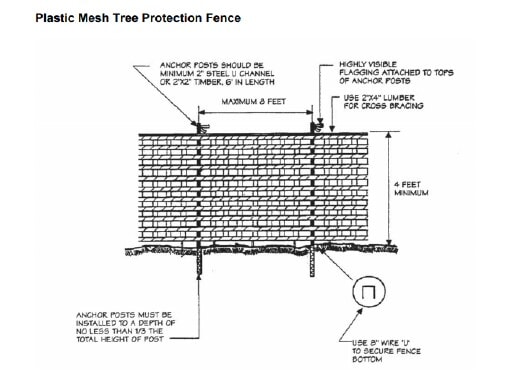
- Areas need marked and fenced off prior to any grading or construction activity on site.
- Orange snow fencing needs to be installed around the perimeter of the designated critical root zone.
- Signs need to be posted reading "TREE PRESERVATION AREA-KEEP OUT".
- If re-grading occurs within the critical root zone, then root pruning with a trencher at the point of disturbance will be performed by a certified Landscape Technician.
Construction
- The sites for preservations should be walked and monitored throughout the construction phase noting any soil compaction, root injury, limb and trunk injury, and amount of water in the areas. If damage has been caused, steps to reduce the issue must be taken.
- If re-grading occurs within the critical root zone, then root pruning with a trencher at the point of disturbance will be performed by a certified Landscape Technician.
- Backfill with loose soil incorporated with a 50/50 mix of compost and topsoil. Gently pack soil down and finish off by watering in the tree to remove any air pockets that may have formed in the backfill.
- Mulch tree with a natural hardwood double processed mulch at 3 inches thick and 3 foot diameter ring around the truck for a 2 inch tree. Adjust mulch ring accordingly with larger caliper trees.
Post Construction
- Upon completion of construction trees will be re-evaluated on tree health by a certified ISA arborist.
- Any broken limbs or trunk damage will be properly pruned and accessed by a certified ISA arborist.
- If soil compaction occurred in critical root zone, then vertical mulching may need to be performed by a certified Landscape Technician.
- Trees will also be re-evaluated 1 year after completion by a certified ISA arborist to access damage unseen after initial completion.
- Ex. Root Damage during construction that was unseen or root compaction.
- Any trees damaged beyond restoration or have died shall be replaced at the cost of the trees current value noted in initial evaluation
BGSU Tree Committee
- The BGSU Tree Committee is an advisory group that focuses on all issues impacting or affecting trees on the BGSU campus. Membership extends to Planning, Construction, & Campus Operations (PCCO) staff, (which includes Planning and Construction, Campus Services, Grounds, and Campus Sustainability), faculty, administrative staff, students, Alumni & Development, and the City of Bowling Green Arborist.
- BGSU Tree Committee Member Terms:
- All appointments are made annually, at the beginning of each academic year (August) for that year.
- Tree Committee membership for the 2025-2026 Academic year includes the following:
- Zachary Hayes, Sustainability Coordinator, Campus Sustainability
- Scott Euler, Sr. Grounds Manager, Campus Operations
- Joel Himmelhan, Assistant Grounds Manager, Campus Operations
- Eric Heilmeier, Director of Campus Services, Campus Operations
- Daniel Lemmerbrock, Planning and Construction
- Will Quanrud, Geospatial Technician, Office of Facilities Information
- Laura Moore, Associate Director of Alumni & Development
- Evili Silva, Greenhouse Manager, Biological Science
- Adrien Lowien-Kirian, City of Bowling Green Arborist
- Carol Wymer, Adjunct Instructor, Biological Science
- Cohen Pierce, Student representative
- The Committee will review/consider/discuss all issues related to trees on the BGSU campus. Decisions/actions/recommendations of the Committee are referred to either the Director of Campus Services or the AVP for Planning, Construction, & Campus Operations for approval and implementation, depending on the issue.
- Meetings take place every month and are coordinated, planned and run by the Sustainability Coordinator. All committee members contribute to the agenda. Typical areas reported on include:
- Grounds report on trees planted, issues encountered, pruning and care status, grant status, etc.
- Campus Sustainability report on student services projects, and Arbor Day recognition.
- Alumni & Development report on Memorial Tree program status and new memorial trees purchased/planted, markers placed, etc.
- Planning and Construction report on any pending construction projects and potential/actual tree impact, protection or replacement status. Update on GIS dashboard features and current status of tree mapping.
- Faculty report on status of tree field classes, projects, or related academic issues.
Updated: 03/02/2026 08:00PM