
Fleet Feet: BGSU forensic science student creates unique footwear database with help of Falcon Marching Band
Estimated Reading Time:
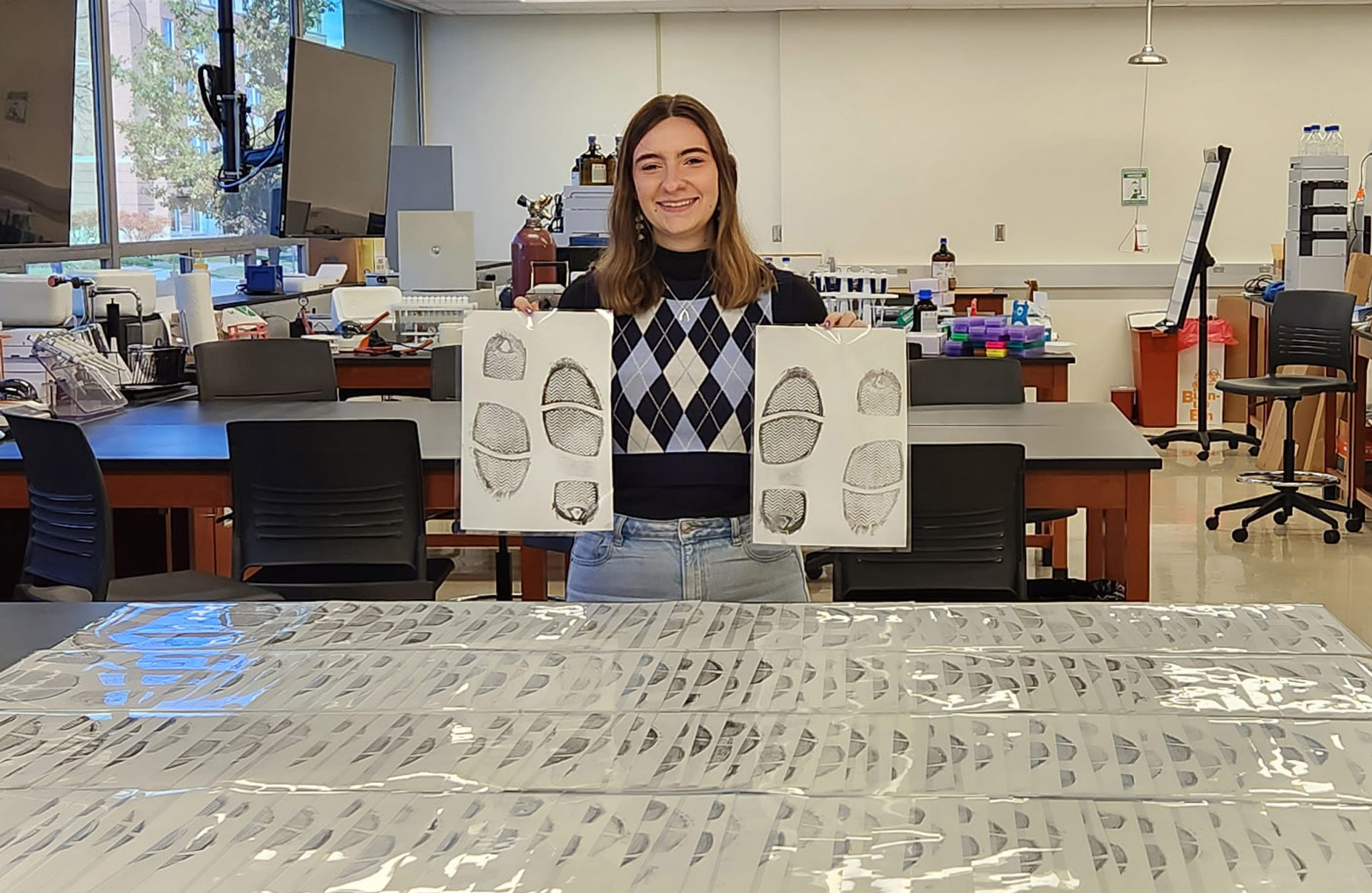
Forensic science graduate student Katie Roy ’25 is studying randomly acquired characteristics in footwear as her thesis project
By combining an idea for her thesis project with the Falcon Marching Band, a Bowling Green State University graduate student created a unique, foundationally useful forensic science database.
Following an internship with the Cuyahoga (Ohio) County Medical Examiner’s Office as part of her coursework as an undergraduate, BGSU student Katie Roy ’25 participated in forensic footwear training – which gave her an innovative research idea.
Roy wanted to study randomly acquired characteristics (RACs) – the unique ways an individual puts wear and tear on the outside of the shoe – which is information a forensic examiner could use to associate a footwear impression with a specific shoe during a criminal investigation.
But the topic came with a catch: there are so many variables that most prior research has been understandably limited. With so many types of shoes, lengths of time people wear them, different surfaces and varying uses for shoes, most prior forensic footwear studies had small sample sizes and mismatched comparisons like brands and tread styles, which are called class characteristics.
“A lot of the research that had been done used small samples, usually about 30 or 40 shoes, and those samples were a mix of different kinds of shoes,” Roy said. “In other studies, they were using a lot of different shoes that had different class characteristics, so in a forensic laboratory setting, those shoes would be immediately ruled out. The data they were looking at for randomly acquired characteristics wasn’t necessarily indicative of real casework.”
But Roy, who hails from Shelby Township, Michigan, knew of a game-changing source of identical footwear right at BGSU, which is also home to the renowned Ohio Attorney General’s Center for the Future of Forensic Science.
The Falcon Marching Band, one of the largest in Division I, requires all members to wear the same shoes as part of their uniform. A former clarinet player and section leader in the Falcon Marching Band, Roy believed she had a sensible answer to the sample problem.
“As soon as I came up with the idea for my project, I knew I was going to need a big group of people with the same kind of shoe,” she said. “I thought to myself, ‘What are we debating about?’ I knew there was an organization on campus with almost 400 people who all wear the same kind of shoe and who would probably be willing to help one of their own alumni.”
As part of the project, Roy sought marching band volunteers to have their shoes printed. During the course of one weekend, Roy and volunteers from Delta Delta Epsilon, the BGSU forensic fraternity, and other graduate students spent 14 hours exhaustively processing 121 pairs – 242 individual shoes – and printing a whopping 236 of them.
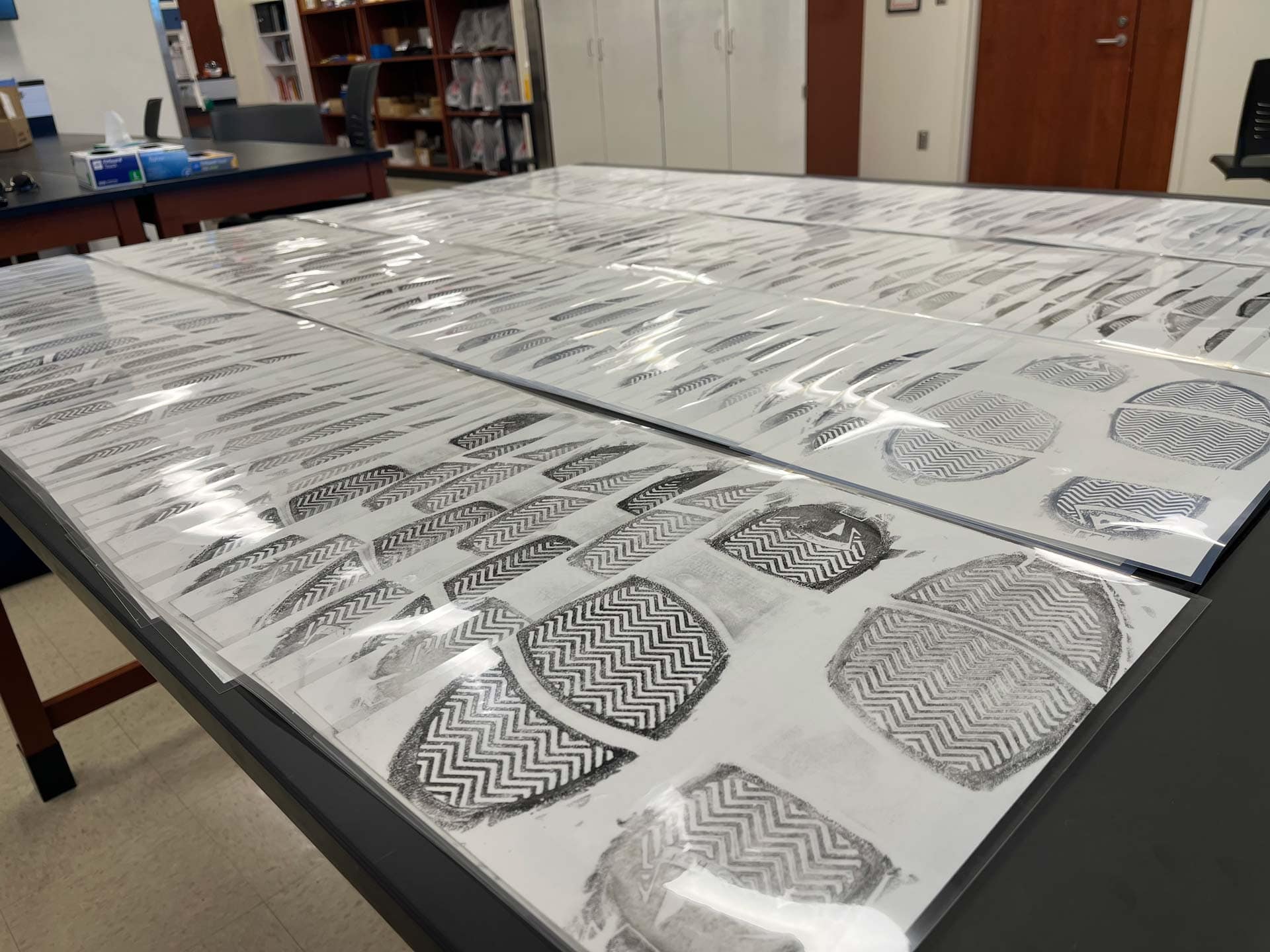
Roy now has the largest known database of shoes that share the same class characteristics.
Dan Davison, an assistant teaching professor of forensic science at BGSU who has advised on the research, called Roy’s approach “novel and pragmatic” to gather such a quality sample.
“Previous studies have either relied on dissimilar shoes, impressions that have been standardized or a limited number of shoes,” Davison said. “Katie’s experience with the Falcon Marching Band allowed her to recruit help from them and acquire a large collection of the same shoe type that has predominantly been worn on the same surface and walked in the same way. This all helps by restricting the number of variables in the experiment.
“It also demonstrates Katie’s ability to utilize available resources in a meaningful and productive way.”
Roy hopes her project will add to the forensic community’s larger understanding of using RACs in studying forensic footwear.
“The goal is to help validate that randomly acquired characteristics — cuts, tears and damage — are able to give scientific backing to an examiner’s opinion about the source of an impression,” Roy said.
Roy is now in the process of analyzing the dataset, but the research already has come with an encouraging start. All of the shoes have the same tread design, but there appears to be many unique RACs across the sample – an indication her project could be onto something major.
The clever idea to sample from the Falcon Marching Band appears to have controlled some of the trickiest variables in completing research of this type.
"The sample that I was able to get from the Falcon Marching Band are the same kinds of shoes; they’ve been worn for the same amount of time doing the same activity on the same surfaces,” Roy said. “Those variables are extremely hard to control in a study, so the fact that the marching band controlled all those variables is something that’s not normally accessible in research – or at least until now.”
Related Stories


Media Contact
Michael Bratton | mbratto@bgsu.edu | 419-372-6349
Updated: 11/14/2025 01:11PM