
Older Parents’ Expectations of Care from Children by Parents’ Nativity Status, Race, and Educational Attainment
Family Profile No. 34, 2025
Authors: Elisa Hernandez, Jaycob Applegate, and Jenjira Yahirun
The share of older adults who are foreign-born is increasing in the United States. According to the U.S. Census Bureau, the foreign born made up 18% of all adults aged 65 and older in 2018. By 2060, the foreign-born population is expected to make up almost a quarter of the population aged 65 and older (Mizoguchi et al., 2019). When examining the relationship between nativity status and caregiving, prior research reveals that immigrant caregivers report more frequent caregiving than their native-born counterparts, except for Mexican Americans and other Latino groups, where the native born reported more frequent caregiving (Rote & Moon, 2018).
This family profile examines differences in care expectations among older adults based on their nativity status, race, and educational attainment. Data are from the 2018 U.S. Health and Retirement Study (HRS). Respondents included in the sample are aged 51 or older and have at least one child. Figures 1 and 2 include non-Hispanic White, non-Hispanic Black, and Hispanic individuals. Figure 3, which examines nativity differences among racial/ethnic groups, compares non-Hispanic White and Hispanic individuals only. Older adults who were already receiving care were not asked about expected caregiving and are excluded from this profile. All descriptive analyses were weighted at the individual level to be nationally representative.
Anticipated Care by Parents’ Nativity Status
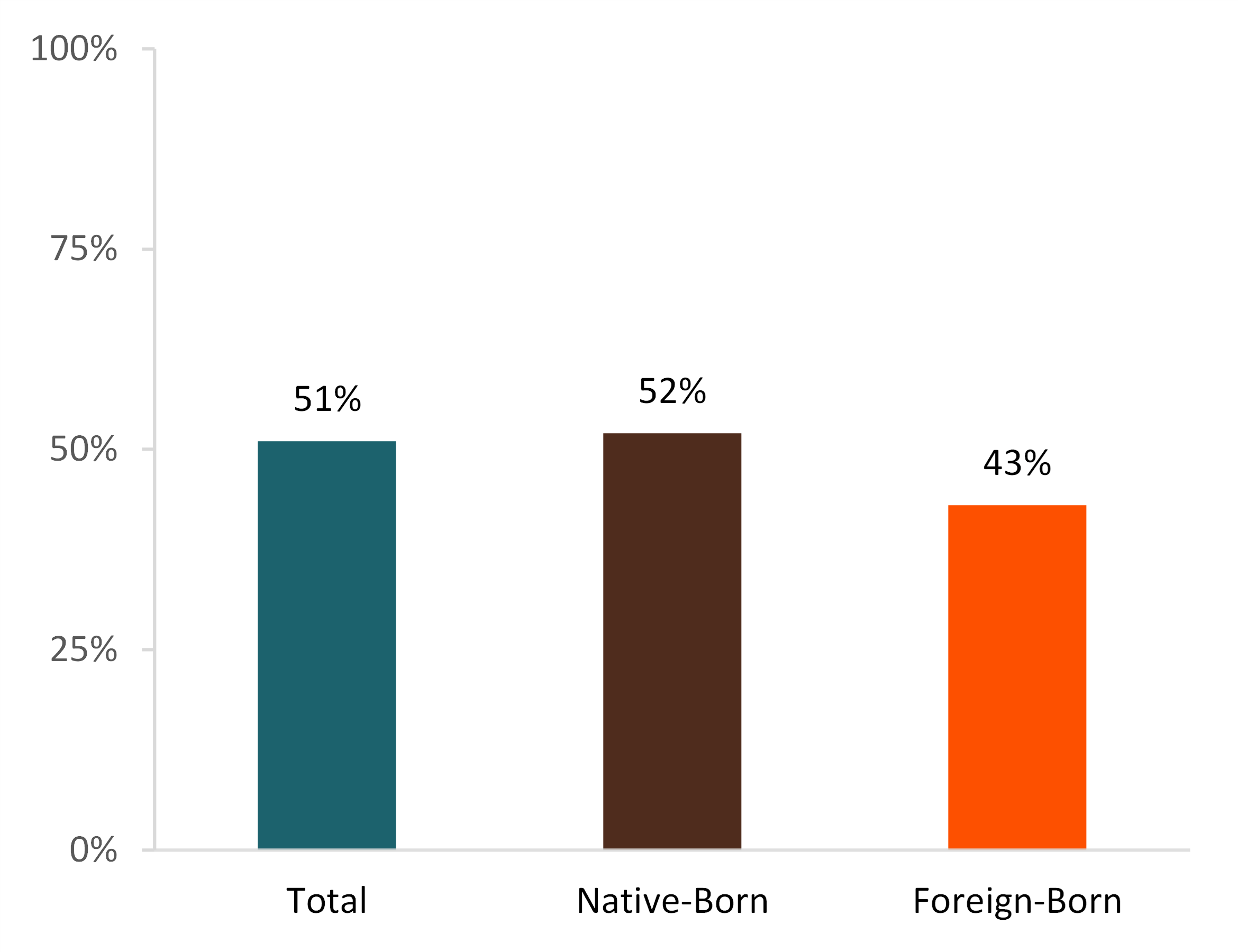
- Among all respondents, 51% reported having one or more children to care for them.
- A greater share of older native-born parents anticipated care from their children than older foreign-born parents.
- Among all native-born individuals, 52% reported having at least one child they could expect to provide care.
- Forty-three percent (43%) of forgein-born respondents reported expecting care from at least one child.
Figure 1. Anticipated Care by Parents’ Nativity Status, 2018
Anticipated Care by Parents’ Nativity Status and Educational Attainment
Figure 2. Anticipated Care by Parents’ Nativity Status and High School Completion, 2018
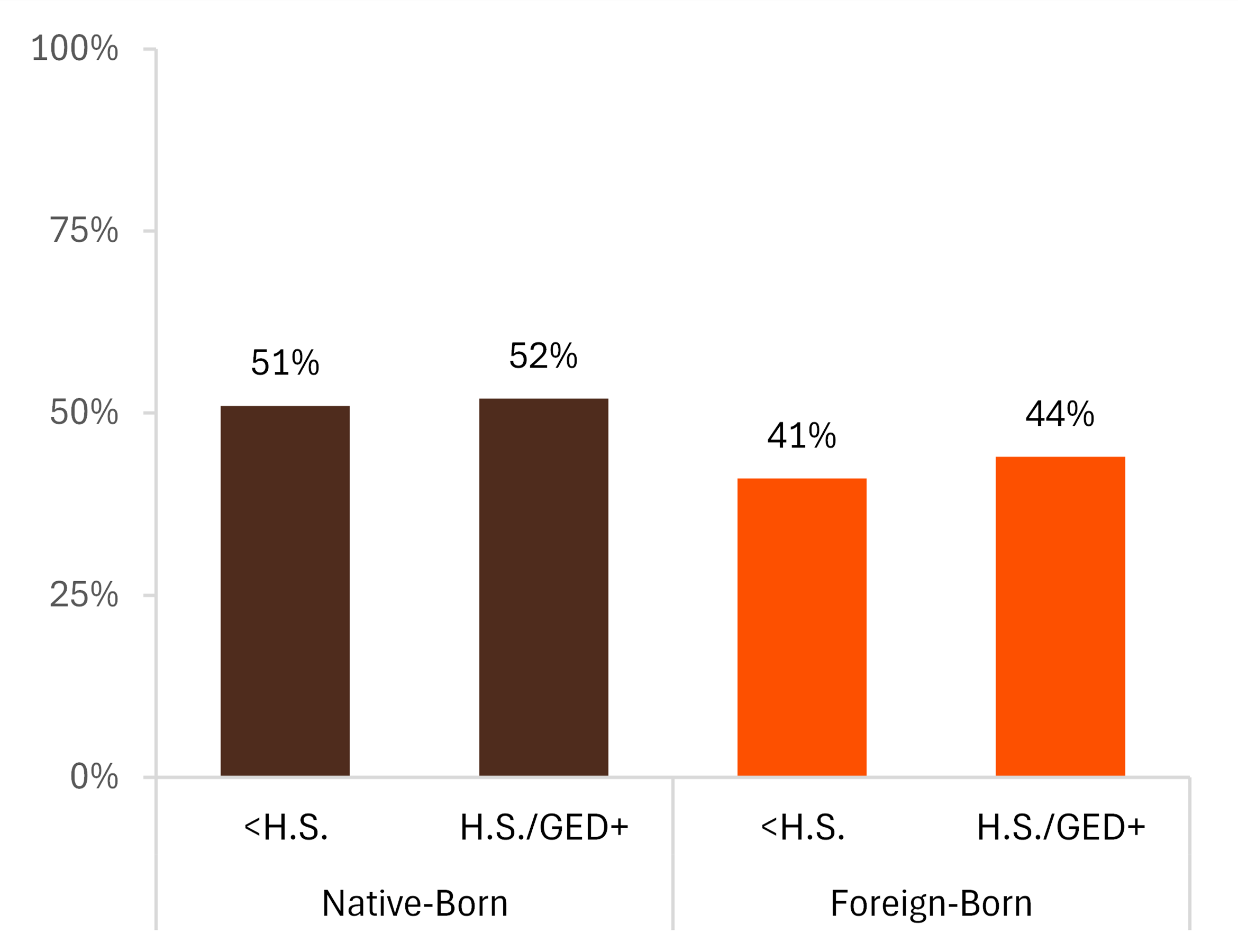
- Educational differences in anticipated care were slightly larger for the foreign-born.
- Among all native-born individuals, 51% of those with less than a high school education and 52% of those with a high school education or higher reported having at least one child to provide care.
- Among the foreign-born, 41% who had less than a high school education reported one or more children they could anticipate receiving care from, compared to 44% of individuals with a high school education or higher.
Anticipated Care by Parents’ Nativity Status and Race/Ethnicity
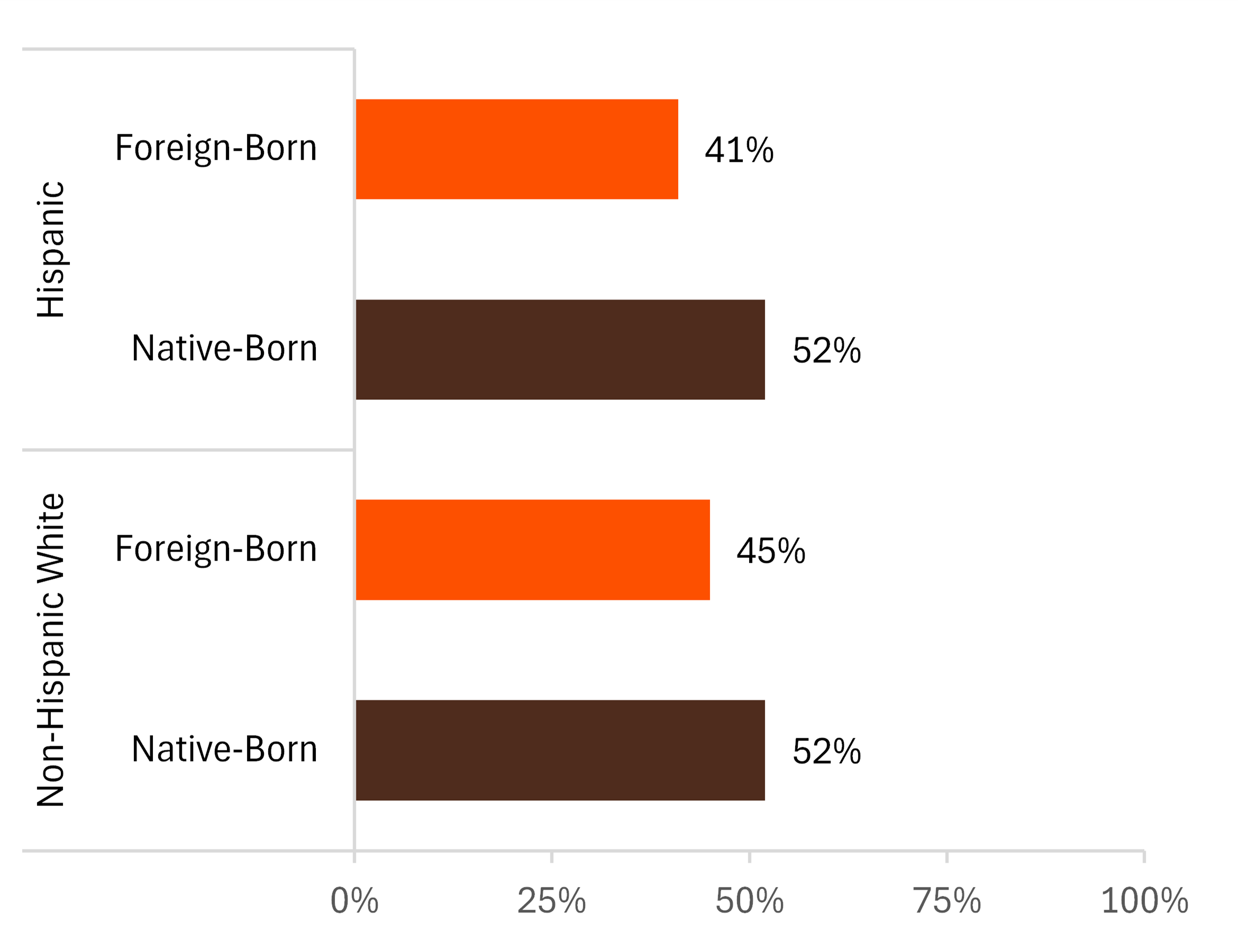
- Within racial/ethnic groups, a greater share of native-born parents anticipated care than foreign-born parents, with a larger difference for Hispanic compared to non-Hispanic White parents.
- Forty-one percent (41%) of foreign-born Hispanic adults reported having at least one child to care for them compared to 52% of native-born Hispanic adults.
- Forty-five percent (45%) of foreign-born non-Hispanic White adults reported expecting care from one or more children compared to 52% of their native-born counterparts.
Figure 3. Anticipated Care by Parents’ Nativity Status and Race/Ethnicity, 2018
Data Sources:
Health and Retirement Study. (n.d.). Public use dataset. University of Michigan. https://hrs.isr.umich.edu
RAND Center for the Study of Aging. (2023, July). RAND HRS Family Data 2018 (V2). RAND Corporation. https://www.rand.org/labor/aging/dataprod.html
References:
Mizoguchi, N., Walker, L., Trevelyan, E., & Ahmed, B. (2019). The Older Foreign-Born Population in the United States: 2012-2016. The United States Census Bureau. https://www.census.gov/content/dam/Census/library/publications/2019/acs/acs-42.pdf
Rote, S. M., & Moon, H. (2018). Racial/Ethnic Differences in Caregiving Frequency: Does Immigrant Status Matter? The Journals of Gerontology. Series B, Psychological Sciences and Social Sciences, 73(6), https://doi.org/10.1093/geronb/gbw106
Suggested Citation:
Hernandez, E., Applegate, J., & Yahirun, J. (2025). Older parents’ expectations of care from children by parents’ nativity status, race, and educational attainment. Family Profiles, FP-25-34. Bowling Green, OH: National Center for Family & Marriage Research. https://doi.org/10.25035/ncfmr/fp-25-34


Updated: 07/08/2026 07:39PM