
Distributions of Age at First Birth, 1960-2023
Family Profile No. 28, 2025
Authors: Christopher A. Julian & Wendy D. Manning
Drawing on United States natality data from about thirty year intervals, including 1960 (National Office of Vital Statistics, 1962), 1990 (National Center for Health Statistics [NCHS], 1994), and 2023 (NCHS, 2023) accessed via CDC WONDER, this Family Profile traces shifts in the age at which women have their first child[1]. We begin by charting changes in the overall age distribution of first-time mothers across these three time points. We then focus on 2023, examining how patterns of age at first birth differ by race and ethnicity (Hispanic/Latina, non-Hispanic White, non-Hispanic Black, and non-Hispanic “Other”) and by educational attainment (less than high school, high school diploma or GED, some college, and bachelor’s degree or higher).
To capture variation in age at first birth by timepoint as well as race/ethnic and education groups we report three indicators. First, we calculate the Blau diversity indexes (Cohen, 2013) which measure the degree to which first births are distributed across age groups, with values closer to one indicating more variation. Second, we report the median age at first birth (the age at which half of women had a child). The median age was calculated using interpolation as the age categories were binned into five-year intervals. Third, we report the modal age group for the age at first birth (the age interval with the greatest share of children born). This analysis updates Family Profile FP-20-11 (Schweizer & Guzzo, 2020), incorporating the finalized natality data from 2023.
[1] We rely on 2023 rather than 2020 to avoid issues related to the COVID-19 pandemic, during which fertility rates declined (Osterman et al., 2024).
Women’s Age at First Birth Distribution
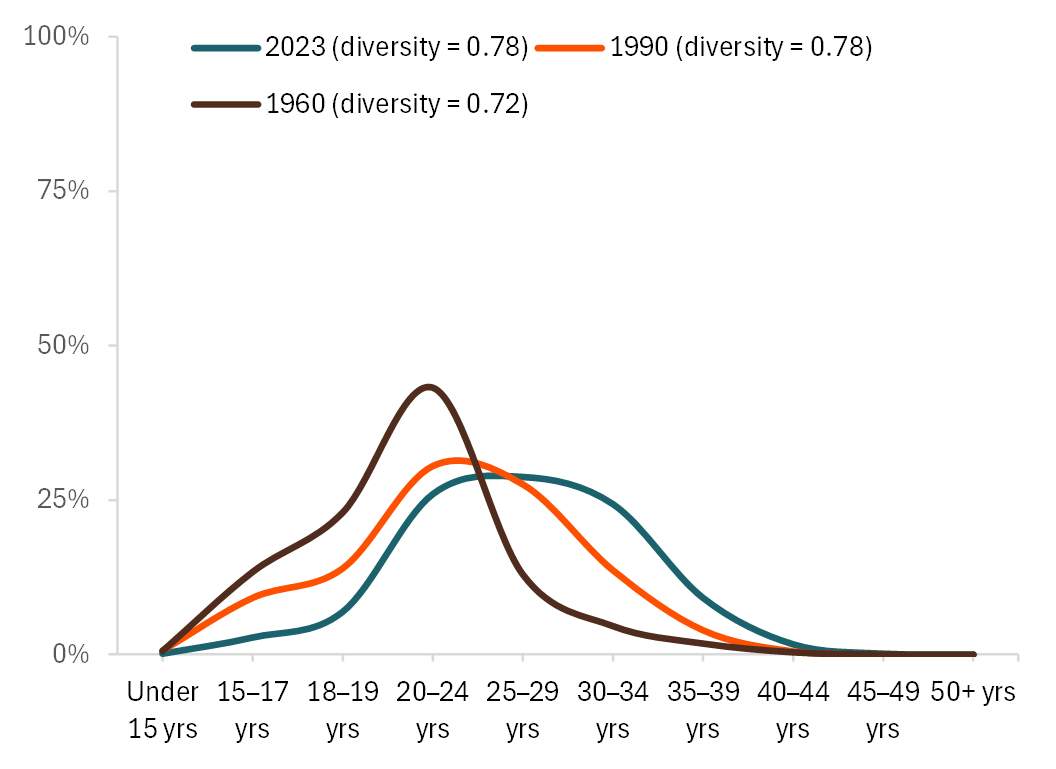
- As shown in Figure 1, the Blau diversity index values indicated less age variation at first birth in 1960 (0.72) compared to 1990 and 2023 (0.78). The diversity scores in 1990 and 2023 were similar, indicating a comparable age variation at first birth at those two time points.
- The estimated median age at first birth has increased by five years from 1960 to 2023. In 1960, it was 22. In 1990, it increased to 24 and by 2023, it stood at 27.
- In 1960, women aged 20 to 24 accounted for the largest share of first births, making up 43% of all first-time mothers. By 1990, the share of first births to mothers aged 20-24 declined to 31% but remained the modal age group for first births.
- By 2023, the share of births to 20–24-year-olds declined to 26% and was no longer the most common age interval. By 2023, first births occurred most often to women aged 25 to 29 (29%).
Figure 1. Distributions of Women’s Age at First Birth, 1960, 1990, & 2023
Note: There is no data for those aged 50+ for the year 1990.
Race/ Ethnicity
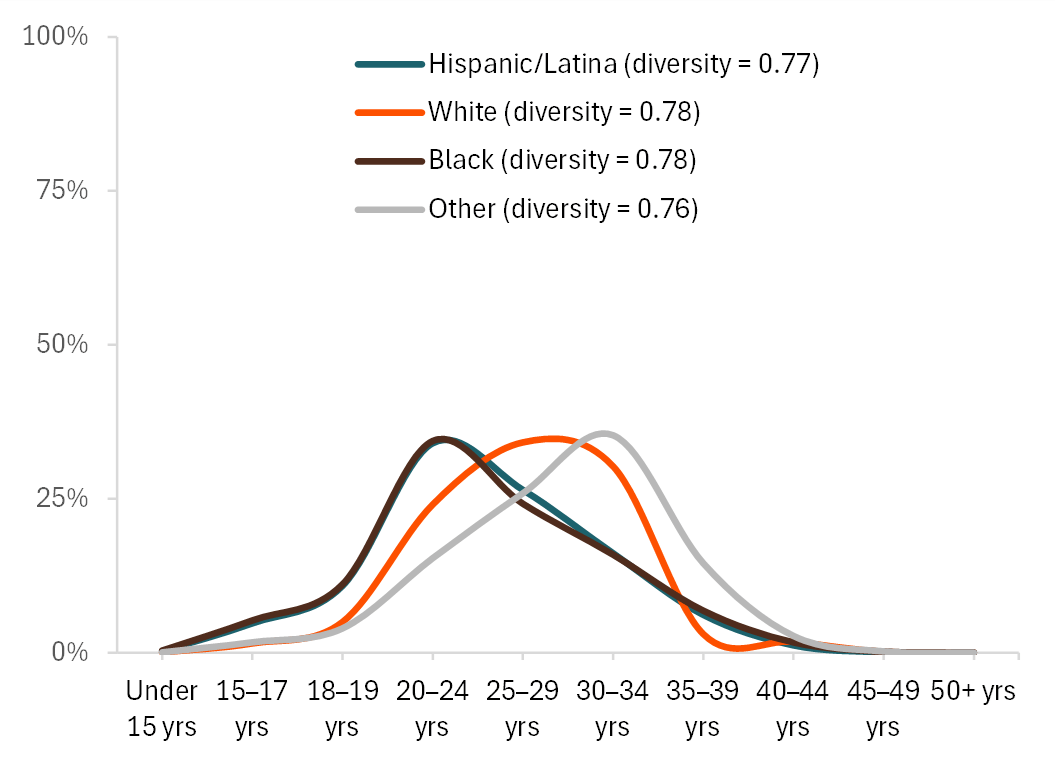
- The Blau diversity index values were similar across race/ethnicity groups, meaning there was a similar degree of age variation at first birth within each race/ethnicity group (Figure 2).
- The estimated median age at first birth was 25 for both Hispanic/Latina and Black women, 28 for White women, and 30 for women categorized as “Other.”
- The modal age interval at first birth was 20-24 for Hispanic and Black women. About one-third (34%) of Hispanic and Black women experienced a first birth between the ages of 20 and 24.
- Among White women, the modal age interval was 25 to 34. Approximately one-third (34%) of White women had their first birth between the ages of 25 and 29
- For women categorized as “Other,” the modal age interval was 30 to 34, with about 35% of women experiencing a first birth between ages 30 and 34.
Figure 2. Distributions of Women’s Age at First Birth by Race/ Ethnicity, 2023
Note: When charting across race/ethnicity, we focus on women for whom their ethnicity was reported.
Educational Attainment
Figure 3. Distributions of Women’s Age at First Birth by Educational Attainment, 202
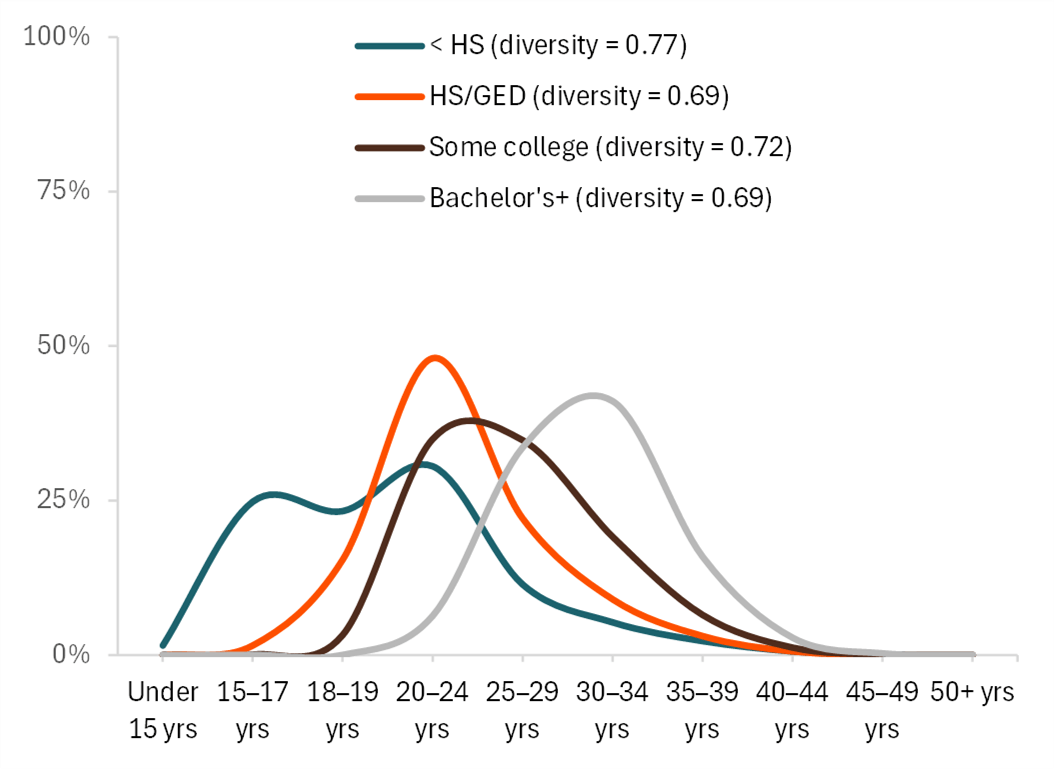
- Women with less than a high school degree had the highest diversity score (0.77), indicating greater variation in age at first birth among these women relative to those with college degrees (0.69).
- Women with more education tended to have their first child at older ages. The median age at first birth was 20 for women with less than a high school degree, 23 for those with a high school degree/GED, 27 for those with some college, and 31 for those with a bachelor’s degree or higher.
- The modal age interval for women with less than a high school diploma and a high school degree or GED was 20-24 (31% and 48%, respectively).
- For women with some college, the modal age groups were split into two, 20-24 and 25-29, with a share of about 35% for both.
- Among women with a bachelor’s degree or higher, the modal age category was 30-34, with about 41% having a birth in this age range.
Data Sources:
Centers for Disease Control and Prevention, National Center for Health Statistics. (n.d.). National Vital Statistics System, Natality on CDC WONDER online database [Data set]. Retrieved August 14, 2025, from http://wonder.cdc.gov/natality-expanded-current.html
National Office of Vital Statistics. (1962). Vital statistics of the United States, 1960: Volume I—Natality. U.S. Department of Health, Education, and Welfare, Public Health Service. Retrieved from https://www.cdc.gov/nchs/data/vsus/nat60_1.pdf
National Center for Health Statistics. (1994). Vital statistics of the United States, 1990: Volume I—Natality. U.S. Department of Health and Human Services, Public Health Service. Retrieved from https://www.cdc.gov/nchs/data/vsus/nat90_1acc.pdf
References:
Cohen, P. N. (2013, February 20). Family, race, religion: The U.S. is becoming more diverse. The Society Pages: Sociological Images. https://thesocietypages.org/socimages/2013/02/20/family-race-religion-the-u-s-is-becoming-more-diverse/
Osterman, M. J. K., Hamilton, B. E., Martin, J. A., Driscoll, A. K., & Valenzuela, C. P. (2024). Births: Final data for 2022. National Vital Statistics Reports, 75(2), 1–54. https://doi.org/10.15620/cdc:145588
Schweizer, V. J. & Guzzo, K. B. (2020). Distributions of age at first birth, 1960-2018. Family Profiles, FP-20-11. Bowling Green, OH: National Center for Family & Marriage Research. https://doi.org/10.25035/ncfmr/fp-20-11
Suggested Citation:
Julian, C. A., & Manning, W. D. (2025). Distributions of age at first birth, 1960-2023. Family Profiles, FP-25-28. Bowling Green, OH: National Center for Family & Marriage Research. https://doi.org/10.25035/ncfmr/fp-25-28


Updated: 07/08/2026 07:40PM