
Married and Living Apart Together
Family Profile No. 27, 2025
Author: Natalie Bankey
Living apart together (LAT) relationships typically involve unmarried individuals in a long-term intimate relationship who maintain separate households but still identify themselves as part of a couple (Strohm et al., 2009). Other researchers have opted to include married couples who choose to live apart as well (Payne et al., 2020). This profile updates FP-20-15 by examining the proportion of newlyweds (those who report having entered a marriage in the last year) who are in a LAT relationship. Newlywed LATs are defined as those not living with their spouse for reasons other than separation. Using data from IPUMS-USA 1-year estimates, this profile examines LAT status by characteristics such as the number of times married, age, and educational attainment.
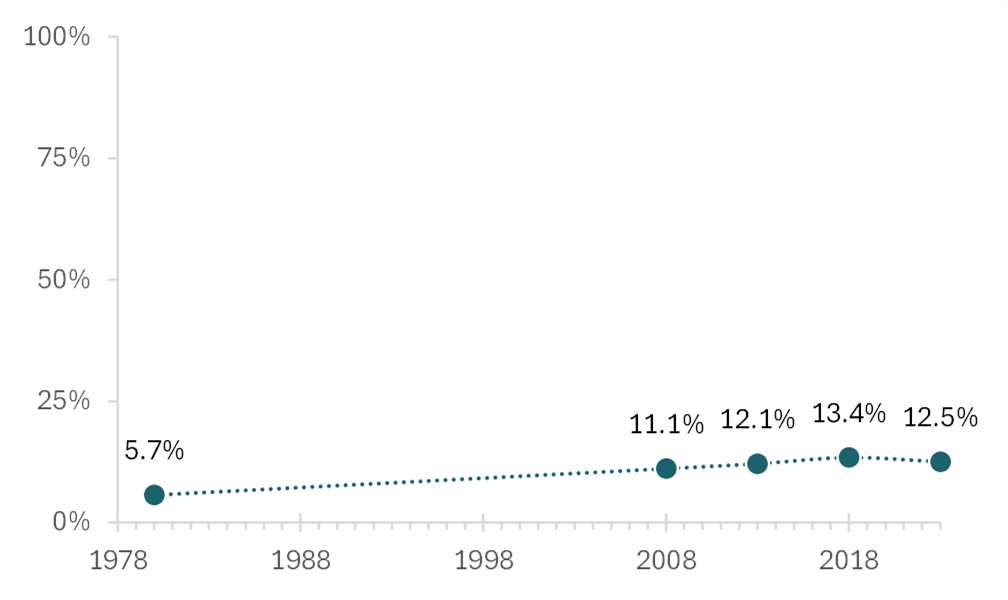
Newlyweds in LAT Relationships, 1980-2023
- The share of newlyweds in a LAT relationship has remained steady over the last five years.
- In 2018, 13.4% of newlyweds were in a LAT relationship, but that number declined slightly to 12.5% in 2023.
- Recent estimates of LAT relationships among newlyweds remained more than double the estimates in 1980 when only 5.7% were in a LAT relationship.
Figure 1. Share of Newlyweds in a LAT Relationship, 1980-2023
Newlyweds in LAT Relationships by Times Married
Figure 2. Share of Newlyweds in a LAT Relationship by Times Married, 2023
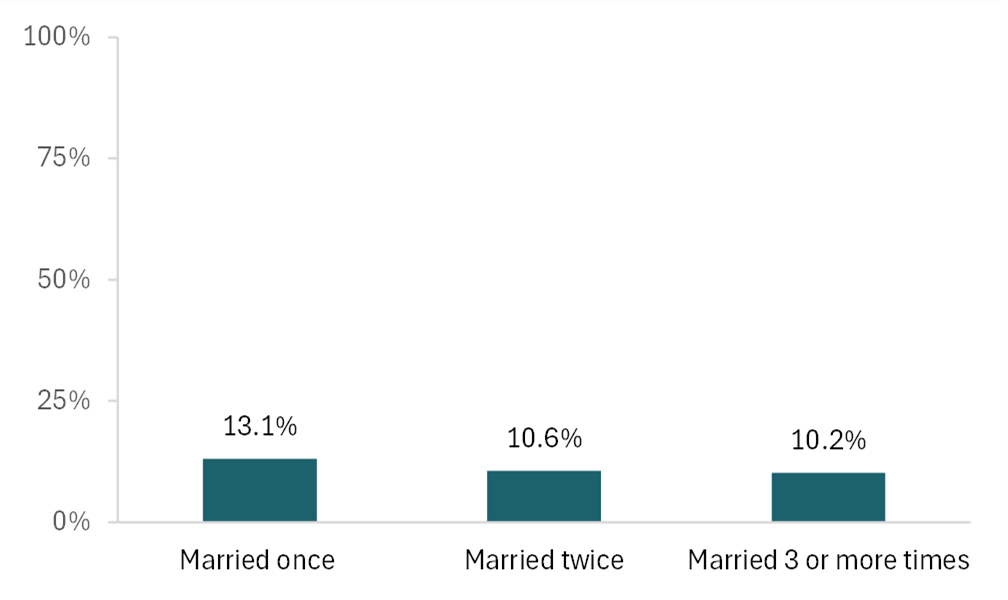
- Among newlyweds in their first marriage, about 13.1% were in a LAT relationship.
- For newlyweds in their second marriage, about 10.6% were in a LAT relationship compared to 10.2% in at least their third marriage.
- Since 2018, the shares of newlyweds in a LAT relationship who had been married only once declined slightly from 14.4% to 13.1%. For those married twice, the decrease was even smaller (from 10.9% to 10.6%). Conversely, there was an increase among those who have been married 3 or more times (from 8.7% to 10.2% [not shown]).
Newlyweds in LAT Relationships by Age
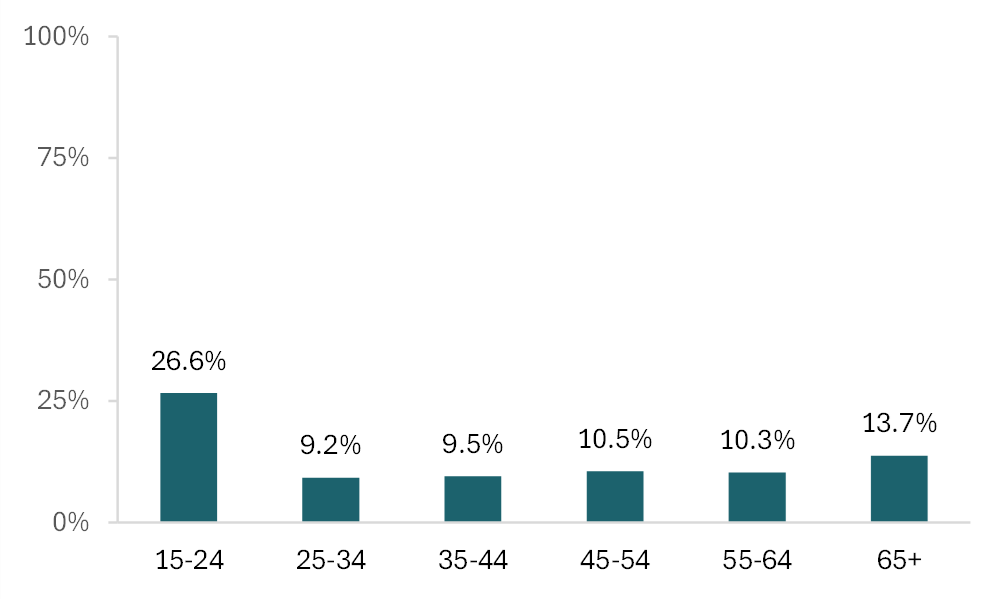
- The share of newlyweds in a LAT relationship differed markedly by age, with those aged 15-24 far outpacing adults of older ages.
- The share of newlyweds in a LAT relationship remained nearly unchanged among those aged 15-24, with over one in four (from 26.5% to 26.6%) in a LAT relationship.
- The smallest share of newlyweds in a LAT relationship were among those aged 25-34 (9.2%) increasing gradually with each successive age group with 13.7% of those aged 65 and older reporting being in a LAT relationship.
- All age groups from 25 through 64 experienced some drop in the share in a LAT relationship. The largest drop was among those aged 55-64 (down 1.9% from 12.2% to 10.3% [not shown]).
Figure 3. Share of Newlyweds in a LAT Relationship by Age Group, 2023
Newlyweds in LAT Relationships by Educational Attainment
Figure 4. Share of Newlyweds in a LAT Relationship by Educational Attainment, 2023
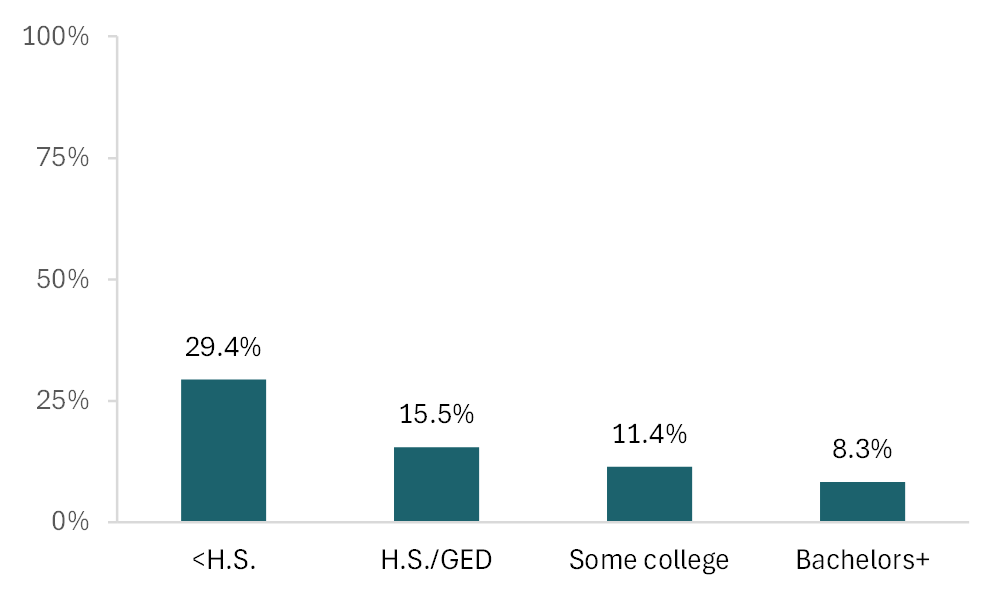
- The share of newlyweds in LAT relationships decreased as educational attainment increased.
- Approaching one-in-three newlyweds with less than a high school education were in a LAT relationship (29.4%) compared to fewer than one-in-ten among those with at least a bachelor’s degree (8.3%).
Data Source:
Ruggles, S., Flood, S., Sobek, M., Backman, D., Cooper, G., Rivera Drew, J. A., Richards, S., Rodgers, R., Schroeder, J., & Williams, K. C. W. (2025). IPUMS USA: Version 16.0 [Data set]. IPUMS. https://doi.org/10.18128/D010.V16.0
References:
Payne, K. K., Allred, C. A., & Brown, S. L. (2020). Married and living apart together. Family Profiles, FP-20-15. Bowling Green, OH: National Center for Family & Marriage Research. https://doi.org/10.25035/ncfmr/fp-20-15
Strohm, C. Q., Seltzer, J. A., Cochran, S. D., & Mays, V. M. (2009). “Living Apart Together" relationships in the United States. Demographic Research, 21, 177–214. https://doi.org/10.4054/demres.2009.21.7
Suggested Citation:
Bankey, N. (2025). Married and living apart together. Family Profiles, FP-25-27. Bowling Green, OH: National Center for Family & Marriage Research. https://doi.org/10.25035/ncfmr/fp-25-27


Updated: 07/08/2026 07:40PM