
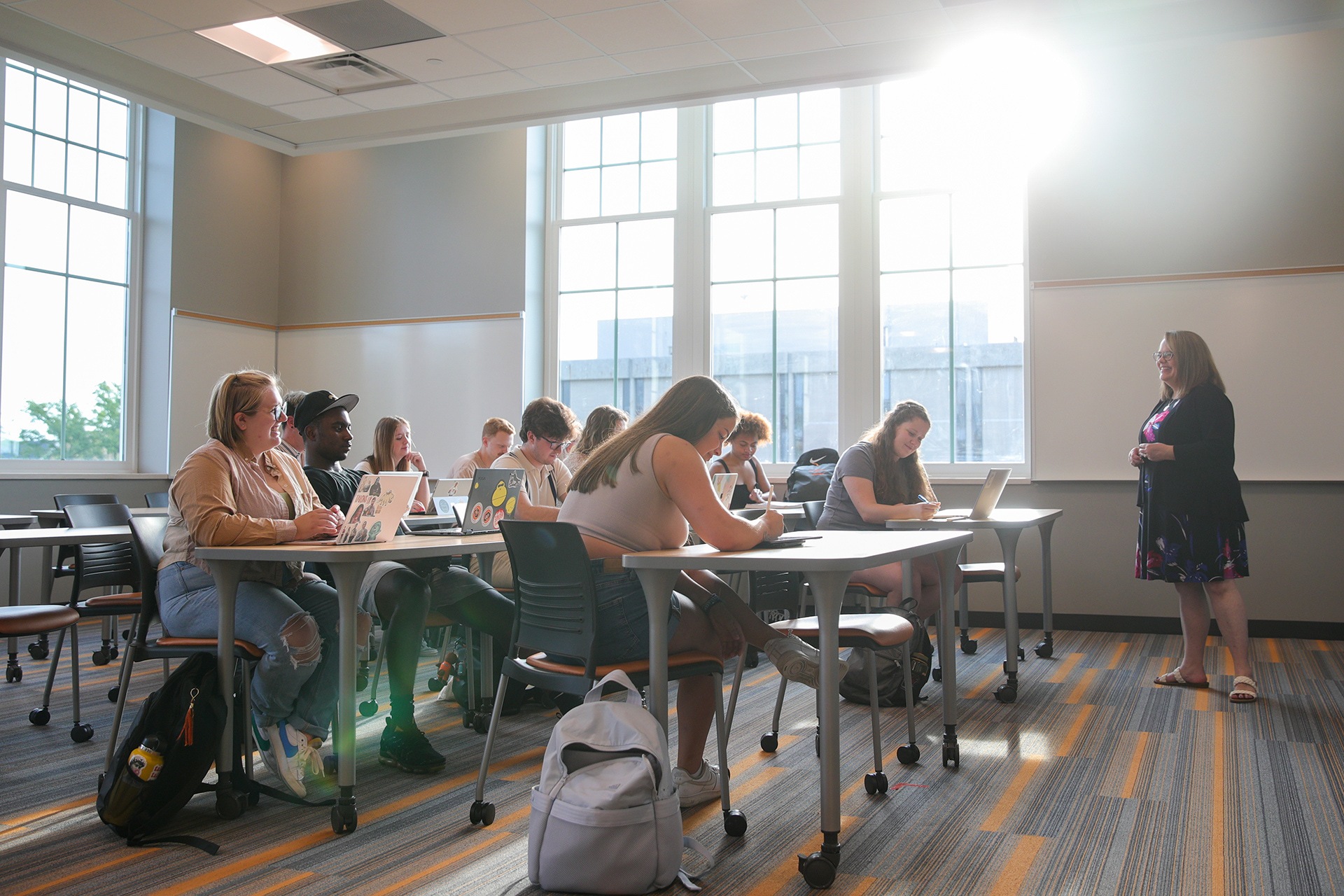
BGSU nationally recognized for increasing first-year retention rates through an innovative, personalized approach
Estimated Reading Time:
The University’s enhanced Early Alert program has transformed how students who consistently miss classes or assignments receive support
Over the past four years, Bowling Green State University has transformed its approach to addressing academic concerns among students, and the results have garnered national attention.
By taking a personalized approach to engaging with students who consistently miss classes or assignments, the University’s enhanced Early Alert program has increased first-year retention rates of those who receive early alerts by 8% since 2021, which has helped drive record retention rates during the past three years.
As a result of the program’s success, BGSU was named a finalist for the EAB Return on Education Award, which highlights institutions nationwide that have demonstrated a high return on investment for their educational practices, with a particular focus on tangible outcomes.
The winner will be announced in October at a conference of more than 1,200 higher education leaders hosted by EAB, a technology, research and consulting services company.
Overall retention has also steadily increased over the past three years, reaching a record high of 81.1% in 2024, which demonstrates the value of providing comprehensive student support – a key factor in the University’s nationally recognized student experience.
Raising the level of support
“We are continuously raising the level of support we provide students at BGSU,” said Sarah Jurden, director of student success strategies and initiatives in the Division of Student Engagement and Success. “When students choose BGSU, they are in an environment that is strategically designed to help them succeed.”
Bowling Green’s unique approach to a practice that is commonplace in higher education has become a recognizable differentiator of student success that other institutions are using as a model for their own programs.
The idea to shift how the University supports students who receive early alerts was introduced by Kim Brooks, director of student success analytics and technologies. Initially, the bulk of the responsibility for early alerts fell on academic advisors, who received notifications of concerns and then emailed the students.
However, as Brooks examined the process, she began to question its effectiveness.
A personal connection
“I thought that if we could pick one person who was connected to that student to be in charge of the outreach, we could lighten the load on academic advisors and approach this more proactively,” Brooks said.
Today, rather than students receiving a general email alerting them of poor performance or attendance concerns, alerts are distributed to a growing team of about 120 outreach coordinators across campus, who are assigned to specific populations at the University.
For example, the outreach coordinator for a student in the Thompson Working Families Scholarship program is a Thompson advisor. Likewise, a student on the University’s dance team receives outreach from the spirit program coordinator.
There are faculty members, program advisors, Life Design coaches and many others across the learning community who serve in the critical role of outreach coordinators, providing a crucial personal connection.
“The key to the success of our approach is that the outreach coordinators already have an established relationship with those students,” said Dr. Glenn Davis, vice president for student engagement and success. “That connection creates a more open and comfortable environment for the student to share their struggles and accept help.”
Every undergraduate and graduate student at BGSU is assigned an outreach coordinator, with more consistently being added to continue elevating the level of support students receive.
Related Stories


Media Contact
Michael Bratton | mbratto@bgsu.edu | 419-372-6349
Updated: 10/09/2025 07:40PM