
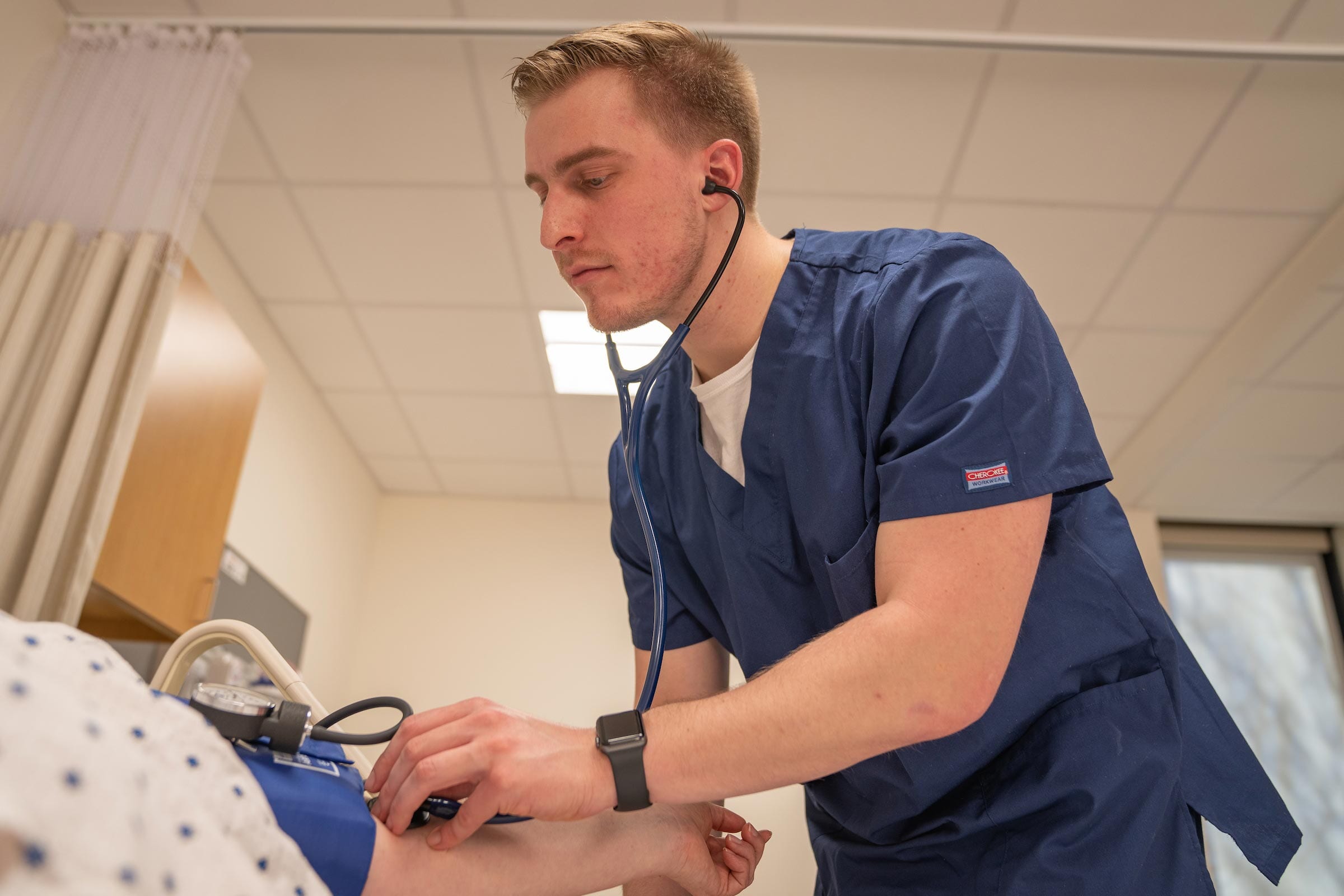
BGSU nursing students gain exposure, compassion and empathy with help of Team Recovery and the mental health nursing course
Estimated Reading Time:
Nursing students learn about mental health disorders and talk with Team Recovery CEO, Matt Bell, about substance use and addiction
By Branden Ferguson
Nursing students at Bowling Green State University are going beyond the state-of-the-art nursing simulation center and 23-bed skills lab on campus to learn more about the patients themselves. Through a uniquely designed mental health nursing course and partnership with a local recovery organization, students are learning firsthand about depression, schizophrenia and substance use disorder (SUD).
"When we developed the mental health nursing course, it was important to provide students with the knowledge on how patients develop coping mechanisms, how to show compassion and empathy for their patients and learn how these patients may be at increased risk for other medical issues," said Dr. Sarah Mahoney, assistant professor in the BGSU School of Nursing.
Initially offered during the Spring 2022 semester as a way to differentiate the BGSU nursing program and prepare students for successful careers, the mental health nursing course quickly expanded, as Mahoney partnered with Team Recovery, an addiction and mental health treatment organization based in Toledo, Ohio.
"By educating the nursing students on how SUD begins and why it evolves, we can educate and train students to provide trauma-informed care to all patients, regardless of the setting in which they work," said Mahoney. "A more knowledgeable, capable and compassionate nursing workforce means better patient care and thus, better patient outcomes."
Matt Bell, CEO and founder of Team Recovery, was excited to be approached by BGSU and Mahoney, eager to share his background as a licensed social worker and as a former addict.
"After 28 rehabs, 13 arrests, homelessness and multiple overdoses and felonies, I decided to start Team Recovery when I was two days sober," said Bell. "What started as an advocacy group has developed into a full continuum of care — from prevention and outpatient services to inpatient detox, residential treatment, recovery housing and mental health care."
Integrating into the mental health nursing course, Bell talks with BGSU nursing students about his troubled past, his road to recovery and discusses common misconceptions and stereotypes surrounding the SUD community.
"This course allows future nurses to challenge their assumptions, hear directly from people in recovery and see addiction treatment from the inside out," said Bell. "That kind of perspective can't be taught in a textbook and isn't discussed enough in traditional nursing higher education."
Recent BGSU nursing graduate Anna Lipinski '25 described Team Recovery and the mental health nursing course as an eye-opening experience.
"It is one thing to read about substance use disorders in a textbook, but to hear a real story from an individual who has lost everything and was able to build themselves back up and create an amazing program for their community was inspiring," said Lipinski. "Team Recovery and the course did an excellent job at teaching about the warning signs, developing empathy and understanding substance use.
"Gaining more knowledge about the subject allowed me as a nurse to improve patient care and safety, reduce stigmas and enhance compassion by strengthening my communication skills with patients and families. I am a better nurse because of this course and Team Recovery."
Upon completing the course, students are asked to describe how Team Recovery has impacted the way they care for mental health patients in a clinical setting. Mahoney said four themes consistently emerge:
- Humanization: Students state that they changed from simply managing and treating the addiction to caring for the person with SUD.
- Compassion: Students learned to approach individuals with SUD with kindness, encouragement and motivation because they now understand that given the opportunity and resources, these individuals can fully recover.
- Empathy: Students demonstrated a deeper understanding of the stigmas associated with SUD and acknowledged their own biases. As a result, students have a better understanding of how a patient's past experiences may contribute to SUD.
- Exposure: Multiple students shared their personal experiences with SUD with friends or family members. They discuss their initial frustration and lack of understanding, but now understand the why.
As BGSU and the School of Nursing continue to educate students in innovative and meaningful ways, Bell hopes that these efforts will create a spark for change.
"I believe the ripple effect that Dr. Mahoney will leave as a result of bringing this conversation into her classroom will positively impact the world. This is something that all higher education programs should adopt into their curriculum," said Bell.
Related Stories


Media Contact
Michael Bratton | mbratto@bgsu.edu | 419-372-6349
Updated: 08/13/2025 07:43PM