
BGSU addresses growing need for occupational therapists with inaugural cohort
Estimated Reading Time:
The new Doctor of Occupational Therapy program allows graduates to enter the workforce in two years
By Laren Kowalczyk ‘07
As an undergraduate, Joseph Munger ‘25 grew accustomed to the sense of community he built at Bowling Green State University, a motivating factor in his decision to continue his graduate education at the University.
Munger, who graduated with a bachelor’s degree in education this past spring, is part of the inaugural cohort of the Doctor of Occupational Therapy (OTD) program, the first and only program of its kind in Ohio.
“The community Bowling Green offers is so well-rounded and everybody feels like family,” Munger said. “I’m looking forward to that same type of supportive community atmosphere in the OTD program.”
The innovative BGSU OTD program, which began this fall with 38 students, is among the few in the country offered in a hybrid, accelerated format, allowing graduates to enter the workforce faster.
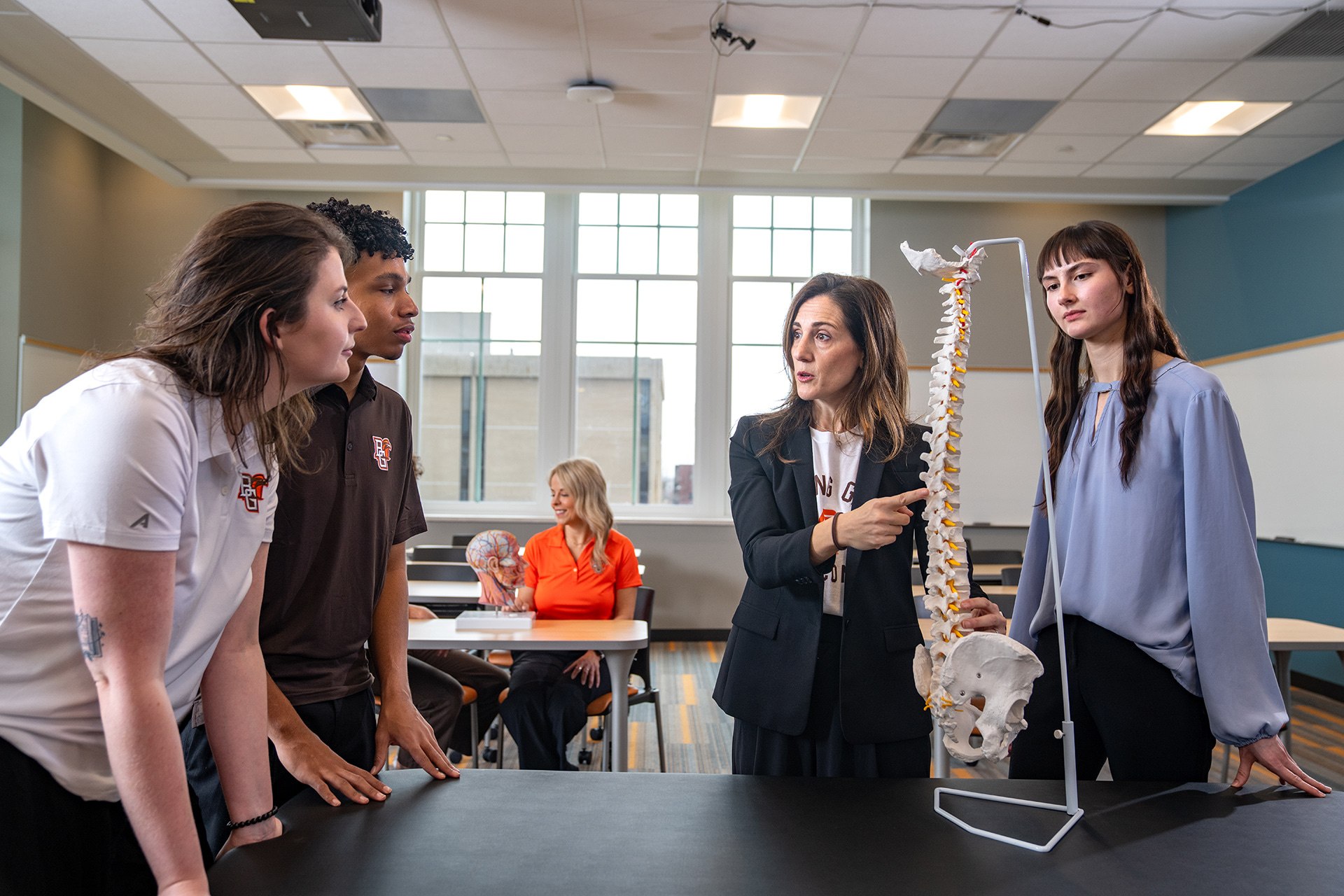
The two-year program requires students to take classes online and come to campus twice per semester for a comprehensive, hands-on clinical lab experience. While on campus, students will learn from practicing occupational therapists, who will bring their clinical experience into the lab environment.
“We’ve been able to recruit some of the country’s top occupational therapy faculty members due to the hybrid nature of our program,” said Dr. Jason Hughes, BGSU OTD program director and associate professor. “They bring educational expertise and clinical relevance to the program, ensuring students are fully qualified for the workforce upon graduation.”
The size of the inaugural cohort aligns with the national average for graduate occupational therapy programs.
Nearly one-third of the inaugural cohort is first-generation college students, and about 21% are considered post-traditional. About 40% of the cohort is from geographical areas with populations of less than 10,000 people, representing an important demographic.
“There is a growing need for occupational therapists across the country, particularly in rural communities,” Hughes said. “One part of our mission is to increase access to care to people in those communities, and having a high percentage of students from those communities in our program is a promising step in that direction.”
The University’s unique, flexible hybrid format is among the distinguishing features that drew Nicole Reed to the program. In the past decade, Reed has moved five times, often staying in a city for just one year before moving to the next for her husband’s college football coaching career.
“It’s comforting knowing that if we have to move again, it won’t disrupt my educational journey,” said Reed, who has been a certified occupational therapy assistant for the past five years.
Reed said she is ready to take the next step in her career and is intrigued by the rigorous and accelerated format of the BGSU OTD program.
“I like programs that are going to challenge me and make me better,” she said. “I was also very impressed by BGSU’s commitment to supporting students. I’m a mother now, so I’m going to be balancing all of those responsibilities while also going to school and working. I really got the sense that BGSU cares for its students in a way that’s not like other universities.”
Within the OTD program, each student will have a faculty mentor and will be part of a small group that will meet each semester. Dr. Jackson Miller, BGSU OTD program admissions director and assistant clinical professor, said the goal is to foster relationships and build a supportive community within the cohort.
“We want our students to be successful, and one of the ways we accomplish that is by creating a supportive and encouraging community,” Miller said.
The OTD program complements the University’s Doctor of Physical Therapy (DPT) program, which launched in 2021 and follows a similar structure. The programs are housed in the School of Physical and Occupational Therapy.
Related Stories


Media Contact
Michael Bratton | mbratto@bgsu.edu | 419-372-6349
Updated: 01/28/2026 06:40PM