

Enhancing our academic and student housing core

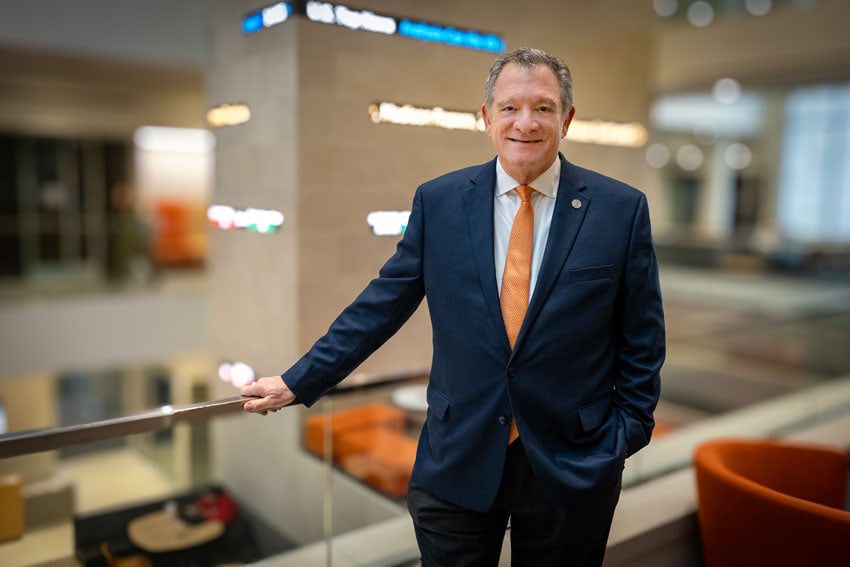 Thank you for your interest and support of our 2024 Campus Master Plan. As a public university for the public good, Bowling Green State University strives, in all we do, to provide relevant, meaningful education that is an exceptional value to both our students and the taxpayers who invest in us.

Objectives
I.
Redefining Student Success
II.
Research, Creative Activities, Partnerships and Engagement
III.
People and Community
IV.
Supporting Public Good Through Efficient and Effective Processes, Structures and Technologies
Campus Master Planning Guiding Principles
Student Experience and Success
- Support strategic academic initiatives and enrollment growth
- Instructional/research spaces
- Residential living and learning community
- Indoor and outdoor spaces - activity and interaction across campus
Preserve Campus Character
- Separation of vehicle and pedestrian
- Pedestrian-friendly campus
- Continued focus on Traditions Buildings and adjacencies
- Wise use of campus core
Integration with Bowling Green Community
- Enhance connections and views between campus and community
- Consider role of campus as community resource
- Coordinate on-campus land uses with adjacent off-campus land uses
Asset Stewardship
- Deferred maintenance needs
- Energy conservation through construction, and renovations
- Highest and best use of buildings long-range
Flexibility and durability of space
- Space will be shared to optimize flexibility and utilization
- Long-range understanding of types, quality of building and land resources
- Flexible plan to allow for unforseen opportunities
Future-Focused
"We must prepare our students for jobs that do not yet exist, using technologies that have not yet been invented, to solve problems we don't even know are problems yet."
-President Rodney Rodgers
Intersectional Connections
Through the Campus Master Plan, BGSU is well-positioned to lead the state and the nation and create learning environments for tomorrow's leaders. We choose to renovate and reposition space within the Colleges and Schools around several overlapping programmatic themes. They include:
- Integration of disciplines
- Critical thinking and problem-solving
- Real-world relevance
- Collaborative learning
- Flexibility and creativity
As a result, the Campus Master Plan reflects a framework of spaces to create innovative learning environments. Programmatically, the plan repositions the academic core to create a technology-rich, experiential and project-based learning environments at the intersection of arts and humanities, science and technology and engineering. Philosophically, these improvements are intended to remain in program, pedagogy, budget and spatial assets.

STEM Continuum
The sciences provide fundamental connections, principles, and critical thinking skills that open various academic paths. As engineering grows, it’s helpful to view these fields not as separate programs but as a continuum of STEM experiences that connect and interact. This includes physical and life sciences, engineering, manufacturing and the built environment. Interdisciplinary themes emerge, crossing traditional boundaries and multiple disciplines, leading to innovative research in areas like water and watersheds, photochemistry and material science.

Computer Science as Keystone
The information age demands ever broader and deeper data and analytics, and Computer Science has leveraged itself into an ideal position at the critical intersection between STEM and health, business and communication, art and science and more, and as a foundational resource across the academic landscape.

Cultural and Social Networks
Though the specializations and competencies may first appear to widely vary among programs like the sciences, business and the humanities, they exist at BGSU within a shared framework of cultural and social responsibility. They challenge students to widen the lens through which they explore their impact on the world. Business is a bridge to entrepreneurship, the sciences, the humanities and health. Just as business influences these fields, they also impact business practices. Paramount to any endeavor is understanding culture, history, language and how to parse ever growing volumes of human information.

Holistic Health & Wellness
The spectrum of health and wellness is wide, encompassing evolving understandings of physiology, human movement, mental acuity and resilience, psychological and social determinants and more.
Disciplines across colleges value deep knowledge and recognize that mental and physical aspects are closely linked and should be considered together. In this context, programs may overlap in innovative ways, opening up multiple pathways to careers in health and wellness, or the education thereof, and connect ground-breaking research in the sciences to life-saving work across many fields.

Arts & The Public Realm
In a trajectory steered toward the “public good,” art and the search for beauty and meaning in an increasingly technical and divisive world is a noble endeavor. The exploration and experimentation required of artists of all kinds should be supported through experiential and immersive environments. This support helps grow both individual expertise and awareness of context, community, and the social and demographic setting in which any art exists. Technology is an emergent tool at this pivotal intersection between information and art, serving either medium or message, or both.

Reposition for Collaboration
The Campus Master Plan expands the constellation of enhanced student gathering spaces within the academic core. To augment the learning that happens inside laboratories and classrooms, these congregating spaces promote student-to-student and faculty-to-student interaction to enhance critical thinking, promote teamwork, explore multiple perspectives and deepen understanding.
Link the Campus Core
BGSU proposes to enhance two existing corridors to link north-south and east-west areas of campus. By design, BGSU seeks to connect the educational and social experiences and to better define the “place” of campus. These two frames – the STEM Corridor and Enhanced Spine – define the BGSU central campus experience.
The STEM Corridor connects Wooster Street northward to the airport. This important linkage offers a transect of BGSU – connecting business, humanities and social sciences, computer science, STEM disciplines, engineering and technology and aviation. The corridor offers opportunities to reposition and transform many of BGSU’s core educational facilities and the pedestrian experience on campus.
Improvement to the east-west Enhanced Spine offers similar opportunities linking core academics with social and student life spaces. This important corridor offers a reinvestment strategy to connect the student union, education, health sciences, the library, arts, residence life, recreation and athletic assets. This corridor will be a renewed and vibrant artery of the student experience.
Near-term Recommendations

Academics
A
Technology Engineering
Innovation Center
B
Overman Hall North
Partial Removal
Remove to open up the STEM Corridor.
C
Overman Hall South
Full Renovation
Renovate to consolidate programs as a first step for other STEM renovations.
D
Hayes Hall
Phased Renovation
Renovate to create a consolidated home for computer science. Add informal learning, research, student spaces and enhanced classroom
E
Eppler Complex
Partial Renovation
Renovate existing gymnasium(s) as a potential home for displaced programs from Memorial Hall, and to serve growth in exercise sciences.
F
East Hall
Partial Renovation
Student Life
G
Founders Hall, Phase 1 & Entrance
Partial Renovation
Investigate and improve plumbing and humidity and renovate bathrooms, provide new entrance into the Honors College
H
McDonald Annex
Removal
I
Kreischer Quadrangle and Sundial Dining
Phased Renovation
Re-invest in student life and east side dining by upgrading finishes, introducing air conditioning and adding pod-style bathrooms for more privacy and enhanced options.
Outdoor/Circulation
J
New Park Avenue
New Connection of Service Drive
Mid-term Recommendations

Academics
A
Physical Sciences Laboratory Building
Full Renovation/Addition
Consolidate various science disciplines into modern, flexible, modular research and teaching environments.
B
Central Hall
Phased Renovation
Re-invest in critical classroom environments and enhanced student learning spaces.
C
Memorial Hall
Removal
Student Life
D
Founders Hall, Phases 2 & 3
Partial Renovation
Improve plumbing and humidity and renovate bathrooms.
Outdoor/Circulation
E
STEM Corridor Pedestrian Mall
Strengthened Connection
F
East/West Pedestrian Corridor
Strengthened Connection
G
Carillon Quad Improvements
Site Improvements
H
Mercer Road Modifications
Strengthened Connection
I
I-75 and Poe Road
Campus Arrival Branding
Long-term Recommendations

Academics
A
McLeod Hall
Partial Renovation
Renovate available space to relocate programs from other facilities to enhance student support. Introduce active learning classrooms.
B
Central Hall
Phased Renovation
Central Hall is a candidate for developing strategic doctoral programs, and in the long term – a relocated Psychology program.
C
Education Building
Partial Renovation
Renovate the ground floor to introduce new student-focused spaces and resources along the east side, with daylight and views into Carillon Park
D
Jerome Library
Partial Renovation
Move library offices to upper floors to create a second-floor student hub and learning commons. Continue to decrease collections using off-site storage.
E
Fine Arts Center
Partial Renovation
Remove obsolete portions, reface the southern facade and renovate associated adjacent areas.
F
College Park Office Building
Partial Removal
G
Life Sciences Building
Removal
H
Psychology Building
Removal
Outdoor/Circulation
I
Park Avenue Streetscape
Strengthened Connection
J
Jerome Library Green Roof
Elevated Sustainable Landscape
Mercer Road Modifications

Mercer Road is an important campus and community vehicular artery. The University, in partnership with the City of Bowling Green and the Ohio Department of Transportation, have the opportunity to redevelop Mercer Road by reducing travel lanes, augmenting pedestrian and bicycle mobility, adding landscaped medians and enhancing pedestrian crossings.
The re-imagined Mercer Road would promote pedestrian safety and increase connectivity from east to west. Solutions may include lane reductions and crosswalk enhancements similar to those found on Wooster Street, trees and planted medians, bike paths, widened pedestrian sidewalks, material changes and other traffic-calming measures. The flexible street design would prioritize pedestrian safety and connectivity every day, but also facilitate high traffic when needed.

Appreciation
Bowling Green State University extends its gratitude to all individuals involved in the development of the Campus Master Plan. This document reflects a progressive, collaborative and inclusive planning initiative shaped by input from staff, faculty, students, alumni, representatives from the City of Bowling Green and members of the community.
The initiative was spearheaded by the Office of Planning, Construction and Campus Operations. The master planning process was overseen by the Master Plan Steering Committee, operating under the guidance of the University Leadership Committee and received approval from the University Board of Trustees on May 3, 2024.
Campus Master Plan Open Forums
Updated: 07/17/2025 08:07PM