
BMG LABTECH PHERAstar Plus
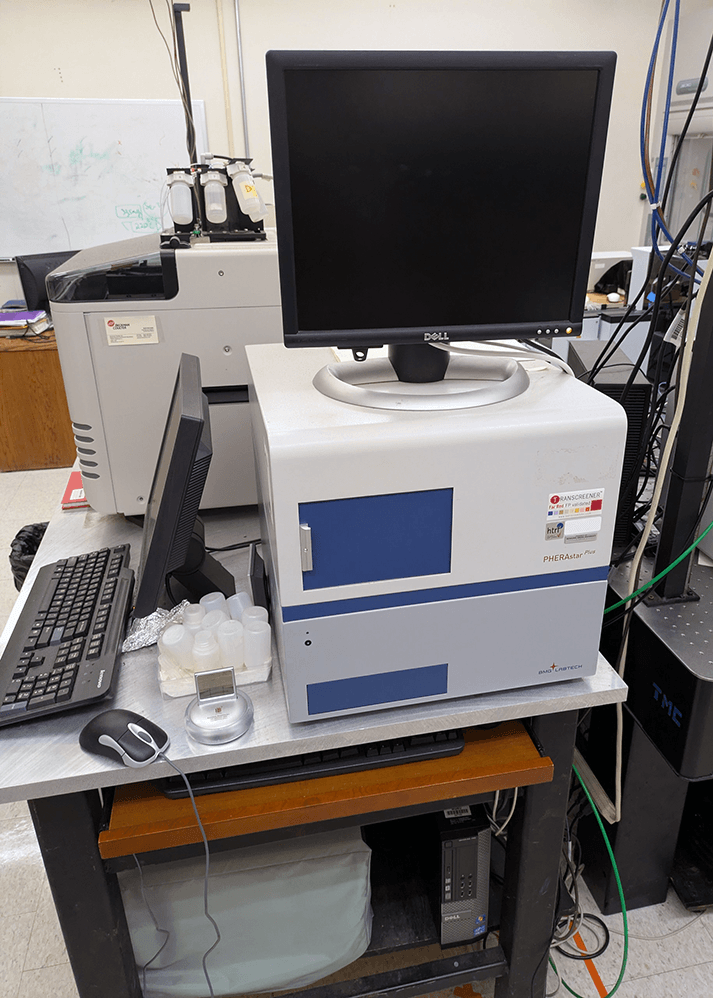
Accelerated Discovery: The PHERAstar Plus & Transcreener Assay Platform
At the Center for Photochemical Sciences (CPS), the integration of the BMG LABTECH PHERAstar Plus with BellBrook Labs' Transcreener® technology represents a powerful leap in our screening capabilities. This duo transforms our core photochemical research into actionable biomedical data, allowing us to bridge the gap between light-matter interactions and translational drug discovery.
The Powerhouse: BMG LABTECH PHERAstar Plus
The PHERAstar Plus is the "gold standard" for High-Throughput Screening (HTS). Engineered for speed and unrivaled sensitivity, it features a unique Simultaneous Dual Emission detection system that reads two signals at once—doubling throughput and eliminating errors caused by timing shifts or plate movement.
Key Detection Modes:
Fluorescence Polarization (FP): Ideal for molecular binding studies.
TR-FRET (Time-Resolved FRET): Low background noise for high-precision molecular distance measurements.
Luminescence & Absorbance: For cell viability and metabolic assays.
Fluorescence Intensity (FI): For standard quantification.
The Precision: The Transcreener® Assay Platform
While the PHERAstar is the "eye," Transcreener is the "probe." It is a competitive immunoassay platform specifically designed to detect the universal byproducts of enzymatic reactions, such as ADP, GDP, AMP, and PPi.
Because Transcreener measures the product of a reaction rather than the substrate, it allows us to study thousands of different enzymes (like kinases or GTPases) using the same universal detection method.
Impact at CPS: Driving Photochemical Innovation
By combining these technologies, CPS researchers can explore the intersection of light and life with unprecedented detail.
1. Photosensitizer & PDT Research
We utilize this platform for high-throughput screening of light-activated compounds. By monitoring how Photodynamic Therapy (PDT) candidates disrupt kinase or phosphatase activity upon irradiation, we can identify more effective treatments for cancer and bacterial infections.
2. Reactive Oxygen Species (ROS) Signaling
Photochemical processes often generate singlet oxygen or ROS. The PHERAstar/Transcreener combo allows us to quantify exactly how these reactive species disrupt critical signaling cascades, such as GTPase or adenylyl cyclase activity.
3. Optogenetics & Light-Triggered Responses
For projects involving light-sensitive proteins, we can measure second messenger levels (cAMP/cGMP) in real-time. This is crucial for understanding how cells respond to light stimuli in optogenetic applications.
4. Enzyme Inhibitor Screening
When our chemists synthesize new light-responsive molecules, we can immediately screen them as potential inhibitors for enzymes involved in DNA damage response (like ATM/ATR kinases) or nucleotide metabolism.
Why This Matters for Our Partners
The PHERAstar Plus is optimized for 96, 384, and 1536-well plates, meaning CPS can handle massive libraries of compounds with the precision of a pharmaceutical screening core.
The CPS Advantage: By housing this specialized equipment, we offer a unique environment where fundamental photochemistry meets high-throughput biochemical validation—accelerating the path from the flask to the clinic.
Updated: 05/06/2026 05:21PM