
BioNex NanoDrop Express
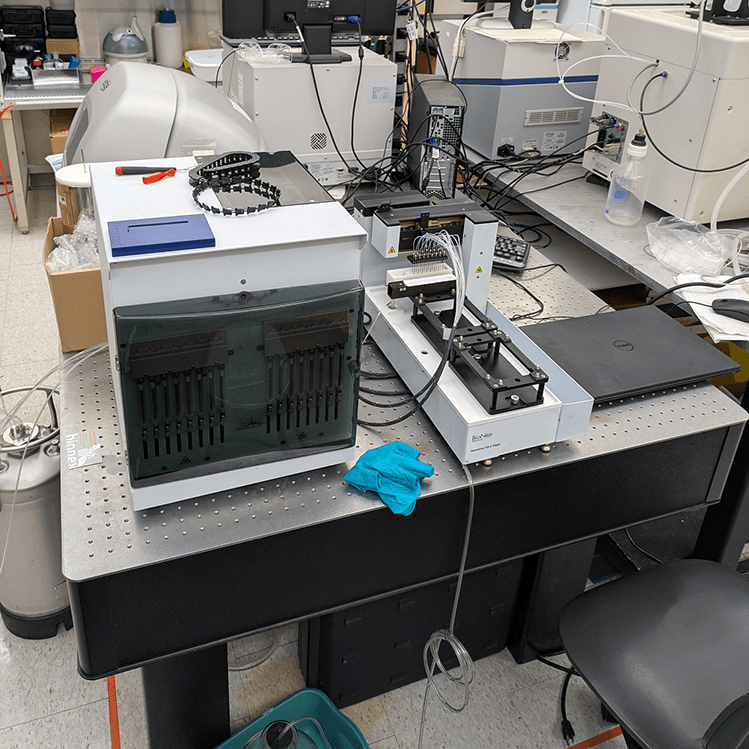
The BioNex NanoDrop Express represents a significant upgrade for the BGSU Center for Photochemical Sciences (CPS), moving beyond simple sample quantification to high-throughput discovery. While traditional NanoDrop units are often used for quick checks of DNA or protein concentration, the Express version is a 16-channel automated system designed for high-volume plate processing.
For a specialized research hub like BGSU CPS—which focuses on the interaction of light with matter—this system provides three primary layers of value:
1. High-Throughput Screening (HTS) of Photochemical Materials
The CPS is a world leader in developing new chromophores, solar energy conversion materials, and sensors.
Rapid Library Analysis: Researchers can screen 96- or 384-well plates of new dyes or quantum dots in minutes. Instead of measuring one sample at a time, the 16-channel head allows for parallel characterization of absorption spectra.
Reaction Optimization: For projects involving photocatalysis or solar water splitting, the system can quickly analyze hundreds of reaction conditions (varying pH, solvent, or catalyst concentration) to identify the most efficient "light-harvesting" configurations.
2. Precise Microvolume Management
The "NanoDrop" technology is famous for requiring as little as 0.1 µL to 1 µL of sample. At BGSU, this is critical for:
Rare or Expensive Compounds: Many of the custom-synthesized organometallic complexes or de novo designed proteins at CPS are produced in tiny quantities. This system allows for full UV-Vis characterization without "sacrificing" the bulk of the sample.
Direct-on-Plate Measurements: The Express system can dispense and aspirate directly into high-density plates, minimizing the risk of contamination or evaporation that often plagues volatile photochemical solvents.
3. Integration with CPS Core Research Areas
The specific technical specs of the BioNex NanoDrop Express align with several CPS research pillars:
CPS Research Pillar
Value of NanoDrop Express
Supramolecular Chemistry
Rapidly determining binding constants by measuring absorbance shifts across serial dilutions in a 384-well plate.
Biosensors & Bioreporters
High-speed screening of luminescent sensors for environmental monitoring across hundreds of water or soil extracts.
Crystallography
Assessing the purity and concentration of protein crystals or nanostructured materials before complex X-ray diffraction studies.
Photodynamic Therapy
Characterizing the light-absorption efficiency of new drug candidates at various concentrations to predict therapeutic windows.
Technical Advantage: The "Express" Difference
Unlike a manual NanoDrop, the BioNex NanoDrop Express is built for automation. It features:
16 Independent Channels: Allowing for simultaneous aspiration and dispensing.
Valve-Free Fluid Path: This reduces maintenance and prevents the "clogging" often seen with the complex suspensions (like YOx beads or cells) used in BGSU’s biological photochemistry labs.
Broad Solvent Compatibility: The FEP, stainless steel, and sapphire parts are compatible with the aggressive organic solvents often required to dissolve photochemical dyes.
In short, for BGSU CPS, this instrument isn't just a "ruler" to measure concentration; it’s a discovery engine that allows researchers to move from testing 10 compounds a week to testing hundreds per day.
Updated: 05/06/2026 05:21PM