
Applied Biosystems StepOne Plus
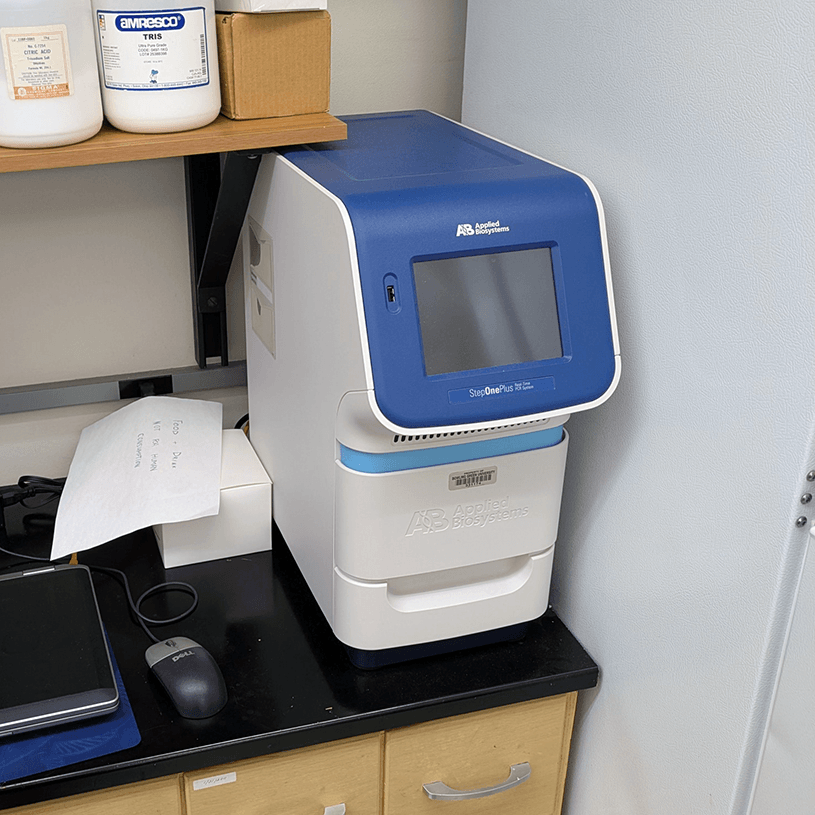
The Applied Biosystems StepOnePlus is a high-performance 96-well real-time PCR (qPCR) system that bridges the gap between pure chemistry and biological application at the BGSU Center for Photochemical Sciences (CPS).
1. Development of DNA/RNA-Based Photobiosensors
A major research pillar at BGSU CPS involves designing "smart" molecules that light up when they detect a specific target.
Aptamer Characterization: Many CPS labs work on DNA/RNA aptamers that change fluorescence upon binding. The StepOnePlus is used to quantify how effectively these sensors bind to their targets (e.g., heavy metals, toxins, or biomarkers) using High-Resolution Melting (HRM) analysis.
Label-Free Sensing: Researchers can test new RNA-based sensors to see how environmental factors (like light exposure or temperature) affect their structural stability and performance.
2. Environmental Photochemistry & Bioreporters
The CPS has significant expertise in how light affects microorganisms in the environment, particularly in Northwest Ohio’s aquatic systems.
Luminescent Bioreporters: Researchers use qPCR to measure gene expression in "bioreporter" bacteria—organisms engineered to produce light or a chemical signal when they encounter pollutants.
Pathogen Detection: In studies of Lake Erie's water quality, the StepOnePlus allows for the rapid quantification of toxic cyanobacteria (blue-green algae) by targeting specific DNA sequences related to toxin production.
3. Photodynamic Therapy (PDT) & Drug Delivery
Many CPS faculty investigate light-activated drugs that kill cancer cells or bacteria.
Gene Expression Profiling: After treating cells with a new photochemical drug and exposing them to light, the StepOnePlus is used to see which genes are turned "on" or "off" (e.g., pro-apoptotic genes that signal the cell to die).
Viral & Bacterial Load Analysis: For those working on light-activated antimicrobials, the system provides a precise count of how many viral or bacterial copies remain after a photochemical treatment.
Key Technical Values for the CPS Environment
Feature
Value to BGSU Research
4-Color LED Optics
Allows for multiplexing (detecting 4 different targets in one tube). This is vital for comparing a target gene against internal controls in complex biological samples.
VeriFlex™ Block
Provides 6 independent temperature zones. This is perfect for "method development"—allowing a student to test 6 different reaction temperatures in a single 40-minute run.
Fast Cycling (<40 min)
Accelerates the "Build-Test-Learn" cycle for graduate students, allowing for 5–10 runs in a single day compared to just 2 or 3 on older thermal cyclers.
HRM Capability
Essential for detecting single nucleotide polymorphisms (SNPs) or small structural changes in the DNA/RNA scaffolds used in photochemical sensors.
Summary of Impact
At the Center for Photochemical Sciences, the StepOnePlus is more than just a "biology tool." It is the primary instrument used to validate the biological efficacy of the new light-active chemicals being synthesized in the lab. It turns "This molecule glows in a test tube" into "This molecule successfully detects and quantifies 10 copies of a pathogen in a real-world sample."
Updated: 05/06/2026 05:21PM