
Horiba Fluorolog-3
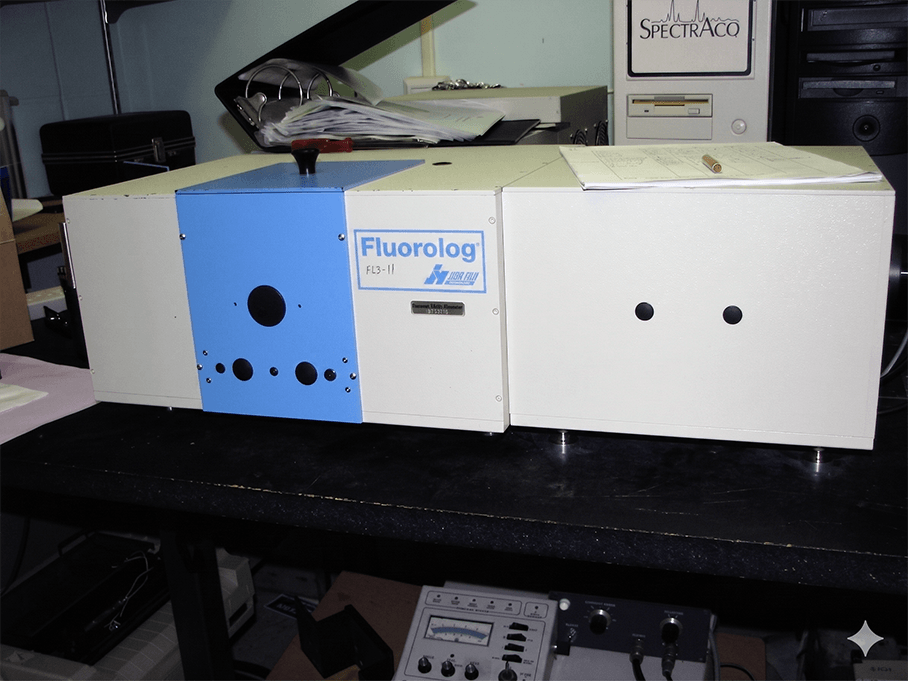
The Horiba Fluorolog-3 has been a cornerstone of the Center for Photochemical Sciences (CPS), providing the modularity and sensitivity required to maintain our status as a world leader in photochemical research. As an interdisciplinary hub, the CPS relies on the Fluorolog-3 to bridge the gap between fundamental molecular studies and advanced materials science.
Here is how this system has specifically benefited our department and research community:
## Unmatched Sensitivity for Precision Research
The Fluorolog-3 is renowned for its exceptional signal-to-noise ratio, which is critical for the low-yield luminescent samples often developed in our labs. It allows CPS researchers to:
Detect trace amounts of photoproducts that would be lost in the "noise" of standard instruments.
Characterize novel fluorophores and transition-metal complexes with high precision.
## Modular Versatility for Interdisciplinary Needs
The "modular" nature of the system is its greatest asset for a diverse center like ours. It has been adapted to meet the specific demands of various research groups:
Time-Resolved Studies: By integrating TCSPC (Time-Correlated Single Photon Counting) modules, we can measure fluorescence lifetimes down to the picosecond range.
NIR Expansion: The system’s ability to swap detectors allows our researchers to move beyond the visible spectrum into the Near-Infrared (NIR), essential for studying biological imaging agents and solar cell materials.
Solid-State Analysis: With specialized sample holders, the Fluorolog-3 facilitates the study of thin films and powders, supporting our work in organic photovoltaics and LEDs.
## A Catalyst for Global Recruitment and Collaboration
As we modernize the digital footprint of the CPS for our 40th Anniversary, the Fluorolog-3 serves as a premier example of our advanced facility capabilities.
Competitive Edge: Having research-grade instrumentation like the Fluorolog-3 makes our program more competitive globally, attracting top-tier graduate students and faculty.
Collaborative Hub: The instrument acts as a shared resource that fosters collaboration between the Department of Chemistry and external industrial partners, driving innovation in photophysics and photochemistry.
Updated: 05/06/2026 05:21PM