
Angstrom Engineering EvoVac system
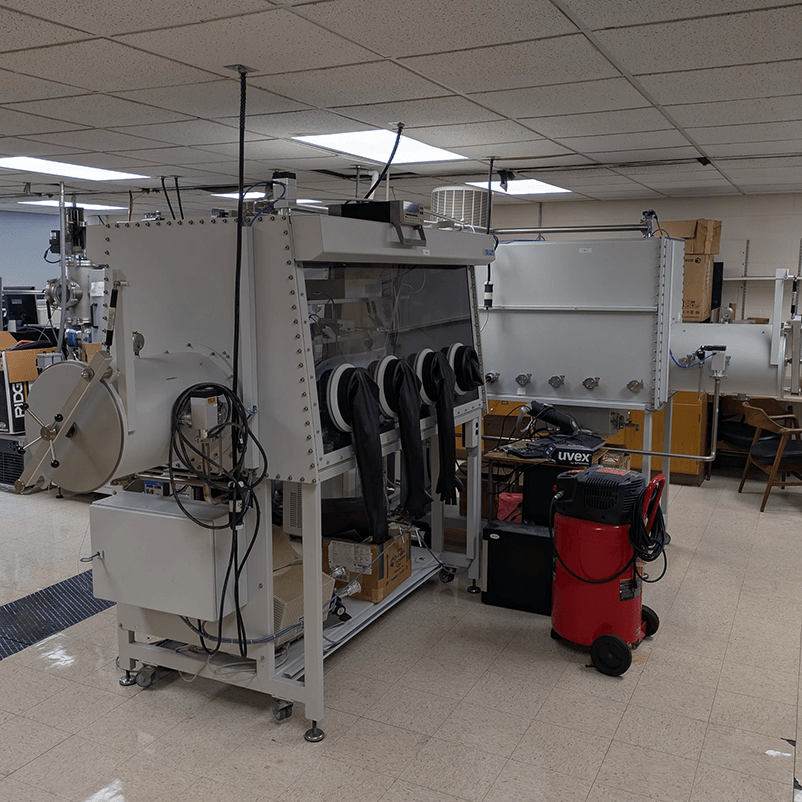
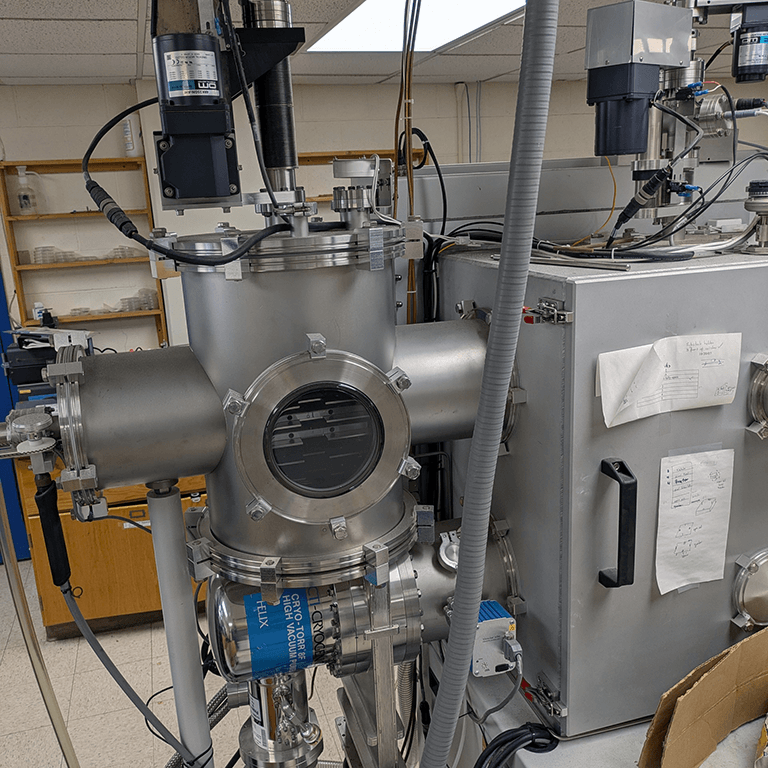
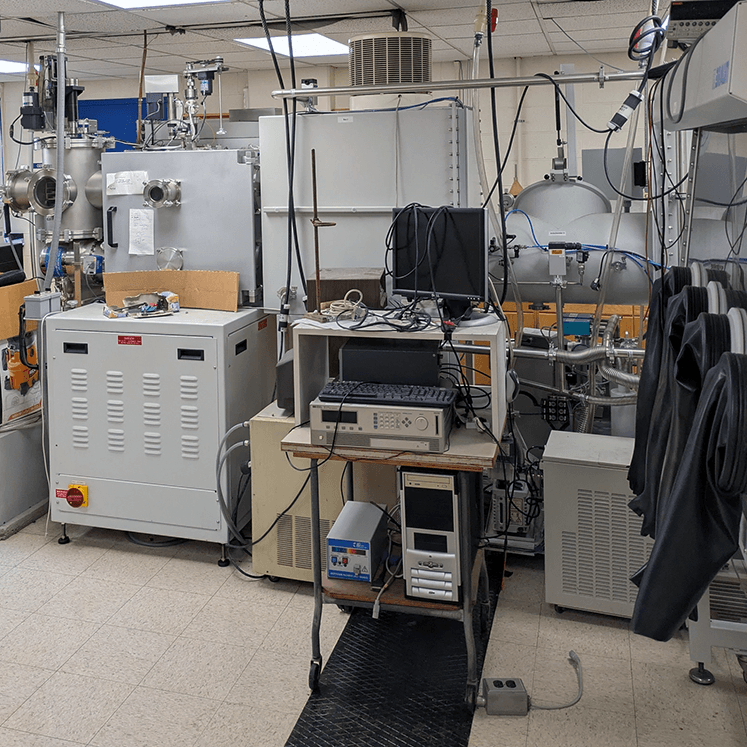
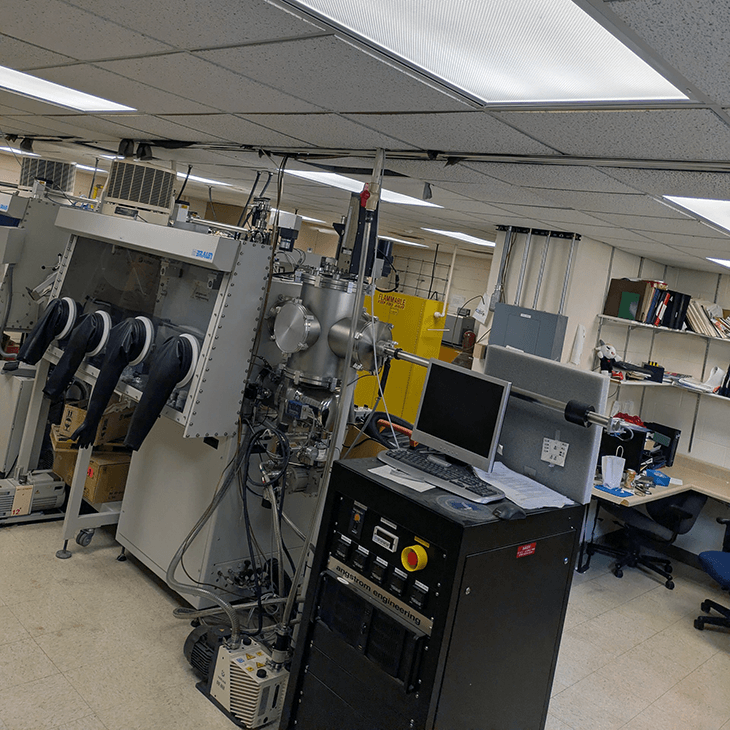
An Angstrom Engineering EvoVac system is a premier tool for thin-film deposition, offering the precision and purity required for the advanced materials research conducted at BGSU’s Center for Photochemical Sciences (CPS).
While the Waters HPLC system you were looking at manages liquid-phase chemistry, the EvoVac handles solid-state device fabrication, allowing researchers to move from synthesizing a molecule to building a functional optoelectronic device.
Key Advantages of the EvoVac Series
1. Ultra-High Vacuum (UHV) Environment
The "Evo" in EvoVac refers to its ability to reach deep vacuum levels, often in the $10^{-7}$ to $10^{-8}$ Torr range.
The Advantage: At these pressures, the "mean free path" (the distance a molecule travels before hitting another) is very long. This ensures that the evaporated material travels in a straight line from the source to the substrate without colliding with air molecules.
Impact on Purity: It minimizes the inclusion of oxygen or water vapor into the film, which is critical for organic electronics where even a few parts-per-million of oxygen can quench the photoluminescence of a newly synthesized dye.
2. Multi-Source Capability (Co-Deposition)
The EvoVac is designed to house multiple deposition sources—such as thermal evaporation boats and electron-beam (E-beam) guns—within the same chamber.
Direct Application: This allows for co-deposition, where two or more materials are evaporated simultaneously to create a "doped" layer. For CPS, this is how you create the active layer of an OLED or an Organic Photovoltaic (OPV) cell, precisely mixing a host polymer with a synthesized phosphorescent iridium complex.
3. Integrated Glovebox Compatibility
Most EvoVac systems are integrated directly into a nitrogen-filled glovebox.
The Workflow: Researchers can synthesize air-sensitive materials in the glovebox, load them into the PVD system, deposit the film, and then encapsulate the device—all without the sample ever touching the atmosphere. This is essential for the longevity and testing of perovskite solar cells or radical-based electronics.
4. Precision Thickness Control (Quartz Crystal Microbalance)
The system uses high-resolution sensors to monitor deposition rates in real-time.
The Precision: It can control film thickness down to the Ångström level ($0.1\text{ nm}$). In photophysics, the thickness of a layer dictates interference patterns and charge-carrier transport; the EvoVac ensures that the device made today is identical to the one made next month.
Direct Applications at BGSU CPS
The EvoVac acts as the "bridge" between molecular synthesis and device-level testing.
A. Fabrication of Solar Energy Harvesting Devices
CPS researchers synthesizing new sensitizers can use the EvoVac to deposit electron-transport layers ($C_{60}$ or $BCP$) and metallic contacts (Silver or Aluminum) to complete a solar cell. The system’s ability to handle masking allows for the creation of multiple test pixels on a single glass slide.
B. Thin-Film Photophysics
For groups studying Singlet Fission or Exciton Diffusion, the EvoVac allows for the creation of "neat" films of purified molecules (purified via your Waters HPLC). These vacuum-deposited films are often more highly ordered and reproducible than spin-coated films, leading to better-defined spectroscopic data.
C. Surface-Enhanced Spectroscopy
By using the E-beam source, researchers can deposit nanometer-thin layers of gold or silver to create substrates for Surface-Enhanced Raman Spectroscopy (SERS), allowing for the detection of photochemical intermediates at the single-molecule level.
Updated: 05/06/2026 05:21PM