
Olympus Fluoview FV1000
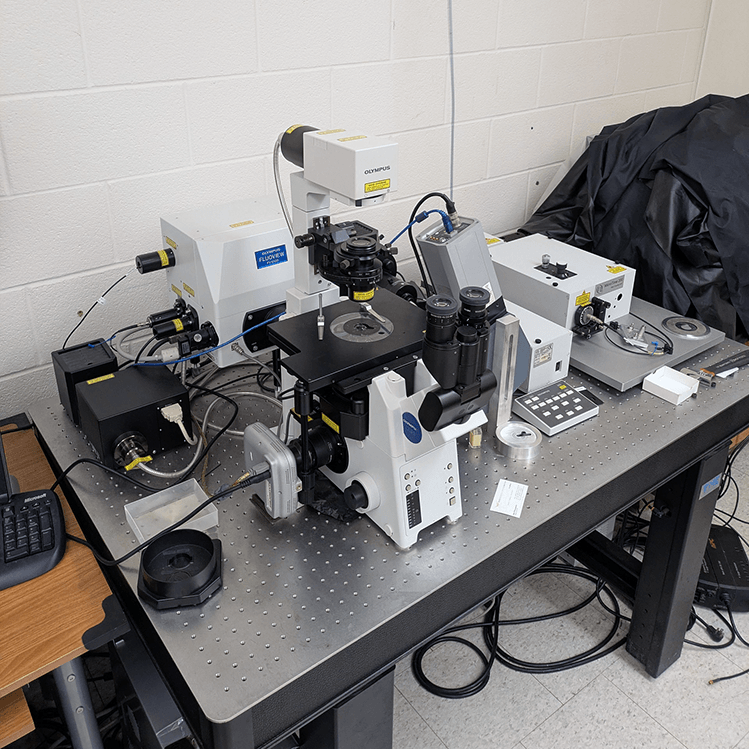
Unlock the Invisible: Precision Imaging with the Olympus FV1000
The Olympus Fluoview FV1000 stands as a cornerstone of confocal laser scanning microscopy, engineered for researchers who refuse to compromise on sensitivity or spatial resolution. Designed to bridge the gap between static observation and dynamic discovery, the FV1000 provides a high-performance platform for probing the complexities of biological systems.
Why Choose the FV1000?
Superior Signal-to-Noise Ratio: Advanced optical paths maximize photon collection while minimizing background noise.
Precision Control: Integrated hardware allows for sub-micron accuracy in Z-stacking and region-of-interest (ROI) scanning.
Multi-Channel Versatility: Simultaneous detection of multiple fluorophores ensures high-throughput data collection without the risk of spectral bleed-through.
Key Applications & Research Capabilities
The FV1000 is more than just a microscope; it is a specialized tool for high-impact biological analysis.
1. Dynamic Live Cell Imaging
Track life as it happens. From protein trafficking to the rapid mechanics of cell division, the FV1000 offers the stability and speed required to capture real-time signaling events without significant phototoxicity.
2. Advanced 3D Reconstruction & Volumetric Analysis
Go beyond the slide. By capturing precise Z-stacks, the system allows researchers to build intricate 3D models of thick samples, providing a holistic view of tissue architecture and multicellular organisms.
3. High-Resolution Co-localization
Determine spatial relationships with confidence. The FV1000’s sophisticated filtering allows for the simultaneous imaging of multiple labels, proving whether your targets of interest truly share the same subcellular space.
4. Molecular Interaction Studies (FRET & FRAP)
FRET: Measure molecular "handshakes" at the nanometer scale to observe protein-protein interactions.
FRAP: Bleach specific areas to study membrane fluidity and protein mobility, quantifying how molecules move within their environment.
5. Photoactivation & Photoswitching
Take control of your fluorophores. Selectively activate or "switch" fluorescent proteins in specific regions to track lineage or monitor the movement of a specific protein population over time.
6. High-Definition Fixed Tissue Imaging
Achieve publication-quality results with immunofluorescently stained histological sections. The FV1000 excels at resolving deep structures within fixed samples, ensuring every detail of your staining is captured with clarity.
The FV1000 Advantage: Whether you are investigating the mobility of a single molecule or the architecture of an entire organoid, this system provides the flexibility and power to turn your hypotheses into visual evidence.
Updated: 05/06/2026 05:21PM