
GE/Sievers Nitric Oxide Analyzer
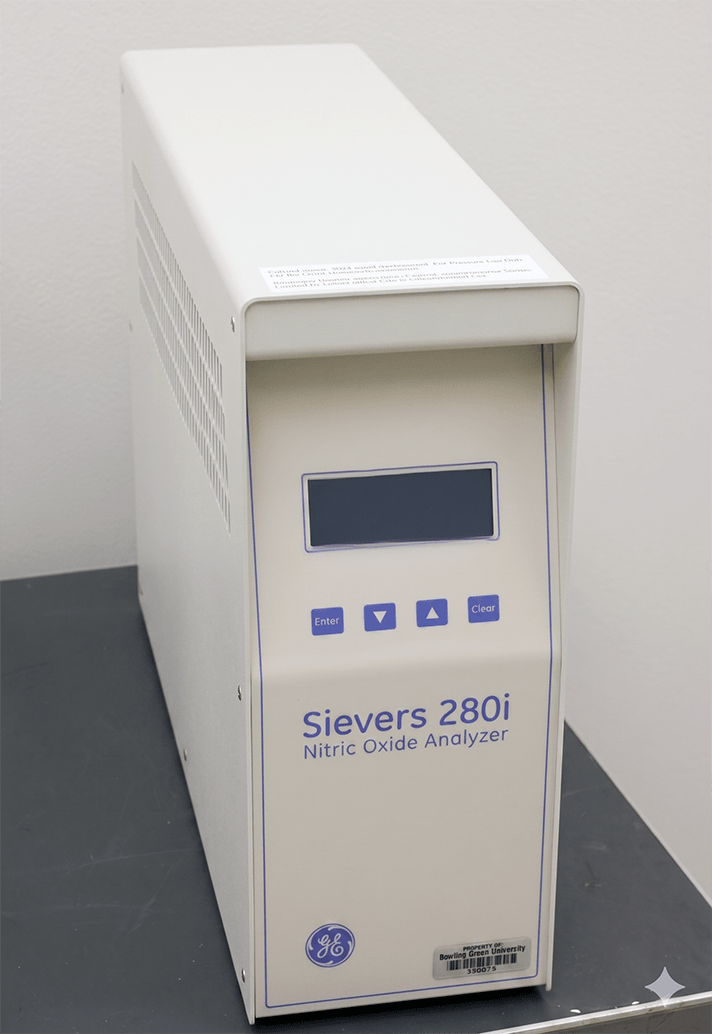
The GE/Sievers Nitric Oxide Analyzer (NOA 280i) is a highly sensitive detection system that provides the Center for Photochemical Sciences with the ability to measure nitric oxide (NO) and its various derivatives in both liquid and gas phases. In the realm of photochemistry, NO is a critical signaling molecule and a frequent byproduct of light-activated reactions, making this analyzer an indispensable tool for our interdisciplinary research.
By utilizing ozone-chemiluminescence technology, the NOA 280i offers a level of sensitivity—down to picomolar levels—that standard spectroscopic methods cannot achieve.
## Critical Benefits to the CPS
Detection of Photo-Triggered NO Release: Many CPS researchers develop "photo-NO donors"—molecules that release nitric oxide upon exposure to specific wavelengths of light. The NOA 280i allows for the real-time quantification of this release, which is vital for developing targeted therapies in photomedicine.
Analysis of Nitrogen Species in Biological Media: The system’s ability to measure nitrite ($NO_2^-$), nitrate ($NO_3^-$), and nitrosothiols ($RSNO$) in complex fluids (like cell culture media or blood plasma) allows our scientists to track the metabolic fate of photochemical compounds in biological systems.
Atmospheric & Environmental Modeling: Nitric oxide plays a key role in atmospheric photochemistry and the formation of ozone. The NOA 280i supports our environmental research by providing high-precision gas-phase measurements of NO, helping to model the photochemical interactions that occur in our atmosphere.
Rapid, High-Sensitivity Quantitation: With the ability to analyze samples in less than a minute and requiring only microliter volumes, the system enables high-throughput screening of new photochemical catalysts and nitrogen-based compounds.
## Key Technical Capabilities
Detection Limit
Sensitivity down to 1 picogram of NO.
Purge Vessel System
Facilitates the conversion of liquid-phase NO derivatives into gas-phase NO for accurate measurement.
Dual-Phase Versatility
Seamlessly switches between exhaled gas/headspace analysis and liquid sample analysis.
Broad Dynamic Range
Measures concentrations from nanomolar to millimolar levels, accommodating diverse experimental scales.
## Strategic Impact at the Center
For 40 years, the CPS has been at the forefront of light-matter interaction. The GE/Sievers Nitric Oxide Analyzer strengthens this mission by:
Enabling Medical Innovations: Supporting the development of light-activated "smart" drugs for cardiovascular and oncological research.
Cross-Disciplinary Synergy: Serving as a bridge between our chemistry, biology, and environmental science faculty by providing a universal standard for nitrogen detection.
Academic Excellence: Providing graduate students with experience on a "gold-standard" instrument that is cited in over 10,000 global research publications, ensuring they are prepared for high-level research careers.
Researcher Note: The NOA 280i requires a specialized vacuum pump and ozone generator for operation. Please ensure the "Zero Air" filter is checked before beginning gas-phase calibration.
Updated: 05/06/2026 05:21PM