
Lambda Physik Excimer Laser
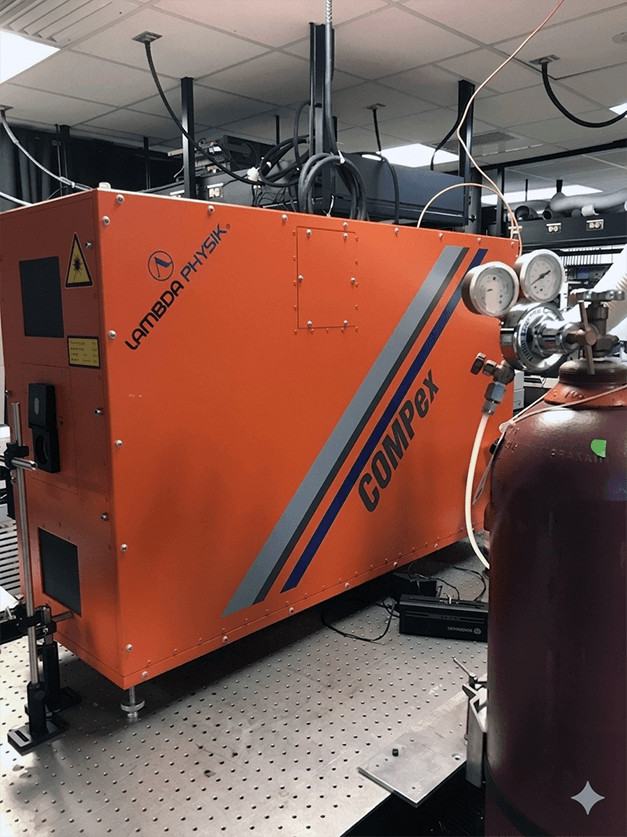
The Lambda Physik Excimer Laser is a premier high-energy ultraviolet (UV) source that provides the Center for Photochemical Sciences with the intense, short-duration pulses necessary for advanced photochemical triggering and materials processing. Unlike solid-state lasers, the excimer (short for "excited dimer") uses a noble gas halide mixture to produce powerful discrete wavelengths in the deep UV, such as 193 nm (ArF), 248 nm (KrF), or 308 nm (XeCl).
This system is particularly valued at the CPS for its ability to initiate chemical reactions that require high-energy photons to break stable molecular bonds.
## Research Benefits & Impact
Laser Flash Photolysis (LFP): The Lambda Physik serves as a critical excitation source for time-resolved spectroscopy. Its nanosecond pulses are used to "pump" a sample, creating short-lived transient species like radicals or triplet states. This allows CPS researchers to study reaction mechanisms that occur on a microsecond to nanosecond timescale.
Precision Polymer Ablation: In the field of materials science, the UV output of the excimer laser is used for "cold ablation." Because the photon energy is high enough to directly break organic polymer bonds (rather than heating them), it allows for the high-precision micro-structuring of surfaces without thermal damage to the surrounding area.
Pulsed Laser Deposition (PLD): The laser is instrumental in creating novel thin films. By ablating a target material with high-energy UV pulses, a plasma plume is created that deposits a thin, uniform layer of material onto a substrate—a technique vital for developing new solar cell components and sensors.
Initiation of Rapid Polymerization: For researchers studying photocuring and dental or industrial coatings, the excimer laser provides the high-intensity burst needed to trigger rapid, large-scale polymerization, allowing for the study of kinetics in highly reactive systems.
## Key Technical Capabilities
Deep UV Wavelengths
Access to high-energy photons (e.g., $6.4$ eV at $193$ nm) for direct bond cleavage.
High Pulse Energy
Capable of delivering hundreds of millijoules per pulse, essential for non-linear processes.
Beam Homogeneity
Designed to provide a uniform energy distribution across the laser spot, critical for consistent material processing.
Wavelength Tunability
By changing the gas mixture (e.g., from KrF to XeCl), the system can be adapted for different absorption profiles.
## Strategic Value to the CPS
As an interdisciplinary center, the presence of a Lambda Physik excimer laser reinforces the CPS's position as a leader in Ultrafast and High-Energy Spectroscopy.
Versatility Across Disciplines: It serves as a shared resource for chemists synthesizing new photoinitiators and physicists studying light-matter interactions in semiconductors.
Industrial Relevance: Mastery of excimer laser systems is a highly sought-after skill in the semiconductor and medical device industries, ensuring that CPS students are trained on the same technology used in microchip lithography and LASIK eye surgery.
Reliability for Long-Term Data: Known for robust engineering and stable pulse-to-pulse energy, the system ensures that experimental results are reproducible over long data-acquisition sequences.
Safety Reminder: Excimer lasers utilize toxic gases (such as Fluorine or Chlorine) and produce high-power UV radiation. Operation must strictly follow departmental safety protocols, including gas cabinet monitoring and the use of UV-rated protective eyewear.
Updated: 05/06/2026 05:21PM