
Bloom's Revised Taxonomy Alignment Table
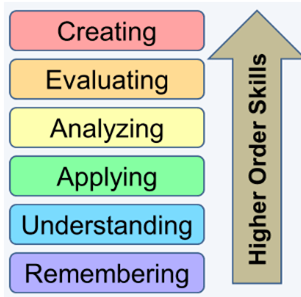
Learning outcomes (LOs) should be measurable to be transparent for students about learning expectations. To help write measurable LOs, we recommend using a Bloom's Revised Taxonomy action verb at the highest level you want students to achieve the concept. The table below starts with the lowest cognitive complexity level in Bloom's taxonomy (Remember) and proceeds to the highest (Create). The table includes a column of learning outcome verbs. To help you identify the cognitive complexity level for your LO, the table also includes columns for instructional strategies, assessment questions, and assessment levels.
| Cognitive Level | Learning Outcome Verbs: Students will be able to... | Instructional Strategies: Startegy properly implemented | Assessment Questions: Specific content to be learned is communicated | Assessment Methods: Well designed assessment aligned with learning outcome(s); may be formative or summative |
| Remember |
RECALL INFORMATION Count, Choose, Define, Draw, Find, Identify, Label, List, Match, Name, Quote, Recall, Recite, Sequence, Tell, Write, Reproduce, Select, State | Lecture, Interactive Lecture, Recitation, Just-In-Time Teaching, Focused Listing, Minute Paper, Mnemonics, Rehearsal, Rote Memorization | What does it mean…? What is the best one? When…? Which one…? Who/What…? Define… Identify… List…. Name… | Quizzes, Tests, Question/Answer Sessions, In-Class Polls, Minute Papers, Focused Listening, Memory Matrix |
| Understand |
EXPLAIN IDEA(S) or CONCEPT(S) Conclude, Convert, Demonstrate, Discuss, Explain, Estimate, Generalize, Identify, Illustrate, Interpret, Paraphrase, Report, Restate, Review, Summarize, Translate, Tell | Interactive Lecture, Recitation, Directed Discussion, Writing/Speaking Exercises, Group Work or Learning, Student-Peer Feedback, Cookbook Science Labs, Just-In-Time Teaching, Project Based Learning, Role Play/Simulations, Case Studies | How will you illustrate…? Which one is true? Is ___ the same as ___? Write in your own words? Draw a graph. Explain…. Give an example of….. Interpret the results of …. Match the following….. | Quizzes, Tests, Essays, Question/Answer Sessions, In-Class Polls, Minute Papers, Dual Entry Journals, Graphic Organizers, Concept Maps, Muddiest Point Paraphrase, Summaries, Misconception/Preconception Check, Empty Outline |
| Apply |
USE INFORMATION IN ANOTHER SITUATION Act, Apply, Assess, Change, Compute, Demonstrate, Determine, Develop, Draw, Imitate, Implement, Include, Inform, Instruct, Interview, Prepare, Produce, Relate, Select, Show, Solve, Transfer, Use, Utilize | Writing/Speaking Exercises, Cookbook Science Labs, Case Studies, Inquiry Based or Inquiry Guided, Problem-Based Learning, Project-Based Learning, Role Play/Stimulations, Service Learning with Reflection, Fieldwork, Clinical, Games | Apply….? Identify the result of…? Which is the best answer/solution? Calculate…. Complete the following… Determine…. Solve…. | Quizzes, Tests, Essays, Question/Answer Sessions, In-Class Polls, Minute Papers, Dual Entry Journals, Summaries, Presentations, Projects, Reflection Papers, Class Modeling |
| Analyze |
BREAK INFORMATION INTO PARTS Analyze, Break Down, Characterize, Classify, Compare, Contrast, Correlate, Debate, Deduce, Diagram, Differentiate, Distinguish, Examine, Illustrate, Infer, Relate, Research, Separate, Subdivide | Debates, Discussions, Hypothetical Scenarios, Just-In-Time Teaching, Writing/Speaking Exercises, Student-Peer Feedback, Case Studies, Inquiry Based or Inquiry Guided, Problem-Based Learning, Project-Based Learning, Role Play/Stimulations, Service Learning with Reflection, Fieldwork, Clinical, Games, Debates, Practice by Doing | What are the different parts of….? What are the possible outcomes of…? What is the relationship between….? Compare the different components of…. Point out some of the problems with…? | Essays, Minute Papers, Dual Entry Journals, Summaries, Presentations, Projects, Reflection Papers, Research Papers, Analytic Memo, Categorization Grid, Defining Features Matrix, Content/Form/Function (What/How/Why) Outlines, Word Journal, One-Sentence Summary |
| Evaluate |
JUSTIFY A DECISION OR COURSE OF ACTION Appraise, Argue, Assess, Choose, Compare & Contrast, Conclude, Critique, Decide, Defend, Evaluate, Interpret, Judge, Justify, Predict, Prioritize, Prove, Rank, Rate, Reframe, Select, Support | Writing/Speaking Exercises, Student-Peer Feedback, Case Studies, Inquiry Based or Inquiry Guided, Problem-Based Learning, Project-Based Learning, Role Play/Stimulations, Service Learning with Reflection, Fieldwork, Clinical, Games, Debates, Practice by Doing, Discussions, Debates | Which of the following will be best to…? What outcome do you predict will occur…? Why did you choose this option? What is your conclusion and explain how you came to that conclusion? Recommend… | Essays, Question/Answer Sessions, Minute Papers, Dual Entry Journals, Summaries, Presentations, Projects, Reflection Papers, Research Papers, Portfolios, Article Critiques, Pros & Cons Grid, Inverted Dialogues, Approximate Analogies ,Student Generated Test Questions, Paper/Project Prospectus. |
| Create |
GENERATE A NEW IDEA OR PRODUCT Adapt, Collaborate, Combine, Compile, Compose, Construct, Design, Develop, Devise, Initiate, Integrate, Invent, Formulate, Generate, Make, Modify, Organize, Perform, Plan, Produce, Propose | Create a Case Study, Conduct Research, Capstone Projects, Cooperative learning Activities, Role Play, Writing Assignments, Debates | How else can you solve this problem? How would you adapt…to this (new setting, new problem, etc.)? How would you change this hypothesis? Given these facts, formulate a new response/answer… Propose an alternative solution. | Presentations, Create (wiki, blog, composition, artwork, etc.), Projects, Research Papers, Portfolios, Theater Performance, Concept Map |
References: Anderson, L.W. & Krathwohl, D.R. (2001). A taxonomy for learning, teaching, and assessing: A revision of Bloom’s taxonomy of educational objectives. New York: Longman. Angelo, T. A., & Cross, K.P. (1993). Classroom assessment techniques: A handbook for college teachers (2nd ed.). San Francisco: Jossey-Bass. Barkley, E. F., Cross, K.P, & Major, C.H. (2005). Collaborative learning techniques: A handbook for college faculty. San Francisco: Jossey-Bass. Nilson, L.B. (2010). Teaching at its best: A research-based resource for college instructors. San Francisco: Jossey-Bass.
The original slide was licensed under the Creative Commons Attribution-NonCommercial 4.0 international License and developed by Dr. Adam Persky and Dr. Todd Zakrajsey; University of North Carolina at Chapel Hill.
Updated: 06/05/2026 01:05PM