
Composer Portrait:
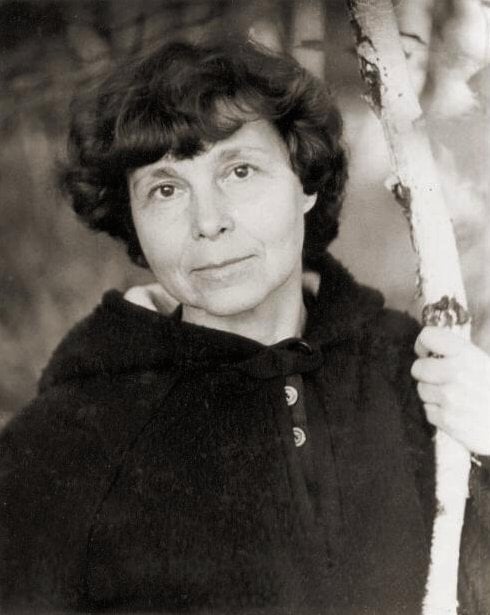
Sofia Gubaidulina
From the BGSU College of Musical Arts DMA Program
Thursday, September 18, 2025
8:00 P.M. Bryan Recital Hall
Moore Musical Arts Center
Program
Duo Sonata for baritone saxophones (1977) | Sofia Gubaidulina (1931–2025)
Jake Loitz & Sam Valancy, saxophone
Cello Preludes nos. 3, 5 and 7 (1974) | Sofia Gubaidulina
Anthony Marchese, cello
Klänge des Waldes (Sounds of the Forest) (1978) | Sofia Gubaidulina
Shannon Lotti, flute; Stephen Eckert, piano
Vivente–non vivente (1970) | Sofia Gubaidulina
Chaconne (1962) | Sofia Gubaidulina
Niayesh Javaheri, piano
Aus den Visionen der Hildegard von Bingen (From the Visions of Hildegard von Bingen) (1994) | Sofia Gubaidulina
Katherine Pracht-Phares, mezzo-soprano
Tonight's program was curated by DMA student Stephen Eckert
Program Essays
The portrait of Sofia Gubaidulina on the cover of a 2007 biography presents the composer in profile, the matted golden-yellow background evoking the tempera of Russian Orthodox iconography. Here is the composer as musical mystic, a nod to Gubaidulina’s lifelong passion for fusing the sacred and the sonic. This passion is evident in works from the 1980s, 90s, and 2000s like Offertorium (a violin concerto), the St. John Passion, and Rejoice! (a sonata for violin and cello), which have captured the ears and imaginations of audiences worldwide. Gubaidulina’s music, however, was not always so widely venerated.
During the 1970s—the decade in which most of tonight’s works were composed—Gubaidulina occupied a tenuous position within Soviet society. Despite successes in the late 1950s at the Moscow Conservatory, where she studied piano before switching to composition, Gubaidulina’s urge to experiment left her at odds with the state-sanctioned ideology of “official” music. Moreover, her shy, reclusive temperament meant she was ill-suited for teaching. As a result, Gubaidulina largely relied on film scoring to support her work as an independent composer for the better part of two decades.
Gubaidulina’s career, one scholar has noted, was marked by a “persistent search for particular sound effects and new, striking instrumental timbres.” This search led the composer in different directions in the 1970s. In the later part of the decade, Gubaidulina took part in an improvisation group that explored the sonic possibilities of folk instruments from Armenian, Uzbek, and other ethnic traditions. Earlier, she used the graphical ANS Tone Synthesizer designed by Evgeny Murzin of Moscow’s Scriabin Museum to compose Vivente–non vivente (Living–non-living), which slowly transforms naturals sounds and noises such as laughter, sighs, bells, and choirs into synthesized sounds, and vice versa. Even her compositions for more standard Western instruments at this time—pieces such as Five Etudes for Harp, Double Bass, and Percussion; Ten Preludes (originally Etudes) for Solo Cello; and Concerto for Bassoon and Low Strings—reflect a relentless curiosity.
Like Alfred Schnittke, Edison Denisov, and other nonconformist composers working behind the Iron Curtain, Gubaidulina found that performance opportunities were limited by her avant-garde aesthetic. The control exerted by the Composers Union over Soviet musical life meant that her works often were limited to a single performance by sympathetic collaborators or, in the case of her larger compositions, not allowed to be performed at all, consigned instead to the drawer. In 1979, with her music officially blacklisted by the Composers Union, Gubaidulina embarked on the risky (but ultimately successful) process of smuggling her music abroad. Tonight’s concert pulls back the curtain and opens the drawer, offering a portrait of Gubaidulina before perestroika, when she was developing her voice as a composer and finding her singular, visionary path.
—Ryan Ebright ©2025
By the time of her death this past March at the age of 93, Sofia Gubaidulina was revered as a composer of religious, modernist, and folk-inspired music. A more fitting title than composer, however, might be a weaver of sound. Gubaidulina draws together various threads in her music, the most prominent of which are timbre and orchestration. My colleague, saxophonist Jake Loitz, describes the Duo Sonata for baritone saxophones (originally for bassoons) as “distinctly Gubaidulina in its acoustic presence.” “The two performers,” he says, “weave in and out of each other’s sounds in such a way that it sounds like a much larger ensemble, even with just two players.” Duo Sonata is structured in three distinct sections. The first features droning chromatic pitches from one saxophonist while the other plays a rhythmically and registrally expressive line. The second section highlights multiphonics and free rhythms, culminating in a chromatic ascent to high A, before both parts converge in a climactic multiphonic and transition into a final section that echoes the opening material. I find the organization of material through texture to be a staple of Gubaidulina that makes the Duo Sonata a signature part of her repertoire.
Where the Duo Sonata uses multiple instruments to create a sonic tapestry, Gubaidulina’s Aus den Visionen der Hildegard von Bingen for contralto voice and her Ten Cello Preludes explore the timbral possibilities of solo instruments. The former calls for the singer to alternate between “singing with respiratory sounds,” singing, and “between whispering and singing.” Gubaidulina’s signature timbral shifts weave through this piece and make it incredibly challenging to perform but wonderfully interesting to observe. In the latter, we hear the cello treated as a sound world unto itself. This is, perhaps, my favorite piece on the program.
Prelude No. 3, titled con sordino - senza sordino (Italian terms meaning “with mute” and “without mute,” respectively) plays on striking differences in tone, reserving the mute for the lower register of the instrument while letting the cello freely sing in its upper register without the mute. No. 5 is titled Sul ponticello ordinario sul tasto. These Italian markings reference the placement of the bow: sul ponticello asks the performer to bow their instrument near the bridge while sul tasto asks the performer to bow near the fingerboard. Finally, ordinario indicates that the performer should bow their instrument normally. Again, Gubaidulina spins out several timbral threads: while bowing near the bridge, the tone becomes raspy or airy; in the second half of the piece, which is played on the fingerboard, the tone immediately becomes soft and gentle. Finally, Prelude No. 7 is titled Al taco - da punta d’arco. This movement focuses on the cellist alternating between playing at the frog and at the tip of the bow. By pairing the low register and performing at the frog of the bow, Gubaidulina creates a short, harsh, and aggressive tone. The end of the piece transitions into bowing with the tip of the bow, and the tone shifts from harsh to gentle. While the tone is lighter, there is also a lack of depth and grit. I find these short works to be universally exciting and attainable to any listener. Sofia Gubaidulina is an expert of threading together varying textures and the Ten Cello Preludes best exemplify her style, making them a personal favorite of mine.
—Will Hermanowski ©2025
The DMA in Contemporary Music at BGSU
The DMA in Contemporary Music program at BGSU develops versatile musicians through a concentrated focus on contemporary music. The degree is grounded in the applied study of music performance or composition, and multidisciplinary seminars in culture, digital media and music cognition. Its flexible curricular programming fosters critical analysis, creative examination, pedagogical training, professional development and traditional as well as nontraditional performing experiences. Graduates of the program have been recipients of major grants and awards and maintain leadership positions at the forefront of contemporary music around the world as performing musicians, scholars, and teachers. More information about the DMA program is available here.
Updated: 04/13/2026 05:27PM