
47th Annual New Music Festival
Welcome to the 47th Annual New Music Festival!
Bowling Green State University is proud to welcome
JULIA WOLFE
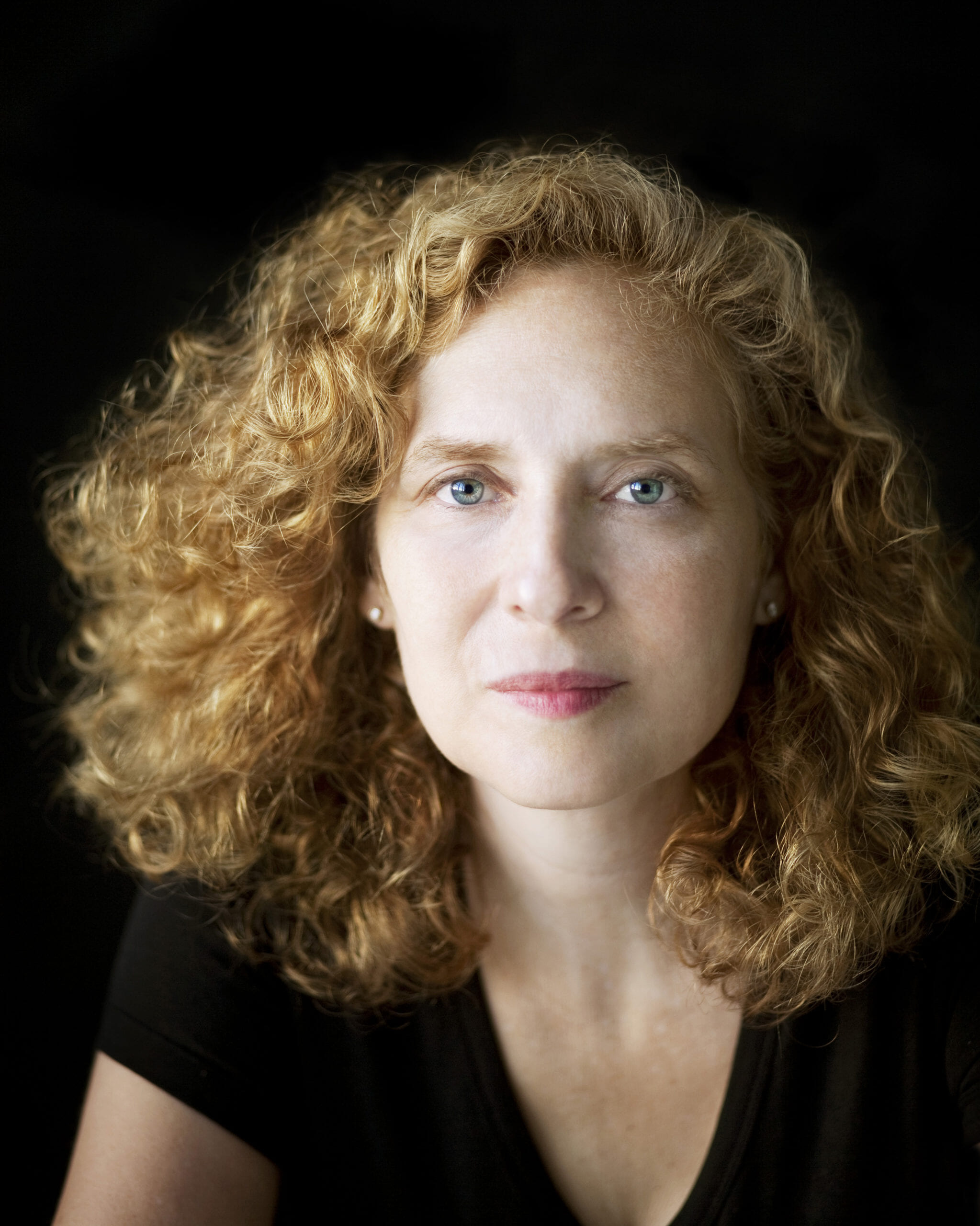
Julia Wolfe’s music is distinguished by an intense physicality and a relentless power that pushes performers to extremes and demands attention from the audience. She draws inspiration from folk, classical, and rock genres, bringing a modern sensibility to each while simultaneously tearing down the walls between them.
Wolfe’s recent premieres include Liberty Bell, premiered by the Houston Symphony in September 2025 — co-commissioned by the Houston Symphony, Pittsburgh Symphony, Philadelphia Orchestra, Carnegie Hall, the Grant Park Music Festival, and the Nashville Symphony. The work celebrates the iconic Liberty Bell — a major symbol of American democracy. Taking the bell’s inscription literally, “unto all the inhabitants thereof”, the proclamation speaks to all who reach for the promise of liberty.
Pretty, premiered in June 2023 by conductor Kirill Petrenko and the Berlin Philharmonic. Co-commissioned by the Berlin Philharmonic, Houston Symphony, Philadelphia Orchestra, and the St. Louis Symphony Orchestra, Pretty is a raucous celebration — embracing the grit of fiddling, the relentlessness of work rhythms, and inspired by the distortion and reverberation of rock and roll.
unEarth, commissioned and premiered in June 2023 by the New York Philharmonic, is a large-scale work for orchestra, men’s chorus, and children’s chorus that addresses the climate crisis. Performed in three movements, the 40 minute piece is realized with spatial staging and scenic design projected on a large circular screen.
Her Story, a 45-minute semi-staged work for orchestra and women’s chamber choir, received its world premiere in September 2022 with the Nashville Symphony, conductor Giancarlo Guerrero, the vocal ensemble Lorelei, and stage direction by Anne Kauffman. Co-commissioned by the Nashville Symphony, Chicago Symphony Orchestra, Boston Symphony Orchestra, San Francisco Symphony, and National Symphony Orchestra, Her Story invokes the words of historical figures and the spirit of pivotal moments to pay tribute to the centuries of ongoing struggle for equal rights and representation for women in America.
In addition to receiving the 2015 Pulitzer Prize in Music, Wolfe was a 2016 MacArthur Fellow. She received the 2015 Herb Alpert Award in Music, and was named Musical America’s 2019 Composer of the Year. Julia Wolfe is co-founder/co-artistic director of New York’s legendary music collective Bang on a Can, and she is Artistic Director of NYU Steinhardt Music Composition.
Her music is published by Red Poppy Music and G. Ricordi & Co., New York (ASCAP) and is distributed worldwide by the Universal Music Publishing Group.
East Broadway, Julia Wolfe
Kai Frueh, toy piano
Sonnets, Robert Honstein
i. Love, though for this you riddle me with darts
ii. I think I should have loved you presently
vi. Only until this cigarette is ended
iv. Oh, my beloved, have you thought this
Sarah Luebke, soprano
Yevgeny Yontov, piano
Jonathan Ovalle, percussion
Fear of Flying, Gemma Peacocke
Gloria Pan, flute
Let me Come in, David Lang
Jenna Diem, soprano
Francisca de Castanheiro de Freitas, piano
The Blue Studio, Stephen Hartke
Caroline Chin, violin
Brian Snow, cello
Solungga Liu, piano
East Broadway is a work for toy piano with boombox in one movement. The toy piano is juxtaposed with a tape reminiscent of a malfunctioning 1980s ‘boombox’ conjuring both nostalgia and humor. The composer uses the toy piano as a loud percussion instrument with the boombox bringing the energy of rock.
Ever since a quixotic beauty caught the eye of an itinerant, 14th century ex-priest, the sonnet has been to poetic expressions of love as bread is to butter. It is an almost protean form, something so innate that whether or not Petrarch fell for his Laura a similar structure would surely have emerged in some other guise at nearly the same time. While the language and style of sonneteers continuously evolves, this timeless form has retained its grip on poetic minds for centuries. From Shakespeare and Donne to Rilke and Neruda, the sonnet persists as a deft expression of human experience in all its vicissitudes. Into the pressure cooker of its compact formal apparatus, the complexity, ambiguity and chaos of humanity emerges reshaped and reborn into powerfully concise, crystalline poetic expression.
Writing in the first half of the 20th century, Edna St. Vincent Millay vigorously takes up this tradition. At a time of high poetic modernism, Millay injects the ancient form with vitality and stylistic ingenuity. In her hands the sonnet feels fresh and urgent. The words are organic and vital, yet also surgically precise in their layered meaning, wit and sheer beauty. Millay’s sonnets are shifting and bold, fearlessly expressing a radically feminine perspective, while at the same time gesturing towards universal themes of love and desire. In writing my piece, Sonnets, I primarily wanted to foreground Millay’s brilliant words. The poetry is so good, so captivating, direct and powerful that it seemed my job, as composer, was simply to provide a musical scaffolding for Millay’s candescent verse. To that end I’ve put together five songs that hopefully allow you to appreciate and be moved by these beautiful words.
Fear of Flying (in broken Gilbertese), by Teresia Teaiwa
I maaku
You told me ba ko tangirai
I maaku
I maaku
My arms were awkward so ko taua baiu
I maaku
I maaku
The dancer trembles because te ruoia is a kind of sorcery
I maaku
I maaku
The frigate birds fly high above us and I’m afraid of falling
I maaku
Gilbertese is an Oceanic language spoken in the islands of Kiribati in the South Pacific. The word Kiribati is a transliteration of the country's former European name, "Gilberts." Gilbertese is also spoken by most inhabitants of Nui (an island of Tuvalu), Rabi Island (part of Fiji), and in places to which I-Kiribati emigrated or were relocated because of British phosphate mining.
Dr Teresia Teaiwa (1968-2017) was a Pacific Studies scholar and poet. Born in Hawai’i to I-Kiribati and African-American parents, Teaiwa was raised in Fiji, studied in the United States, and in 2000 emigrated to New Zealand where she became the director of Va’aomanū Pasifika at Victoria University of Wellington. A feminist activist and pacifist, Teaiwa was an acclaimed teacher and part of the Niu Waves Writers’ Collective, the Nuclear Free and Independent Pacific Movement and the Citizens’ Constitutional Forum. Dr Teaiwa died of cancer in 2017 at the age of 48.
let me come in was written for the soprano Angel Blue, co-commissioned by LA Opera and the Fisher Center at Bard College. let me come inis part of a series of pieces I have been writing over the past several years, in which I have applied different literary filters to the text of the biblical ‘Song of Songs.’ The idea behind this series is that if we look at the text from many different angles it may eventually begin to reveal more of its emotional and spiritual powers. Or at least that is the hope. For this song, I started with one verse in the King James version of the text, where the woman is awaiting the knock of her lover on her door. 5:2 I sleep, but my heart waketh: it is the voice of my beloved that knocketh, saying, open to me, my sister, my love, my dove, my undefiled: for my head is filled with dew, and my locks with the drops of the night. I love the sense of waiting for something beautiful to happen, the anticipation of the moment, and also I love that the narrator hasn’t moved to open the door yet – the sensuousness of the waiting is more powerful for her, and for us, than the actual physicality of meeting. Of course, these texts were originally in Hebrew, then translated and mistranslated into Greek and Latin and eventually English, and their various translations have changed the details of their various meanings. Many of these are intentional mistranslations; different Christian denominations, for example, have their own shaded versions of the text, in an attempt to lower the temperature of the original, to tone down its sensuality, or to make it seem more like a metaphor, or like a dream. I took 17 different versions of this verse, each slightly different, and then I alphabetized their phrases and got rid of all the duplicated lines, in order to make one single text, with all its interpretive angles shown. let me come inis dedicated to Sophie Claudel, in memory of Frédéric Bonnemaison.
Among the many treasures in the collection of the Barnes Foundation in Philadelphia are a number of paintings of artists' studios, one of the most remarkable being Matisse's Studio with goldfish. As it happens, the blue shade of the walls in his picture is very much like that of my workroom at home, and so the title, The Blue Studio, refers to both. As a genre, these scenes of an artist's workplace are especially fascinating for their incorporating paintings of paintings and other artworks. I thus came to conceive of this piece as a sort of studio visit. The listener becomes a visitor leafing through the movements as if a portfolio of drawings, the little interludes separating them representing the brief, quiet transition from image to image. I went back to my own sketchbooks for earlier pieces and appropriated unused material from them for parts of this work, so certain family resemblances to this or that piece of mine are intentional
Slow Burn, Mike Laurello
~world premiere~
BGSU Percussion Ensemble
Dan Piccolo, director
Jacob Koch; Chris Harris; Cahaya Drucilla; Brooke Guyton, percussion
Jacob Kendall; Nathaniel Brown; Shawn Muench, keyboards
All Vows, Michael Gordon
Brian Snow, cello
Quietly Revealed, Marilyn Shrude
John Sampen; Garrett Evans, soprano saxophone
Darek Samol; Sam Valancy; Jake Loitz, alto saxophone
Piano Quintet, Zygmunt Krauze
Big Reeling, Julia Wolfe
Les Moutons de Panurge, Frederic Rzewski
BGSU New Music Ensemble
Benjamin Hoffman, conductor
Slow Burn (2026) receives its world premiere on tonight's program.
All Vows was commissioned by the Carnegie Hall Corporation and premiered by Maya Beiser in Zankel Hall at Carnegie Hall in 2006.
Quietly Revealed was written in memory of my teacher Alan Stout who died in February 2018. Stout was an unassuming individual, whose vast knowledge of music served to inspire a generation of composers who worked under his guidance at Northwestern University. Deeply embedded in the harmonic fabric of the piece is a chord progression from his Suite for Saxophone and Organ (1973) written for the wedding of John Sampen and Marilyn Shrude. Quietly Revealed was premiered in July 2018 at the World Saxophone Congress in Zagreb, Croatia by John Sampen, Brianna Buck, Claire Salli, Drew Hosler and Jonathan Kierspe.
Krauze’s work is greatly influenced by the Constructivist art movement and in particular the work of painter Władysław Strzemiński. Written on the 100th anniversary of the painter’s birth, the Piano Quintet (1993) is an extraordinarily expressive and personal work exploring a wide range of emotional states. The composer writes: “. . . All the most important musical inspirations–I am talking here about early 1960s and even the end of the 1950s–were connected with the fine arts, and in particular with constructivism, especially as represented by Strzemiński . . . I realized that both his art and what I read is the source from which I might draw. Strzemiński used such notions as form, color, movement, texture, which are also characteristic for music. My goal was to translate his theory into sound, to translate into my music what he had created and invented. This is mostly connected to the theory of “unism,” i.e. a theory completely opposed to Baroque art, a theory which required a unity of elements, the elimination of contrasts, the concern for the form which was homogeneous, seemingly created from a single unit.”
Big Reeling is an expansion of a previous work, Reeling, a field recording project. For my field recording I’ve used a fantastic clip of a French Canadian singer. He’s an older man and he sings a very beautiful kind of music that’s basically the music that you make when you don’t have a fiddler and you don’t have a banjo. You just use your voice. You sing syllables in a sing-song twirly way. I started this project from a very pure place, just using his voice. And little by little I go from his world to my world, which is much more cacophonous and has a more urban sensibility. There is a very personal connection for me. I love folk music and I’ve played a lot of folk music. So in a way I’m connecting my own history by going to his singing and revving it up.
Les mouton des Panurge ("The sheep of Panurge") is based on the fourth book of Gargantua and Partagruel series by the French Renaissance author Francois Rabelais. In the eighth chapter, Panurge is traveling by ship with Pantagruel when their boat meets with a merchant ship carrying sheep. When the merchants make fun of Panurge, he buys one of their sheep and then proceeds to throw it into the ocean - and all of the other sheep follow it. To this day, the phrase "sheep of Panurge" implies a person who blindly follows the lead of another. Written "for any number of musicians playing melody instruments, plus any number of nonmusicians playing anything," the piece contains a 65-note melody played in a cumulative sequence by the entire ensemble in unison; then the melody is played in reverse at the conclusion of which all begin improvising. Rzewski instructs: "Always play loud, never stop or falter, stay together as long as you can, but if you get lost, stay lost. Do not try to find your way back into the fold. Continue to follow the rules strictly."
Primal Suite, Erik Santos
Francisca de Castanheiro de Freitas, piano
Revenant, Anthony Marasco
Roberta Michel, flute
John Eagle, horn & electronics
where my power is, Cahaya Drucilla*
i. rich feet
Cahaya Drucilla, performer
*Uses visual elements
Maybe I’ve run out of thoughts and my teeth fill the silence, Tanawat Naruepai
Liam Battle, eight-string modified cello
reservoirs, John Eagle
Justin Johnston; John Eagle, performers
Primal Suite for piano was originally written in 1988, while studying composition at Indiana University of Pennsylvania with Daniel Perlongo, and piano with Niccolo Sartori. It was the first concert piece of mine ever performed. Originally a five-movement work, it was also my first composition to win a prize (BMI), and it encouraged my decision to focus my energies on music composition. Like many dance suites, they are not necessarily meant to be danced to, but to evoke dance through music. And, instead of referring to particular styles of dance (i.e., corrente, sarabande, gigue, etc.), I was more interested to embody general patterns of movement which occur naturally in the world (i.e., running, floating, swirling, etc.). Nouns and verbs are one, and none.
Revenant is an exercise in conjuring ghosts and reliving the past. Members of the ensemble are divided into one of two roles: Storytellers and a single Conjuror, with the Conjuror summoning sonic remnants from the ensemble's past gestures throughout the performance. The Storytellers treat each performance like an evening spent sharing tales around a campfire. As a team, they are tasked with creating sonic representations of ghosts based on different text prompts, using their own individual interpretations of the prompts to create sonic events and musical statements that represent ghosts in their many, varied forms.
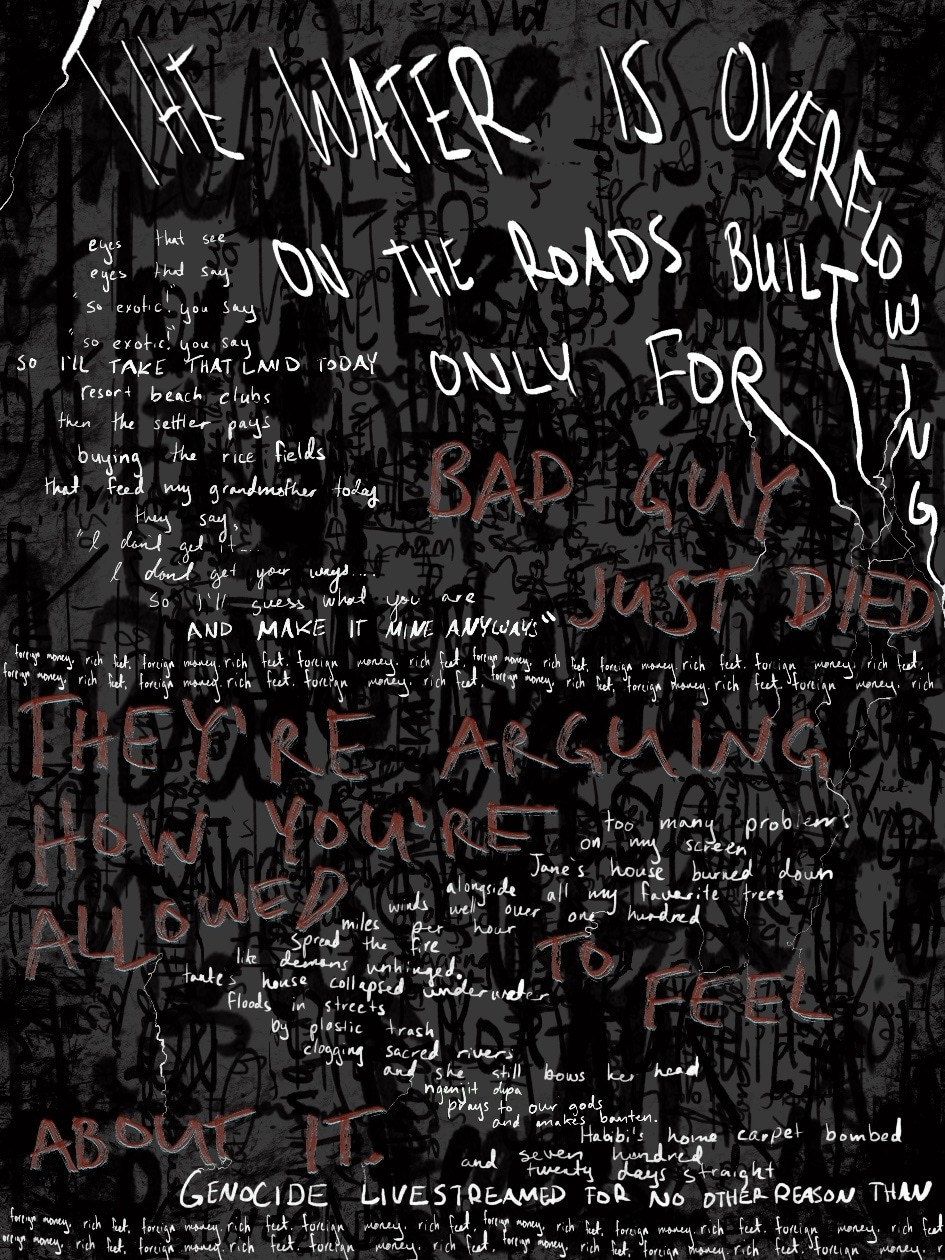
where my power is, i. rich feet is a mixed media theatrical percussion piece that highlights the intersectinal irony of sensationalism in Western media's portrayal of current events. Simultaneously, we witness Western leadership negatively and disproportionately affect livelihoods in the Global South through policies that inflame climate catastrophes, neocolonialism, and capitalisitc imperialism. rich feet is inspired by Cahaya's own personal experiences, her family, community, and loved ones across the world. The performance expresses the hopelessness that comes from witnessing suffering from afar while yearning to name the feelings and turn them into action for a better world. This work is the first movement of a multiple percussion and voice solo titled where my power is, premiered at Bowling Green State University in March 2026.
reservoirs (2022, for two performers) belongs to a series of pieces which explore our ability to listen and respond to our environment in performance situations which translate environmental sound into electronically synthesized pitches. Here, the environment is a closed water system in a performance space as heard through two hydrophones (microphones made for water) placed inside glass jars connected to each other with a siphon. The hydrophones monitor the changing water levels by making periodic recordings which are analyzed in near-real time and the most prominent frequencies are played back through speakers. The short delays in the electronic system and the physical delays in the water movement (determined by the capacity of the tube) require the performers to balance the sound dimensions of the piece with those of the physical system. The performers’ actions cause the system to be in a constant stage of change while they must react to each other to maintain balance in the system (no spilling—keep the water in the jars).
Retrieve, Julia Wolfe
Brian Snow, cello
Jacob Warren, bass
Early That Summer, Julia Wolfe
Graduate String Quartet
Brayan Cabeza, violin
Eric Funk, violin
Natalia Velasquez, viola
Che Dixon, cello
Cha, Julia Wolfe
BiG SU
Garrett Evans, soprano saxophone
Jake Loitz, alto saxophone
Chandler Creedon, tenor saxophone
Sam Valancy, baritone saxophone
Cloth, Julia Wolfe
Hannah Levinson; Natalie Holstine; Natalia Velsquez; Jake Weil;
Cruz Pena; Melissa Peraza; Zihua Ma; Cole Habekost; Eric Funk, viola
Emily Cromwell, conductor
Retrieve was premiered at Sage Chapel at Cornell University on Thursday September 15, 2016 as a part of the Technologies of Memory series created by Cornell University Jewish Studies Director/Professor Jonathan Boyarin. The piece was commissioned by Baryshnikov Arts Center (BAC) and Alexei Lubimov through BAC's John Cage and Merce Cunningham Fellowship. The fellowship was established to further the legacies of John Cage and Merce Cunningham through annual awards to artists embodying Cage and Cunningham's dedication to innovation and collaboration across disciplines.
While living in Amsterdam for the year [in 1992] I began Early That Summer. At the time I was reading a book about US political history. The author would introduce small incidents with phrases like “Early that summer …” Incidents would snowball into major political events or crises. I realized that the music I was writing was exactly like this—that I was creating a state of anticipation and forward build.
Cha is part of Breath Beneath, a pilot project in which the PRISM Saxophone Quartet explores the intersection of music, interactive technology, and durational visual art. Cha is dedicated to the memory of the composer’s father. Julia Wolfe writes: “My favorite memory is dancing the cha-cha-cha with my father. He would hit the dance floor and take me along with him. We danced together from when I was 10 until sometime into my early teens. It was great fun. As I thought about this way of remembering my dad I began to research the cha-cha-cha, and very quickly realized that our suburban version was hardly like the various Cuban versions with their wild sensuality, polyrhythms, and highly stylized movement. The cha-cha-cha takes its name from the shuffling sound of the feet against the dance floor and first emerged just a few years before I was born. The piece takes the cha cha as a starting point and create a joyful deconstruction/exaggeration of the style for the sax quartet.”
The viola is the unsung hero – the middle voice – sturdy, strong, and steady. In Cloth the viola wildly weaves a warf of arpeggios – like the over-and-under threads of a loom. Fragments of material fill in, increase the density, and illuminate threads of color within the fabric. Cloth is both practical and personal, intimate and grand, economical and extravagant, as the nine violas become one large instrument.
Cloth was written for violist Sào Soulez Larivière, with whom I workshopped the piece through its various stages of creation.
Julia Wolfe Composer Talk: "Telling History through Music"
Guard My Tongue, Julia Wolfe
Turn Ya Head, Shara Nova
All Seems Beautiful to Me, Eric Whitacre
Tuttarana, Reena Esmail
Collegiate Chorale
Dr. Richard Schnipke, conductor
Heather Goldman, pianist
Grayson Abend, graduate assistant
Vincent’s Sky, Jake Runestad
Collegiate Chorale, A Cappella Choir, & BGSU Wind Symphony
Dr. Richard Schnipke, Collegiate Chorale conductor
Prof. Todd Schreiber, A Cappella Choir conductor
Dr. Matthew Dockendorf, Wind Symphony conductor
Zig Zag, Julia Wolfe
BGSU Wind Symphony
Dr. Matthew Dockendorf, conductor
Guard my Tongue was composed for the 2009 Commissioned Composer Project of the University of Wisconsin River Falls.
Guard my tongue from speaking evil,
and my lips from speaking deceit.
– after Psalm 34
Commissioned by The Crossing and Conspirare, Turn Ya Head, from the "Titration" choral song cycle, was inspired by the Uvalde school shooting. Using sonic effects such as breathing, sirens, and heartbeats as well as performance cues, this movement speaks powerfully. This is a challenging work for experienced ensembles.
Look Look around
Turn ya head around
Notice the exits
Notice the window
Notice the entrances
Notice the path leading away
Notice the body
Notice the change
Notice sensation
Tingling
Numbness
Pressure
– Shara Nova
All Seems Beautiful to Me was commissioned by The United States Air Force Band, Colonel Don Schofield, Commander and Conductor. It is a tribute to the poet Walt Whitman, and its lyrics are taken from his poem “Song of the Open Road." It explores the cycle of life and death, and the idea that even in death, beauty and growth can be found.
From this hour I ordain myself loos’d of imaginary lines
Going where I list, my own master total and absolute.
Listening to others, considering well what they say,
Pausing, searching, receiving, contemplating,
gently, but with undeniable will, divesting myself from the holds that
would hold me.
I inhale great draughts of space.
The East and the West are mine, and the North and the South are mine.
I am larger, better than I thought,
I did not know I held so much goodness.
All seems beautiful to me,
I can repeat over and over to men and women
You have done such good to me, I would do the same to you,
I will recruit for myself and you as I go,
I will scatter myself among men and women as I go,
I will toss a new gladness and roughness among them,
Whoever denies me it shall not trouble me,
Whoever accepts me he or she shall be blessed and shall bless me.
– Walt Whitman, 1819–1892
The title of this Tuttarana is a conglomeration of two words: the Italian word ‘tutti’, means ‘all’ or ‘everyone’, and the term ‘tarana’ designates a specific Hindustani (North Indian) musical form, whose closest Western counterpart is the ‘scat’ in jazz. Made up of rhythmic syllables, a tarana is the singer’s chance to display agility and dexterity. While a Hindustani tarana is a solo form, I wanted to bring the tarana into an ensemble setting. Tuttarana was commissioned by the Mount Holyoke College Glee Club for their 2014-15 season, and has since been performed across the US, also in arrangements for SATB and brass quintet.
Vincent van Gogh’s story is often framed by struggle—his lack of recognition, his illness, and the myths that surround his life. Yet, beyond the shadows, Vincent lived with a luminous heart: he gave generously to those in need, loved with intensity, and uncovered beauty in the ordinary. Though he endured what many now believe was temporal lobe epilepsy, his greatest gift was his vision—teaching us to see the world with fresh eyes, alive with light and wonder. Across the ocean, Walt Whitman sang with a similar spirit. Vincent read him with admiration, and one senses in his letters and paintings a kinship with Whitman’s voice. Both were largely self-taught, both were seekers of truth and beauty, both revealed through their art a profound tenderness for people and the natural world. In Whitman’s words, Vincent may have found a companion; in Vincent’s colors, we may glimpse Whitman’s song. In Vincent’s Sky, I explore van Gogh’s emotional world through the lens of three of his paintings, guided by Whitman’s words. I used a musical cryptogram, assigning pitches to letters, to spell words that would inform the musical content. For example, “VINCENT” is spelled with the notes A, B, G, C, E, G, F. This performance is presented as part of a commission corsortium which Bowling Green State University supported.
I. Olive Trees
Shine!
Pour down your warmth, great sun!
Shot gold, maroon and violet, dazzling silver, emerald, fawn,
the earth’s whole amplitude consigned to colors;
pure luminous color fighting the silent shadows to the last.
Prepare my lengthening shadows,
prepare my starry nights.
II. Wheatfield with Crows
The whole of nature is so indescribably beautiful.
I never tire of the blue sky. Pure luminous color.
This infinite earth, that infinite sky.
My life is under attack at the very root.
I have set to work again, although the brush is nearly falling from my hands.
I have painted three more large canvases — they are vast stretches of wheat under troubled skies — and I didn’t have to try very hard in order to express sadness and extreme loneliness.
Il me semble absurde que les hommes veuillent paraitre autre chose que ce qu’ils sont.
(It seems absurd to me that men want to appear something other than what they are.)
Un soleil dans la tete et un orage dans le coeur.
(A sun in the head and a storm in the heart.)
Wild, wild the storm, and the sea high running,
Steady the roar of the gale, with incessant undertone muttering,
Shouts of demonic laughter fitfully piercing and pealing,
Waves, air, midnight, their savagest trinity lashing.
III. The Starry Night
I hear you whispering there, O stars of heaven.
Up through the darkness, the ravening clouds shall not long be victorious.
The stars are immortal, they shall shine out again. They will endure.
The vast immortal suns, and long-enduring moons, shall shine again.
And over all, the sky—the sky! far out of reach, breaking out, the eternal stars.
My lengthening shadows…my starry nights.
Zigzag is a high-energy, rhythmically charged work pulsing with drive and daring. It was commissioned by a consortium of universities led by Michael Butler, University of Wisconsin-Stevens Point, the Big Ten Band Directors Association and The President’s Own Marine Band. The piece was premiered in 2021 by the Ohio State University Band as conducted by Russel C. Mikkelson in the Mershon Auditorium at Ohio State University in Columbus Ohio.
Bolero, Matthew Saunders
Nick Callcut; Che Dixon, cello
Little Risks, Margi Griebling-Haigh
Brian Snow; Calem Nagy, cello
Prayer Mosaic, Adam Roberts
Brian Snow; Calem Nagy; Che Dixon; Nick Callcut, cello
Early That Summer, Julia Wolfe
Graduate String Quartet
Brayan Cabeza, violin
Eric Funk, violin
Natalia Velasquez, viola
Che Dixon, cello
Maso, Cole Reyes
Cole Habekost; Zihua Ma, violin
Thistledown, George Lewis
Zihua Ma, violin
Liam Battle, cello
Francisca de Castanheiro de Freitas, piano
Jacob Koch, percussion
Aus Tiefer Not, Thomas Wells
Justin Johnston, clarinet
Bolero is a short duet for two cellos taking its structure from the Prelude of J.S. Bach's Suite No. 1 in G Major for solo violoncello and its inspiration from the Bachiannas Brasilieras of Heitor Villa-Lobos. Bach's prelude is, of course, one of the best-known works for cello, and Villa-Lobos' reimaginings of Bach in his personal idiom, often featuring the cello, led me to create this duet. My work bears little intentional resemblance beyond meter and tempo to the most famous piece of the same title, but as a trombonist, Ravel's Bolero is a benchmark work that I use as a mnemonic for setting an andante tempo without recourse to a metronome. Where I have added a bar or two to Bach's structure, I hope that I haven't diminished the architecture of the master.
Little Risks (2015) is a compact adventure for two cellists. The players dart in and out of each other’s musical territory, trading fragments, accompanying and interrupting one another, and moving freely between arco and pizzicato. An energetic opening gives way to more mysterious and deliberately “sneaky” episodes before earlier ideas return in altered form. Shifting meters, sudden dynamic contrasts, harmonics, and changes of register keep both players alert, while the two equal voices alternate between cooperation and friendly competition. The piece gradually retreats, finally ending with a very quiet gesture.
Prayer Mosaic was written as a memorial piece for friend and composer Alastair Putt, who tragically committed suicide on August 12, 2022. Alastair was kind, witty, and wrote colorful and highly crafted music. It was through Alastair that I explored London, as he graciously allowed me to stay at the “Putt Cottage,” his home just outside of London. I had not been in recent touch with Alastair, and was unaware of his struggle with mental illness. I was shocked by this sudden loss. An opportunity to compose for the cello quartet UCelli through Zoe and Jack Johnstone’s Ten Score project provided an avenue to give voice to this shock. Prayer Mosaic is at turns singing, longing, and becomes increasingly agitated through the use of microtonal harmony; it cries out, and finally resigns, saying goodbye, and drifts off into the ether.
While living in Amsterdam for the year [in 1992] I began Early that summer. At the time I was reading a book about US political history. The author would introduce small incidents with phrases like “Early that summer …” Incidents would snowball into major political events or crises. I realized that the music I was writing was exactly like this—that I was creating a state of anticipation and forward build.
Maso takes its title from a diminutive nickname for Tomaso, the Italian form of the name Thomas, which derives from the Aramaic word for “twin.” The duo is conceived as a pair of “twin” violins whose musical interaction is characterized by a sense of playful exchange. Throughout the work, the two parts engage in imitative gestures, echoing and mirroring one another before periodically reuniting in shared material. In this way, Maso explores the spirit of camaraderie and the particular joy that arises from making music collaboratively with close friends.
Written for and premiered by Ensemble Either/Or in 2012, the title of the work is drawn from Greg Bear's novel Eon (1985), in which a team sent to investigate the sudden appearance of an enormous asteroid in Earth’s skies discovers that the asteroid is in fact a human-built starship from their own future, which has now overlapped with their present. Named “Thistledown” by its builders, the asteroid contains various chambers, including a highly evolved city, but the seventh chamber, a human technological construct called “The Way,” appears to stretch beyond the dimensions of the asteroid, leading to parallel universes that render irrelevant the notion of a single, final destination for the starship’s journey. Analogously, my piece could be said to present a number of chambers that listeners may visit and inhabit. Each chamber possesses its own character, while overlapping temporally with others to present a rough and smearing future at ironic odds with the fragility implied by the work’s title, and continually deferring all teleological reckoning.
Aus Tiefer Not is based on a chorale tune of the same name by Martin Luther, set famously by Johann Sebastian Bach, that paraphrases Psalm 130, "Out of the depths, I cry to you, Lord."
Raindrop Army, Gulli Björnsson
Gulli Björnsson, guitar
Lucid Dreaming, Liza Lim
Roberta Michel, flute
BIG Talk, Shelley Washington
Garrett Evans; Jake Loitz, baritone saxophone
Sky Event, Hao Zhen
Liam Battle, cello
Shadowgraph 5, George Lewis
Cole Habekost, violin
Gloria Pan, flute
Martha Hudson, oboe
Sam Valancy, soprano saxophone
Jake Loitz, alto saxophone
Jared Beu, piano
Chris Harris, percussion
Will Hermanowski, electronics
Raindrop Army was originally composed for guitar orchestra and electronics. The piece is rooted in an experience I had during a recording session in Iceland. I was working in a cabin when it began to rain, so I took a break, lay down, and watched the weather shifting outside. I saw the clouds move in over the lake and valley; the rain began softly, the cloud cover thickened, and the rainfall gradually built into a heavy downpour before slowly dissipating. Musically, the piece unfolds through repeated arpeggiated patterns governed by a counter that cues when each part should move to the next idea, attempting to mirror the before mentioned journey. I focused a lot on harmonic ranges and the density of the composite texture, and while each individual part moves at its own natural pace, almost oblivious to the others, the counter functions as a precise conductor, guiding everyone to shift patterns at the specific moments, creating an underlying order within the chaos. There was something in the sound of many classical guitars together, layers of plucked attacks and overlapping resonances, that felt like an army of raindrops crashing towards earth.
Liza Lim’s work lucid dreaming is a companion piece to her bioluminescence and uses Salvatore Sciarrino’s trill techniques to create a flickering, shimmering line, almost a feeling of the instrument playing the performer. Lim’s employs both nested repeats and pockets, or adding musical material “pockets” ad lib. into the through line of the piece. In integrating these types of notation, "the musician may experience a kind of dissociation from a unitary flow of time/reality." dream state; recursive structures; dissociation from a unitary flow of time/reality.
BIG Talk was written for two baritone saxophones as a personal response to the repulsive prevalence of rape culture that can be observed in catcalling and sexual harassment that female-identifying persons experience and endure on a daily basis. Many women experience these situations enough to psychologically alter their self-perception and their perception of others in a long-lasting negative way: fear, anger, depression- emotions that seep deeper into the self and permeate deeper into society. This unrelenting, churning duo is written to be somewhat of an endurance piece that incorporates all aspects of the body- the muscular ability to play the piece, the wind to power the horn, the focus to see it through... I carefully considered the everyday endurance of a constant barrage of physical and verbal abuse, how we as women bear the brunt of the cultural burden, how we are expected to silently maintain physical and emotional poise to align with many "social graces" and how sick of it I am. How sick of it we are. The piece, the poetry, and the visual components are all linked to send a very clear and targeted message: stop perpetuating rape culture by any and every means necessary.
Shadowgraph, 5 is the last in a series of works for "creative orchestra" that I made between 1975 and 1977. There is no centralized score or conductor, and instrumentation is relatively open. Any number or combination of performers, from solo to full orchestra, can realize the piece's task instructions, choosing them as needed. The work is open to performers from any musical tradition, including those that do not regularly include improvisative modes of performance. Extensive prior experience with improvisation, while welcome, does not necessarily confer an advantage. The duration of the piece is determined by real-time negotiation and consensus. The success of a given performance of this work will be less a question of individual freedom than of the assumption of personal responsibility for the sonic environment. When performed well,Shadowgraph, 5 becomes a meditative evocation of weather. The work was composed for the AACM Big Band.
Musical Installation with the BGSU Contemporary Improvisation Ensemble
Aidan Plank, Director
Kobacker Lobby, 7 PM
Resilience, Szu-An Chen
Jared Beu, conductor
Concerto for Horn and Orchestra, Samuel Adler
i. Slowly and Declamatory
ii. Slowly
iii. Fast and very rhythmic
Andrew Pelletier, french horn
Pretty, Julia Wolfe
Bowling Green Philharmonia
Emily Freeman-Brown, conductor
The Contemporary Improvisation Ensemble, under the direction of Aidan Plank, will perform free improvisations exploring sound and space, interaction, extended techniques, storytelling, and humor. Students in the ensemble span multiple areas of the BGSU College of Musical Arts, notably composition, music performance, and jazz.
Resilience is the central concept of this piece— the spirit of always rising again and continuing to strive, no matter what challenges we may encounter. The inspiration came from two documentaries I watched this summer about my home country, Taiwan. The first one, A Chip Odyssey, describes the challenging path taken by Taiwan's semiconductor industry from beginnings to its current standing as an important player in the world of technology; and the second, Invisible Nation depicts Taiwan's history and geopolitical difficulties while also portraying Taiwan's struggle for international recognition and democratic defense against China's threats. Building an industry or achieving international recognition is never easy. These two documentaries showed me how incredibly resilient previous generations were. Even when faced with obstacles, doubt, uncertainty, or even external impediments, they persisted, overcame adversity, and continued to move forward—efforts that continue to this day. Their spirit greatly touched and inspired me, and this piece is both a tribute to them and a reminder to keep striving for what I believe. To convey the idea of resilience, I mainly use dense clusters, exaggerated continuous crescendos and diminuendos, and rhythmic pulses that create an unending momentum. At times, this flow is interrupted, but the original material soon returns, symbolizing recovery and reconstruction after disruption. I dedicate it to my dearest home, Taiwan, with pride and gratitude.
The Concerto for Horn and Orchestra was written in 1994-1995 commissioned by the Houston TX Symphony Orchestra for their principal horn William VerMeulen. It is in three movements. The first begins with a short slow introduction and is followed by a vigorous fast movement exploring the full range of possibilities of the horn and its artist There is a constant interplay between the soloist and the orchestra the two playing off one another. The second movement features the 'Shofar Calls' heard on the High Holidays in the Synagogue which is one of the most ancient musical examples we have. This is also performed against a duet between the Piccolo and the English horn from opposite sides of the stage.. I have always loved the four Horn Concerti by Mozart'. The last movement of each of them is quite similar one to the other., The themes are not quite the same but they introduce a movement of joy and brightness . I have tried to catch that spirit in my final movement. Mozart's last movements are all in 6/8 time while mine alternates between 6/8 and 5/8 and begins with the timpani paving the way and setting the joyous mood for the entire movement, The whole piece is about 25 minutes in length.
The word “pretty” has had a complicated relationship to women. It implies an attractiveness without any rough edges, without strength or power. And it has served as a measure of worth in strange, limited, and destructive ways. It has a less sweet origin from the old English – “cunning, crafty, clever.” As words evolve, it morphed to a much softer sentiment. My Pretty is a raucous celebration – embracing the grit of fiddling, the relentlessness of work rhythms, and inspired by the distortion and reverberation of rock and roll.

Samuel Adler taught at the Eastman School of Music from 1966 to 1995 and served as chair of the composition department from 1974 until his retirement. In 1989, he received the Eastman School’s Eisenhart Award for distinguished teaching. Adler was educated at Boston University and Harvard University, and holds several honorary doctorates. His major teachers in composition were Herbert Fromm, Walter Piston, Randall Thompson, Paul Hindemith, and Aaron Copland. Samuel Adler is the composer of more than 400 published works, which have been performed all over the world. He is also the author of four books: Choral Conducting; Sight Singing; The Study of Orchestration; and a memoir, Building Bridges with Music. Samuel Adler’s many prizes include a 1990 award from the American Academy of Arts and Letters, the Charles Ives Award, the University of Rochester’s Lillian Fairchild Award, the Deems Taylor Award for The Study of Orchestration, and more. In 1999, Adler was elected to the Germany’s Akademie der Künste for distinguished service to music, and in 2003 was awarded the Aaron Copland Award by ASCAP for lifetime achievement in composition and teaching.
Gulli Bjornsson (b. 1991) is an Icelandic guitarist, composer, and programmer whose work combines electronics, acoustic instruments, and visual media to create immersive, nature-inspired experiences. His music has received critical acclaim for its virtuosic and accessible qualities, and his compositions have been performed by ensembles including the New Jersey Symphony, Alarm Will Sound, Sō Percussion, and Aizuri Quartet. His work has been featured at major venues and festivals such as Carnegie Hall, Caramoor, Le Poisson Rouge, San Francisco Performances, and the Guitar Foundation of America. Bjornsson has received numerous international composition awards and grants, while also earning recognition as a guitarist through competitions and honors including the Eliot Fisk Prize and Andrés Segovia Award. He currently teaches composition and music technology at Bowling Green State University, holds a PhD in music composition from Princeton University, and is an Augustine Artist who performs exclusively on Augustine Strings.
Szu-An Chen is a Taiwanese composer with a keen ability for observation and a vivid imagination. Drawing inspiration from her Taiwanese heritage and reflections on social and environmental issues, she enjoys imagining new possibilities, exploring cross-cultural perspectives, and creating her own magical worlds through music. Her works include a wide range of instrumentation, from solo and ensemble pieces to orchestral, theatrical, and electronic music. Szu-An’s music has received various awards and commissions globally, and she has collaborated with and been commissioned by distinguished performers and organizations, including SPLICE Ensemble, Stuttgart Philharmonic (under Mario Venzago), Taiwan National Symphony Orchestra (under Jun Märkl), Taiwan National Center for Traditional Arts, and Bratsche Camerata Taiwan. Notably, her orchestral work, Resilience, won the 2025 BGSU Concerto Competition (composition division). Szu-An is currently pursuing a Ph.D. in Composition at the University of North Texas. She holds a Master of Music in Composition from Bowling Green State University and Bachelor of Music in Composition from Taipei National University of the Arts.
Percussionist and composer Cahaya Drucilla [cha-hai-uh dru-sil-uh], a Balinese-American artist, specializes in intersectional musical storytelling through Western Contemporary Classical and Balinese Gamelan traditions. Cahaya’s craft centers stories and lived experiences through holistic mixed media performance. The integration of spoken word, song, visual artwork, performance art, and sound invites the audience into her world. Raised in small town Graham, Washington State, Cahaya began her artistic journey transcribing rock and jazz tunes on piano, drums, and voice - quickly falling in love and beginning formal percussion and piano study. She holds a music degree from Central Washington University and is working towards a M.M. in Percussion Performance while serving as a graduate assistant at Bowling Green State University. Cahaya is currently co-director of Gamelan Kusuma Sari, a founding member of contemporary ensemble Playroom Percussion, and solo performer of her own compositions centering social and climate justice. Cahaya’s artistry is characterized by passionate dualistic energy and thought-provoking emotional exploration, with hopes to inspire authenticity and intention in listeners.
John Eagle is a composer and musician whose interdisciplinary work spans performance, installation, and experimental music that explores ecological frameworks, extended instrumental systems, tuning, microtonal just intonation, and physical movement. His work has been presented throughout the United States and internationally at festivals and events like the LA Phil’s Noon to Midnight, EMPAC, the Sound/Image Festival in London, and Göteborg Art Sounds. Eagle has collaborated extensively with conceptual artist Charles Gaines as a music director and arranger for the Manifestos series, conducting premieres and performances at venues including MoMA, Times Square, REDCAT, and the Art Institute of Chicago. His other projects include the performance installation Sound House, collaborative sound films, and the solo work erosion and growth. Eagle holds degrees from Bennington College, California Institute of the Arts, and Cornell University, and currently teaches composition and music technology at Bowling Green State University. He is also an active French hornist, performing his own music and other works of experimental music.
Reena Esmail is a composer whose music brings together the traditions of Hindustani and Western classical music, creating collaborative spaces for musicians from diverse backgrounds. Her work spans orchestral, chamber, and choral music, with commissions from major ensembles including the Los Angeles Master Chorale, Seattle Symphony, Philadelphia Orchestra, and San Francisco Symphony. Her music has received broad recognition, with recordings featured on multiple Grammy-nominated albums. Esmail has held prestigious residencies with organizations including the Los Angeles Master Chorale, Seattle Symphony, Tanglewood Music Center, Spoleto Festival, and Marlboro Music Festival. She holds composition degrees from Juilliard and Yale and received a Fulbright-Nehru grant to study Hindustani music in India.
Michael Gordon is known for his monumental and immersive works. Decasia, for 55 retuned spatially positioned instruments (with Bill Morrison’s accompanying cult-classic film) has been featured on the Los Angeles Philharmonic’s Minimalist Jukebox Festival and at the Southbank Centre. Timber, a tour-de-force for percussion sextet played on amplified microtonal simantras has been performed on every continent, including by Slagwerk Den Haag at the Musikgebouw and Mantra Percussion at BAM. Natural History, a collaboration with the Steiger Butte Drum of the Klamath tribe, was premiered by the Britt Festival Orchestra and Chorus on the rim of Crater Lake (Oregon) by conductor Teddy Abrams and is the subject of the PBS documentary Symphony for Nature. Gordon’s vocal works include Travel Guide to Nicaragua, an autobiographical choral work for The Crossing; the opera What to wear with the legendary director Richard Foreman; and the film-opera Acquanetta with director Daniel Fish. Recent recordings include Clouded Yellow, Gordon’s complete string quartets performed by the Kronos Quartet.
The music of Margi Griebling-Haigh has been characterized as haunting, charismatic, yearning, wistful, lyrical, colorful, and insoucient! She is concerned with conveying emotions and moods, but firmly believes in the powers of memorable melodies and rhythms and strong formal structure. Ms. Griebling-Haigh has been Composer in Residence at the Kent/Blossom Music Festival since 2011 and her music has been repeatedly featured on American Public Media's "Performance Today". Ms. Griebling-Haigh has received commissions from International Society of Bassists, Cleveland Orchestra Principal Hornist Richard King and Assistant Principal Bassoonist Barrick Stees, Cleveland Orchestra (deceased) Principal Oboist John Mack, renowned organist Karel Paukert, the Schenectady Symphony, the Cleveland and Kulas Foundations, The Cleveland Institute of Music Cello Ensemble, among others. Ms. Griebling-Haigh's music is published by Jeanne, Inc., Trevco, Inc., and her own company, Musicalligraphics. Her music is featured on 17 CD recordings, on the Centaur, Capstone, and Jeanné labels, as well as on independently released projects. Majoring in oboe performance, she earned a Bachelor of Music degree from the Eastman School of Music with Robert Sprenkle and a Masters degree from the San Francisco Conservatory with Marc Lifschey.
Winner of the 2013 Grammy Award for Best Contemporary Classical Composition, Stephen Hartke is widely recognized as one of the leading composers of his generation. His work has been recognized for both its singularity of voice and the inclusive breadth of its inspiration. Born in Orange, New Jersey, in 1952, Hartke grew up in Manhattan, where he began his musical career as a professional boy chorister, performing with such organizations as the New York Pro Musica, the New York Philharmonic, the American Symphony Orchestra, and the Metropolitan Opera. He studied at Yale, the University of Pennsylvania, and the University of California at Santa Barbara, then worked as advertising manager for several major music publishers. He was a Fulbright Professor at the Universidade de São Paulo in Brazil before joining the University of Southern California faculty in 1987.
Celebrated for his “waves of colorful sounds” (New York Times) and “smart, appealing works” (The New Yorker), Robert Honstein (b. 1980) is a New York-based composer of orchestral, chamber, vocal, and film music. His music has been performed by the Albany Symphony, Dayton Philharmonic, Eighth Blackbird, Ensemble Dal Niente, Mivos Quartet, Del Sol Quartet, Argus Quartet, New Morse Code, Colin Currie, Theo Bleckmann, Doug Perkins, Michael Burritt, Karl Larson, and Ashley Bathgate, among others. Interdisciplinary collaborators include photographer Chris McCaw, projection designer Hannash Wasileski, graphic designer Laura Grey, and director Daniel Fish. His music has been released by New Amsterdam Records, New Focus Recordings, Soundspells Productions, Cedille Records, and Other Minds Records. His debut film score, The Real Charlie Chaplin, was nominated for a News & Documentary Emmy in Outstanding Music Composition. Robert is a founding member of the New York-based composer collective Sleeping Giant and co-founder of Fast Forward Austin. He is Program Director of Concert Composition and Composition Faculty at NYU, Steinhardt.
Composer and pianist. Zygmunt Krauze divides his work into four categories: the first is unitary music inspired by the paintings of Władysław Strzemiński; the second – spatial compositions performed in specially constructed interiors; the third – “music about music”, characterized by the presence of allusions and quotes; the fourth is subjective, deeply expressive “music of returning to the roots”. He is the author of 10 operas and over 100 orchestral, chamber and solo compositions. In 1967 he founded the band Warsztat Muzyczny, which he managed for 25 years and for which over 120 works were written by leading composers from around the world. He sat as a juror in over 50 international composers’ competitions. At the invitation of Pierre Boulez, he became an artistic advisor at IRCAM. In 1987–90 he was the president of the International Society for Contemporary Music, for two decades he was the chairman of the Polish section of this organization. He was awarded, among others, the French National Order of the Legion of Honor (2007) and the title Chevalier dans l’Ordre des Arts et des Lettres (1984), and in Poland the Knight’s Cross – The Order of Polonia Restituta (2014) and the Gold Medal for Merit to Culture – Gloria Artis (2010).
David Lang is one of the most highly esteemed and performed American composers writing today. His works have been performed around the world in most of the great concert halls. Lang’s the little match girl passion, commissioned by Carnegie Hall and premiered by Paul Hillier and Theatre of Voices, was recently listed by The Guardian as “one of the top 25 works of classical music written in the 21st Century.” His opera prisoner of the state (with libretto by Lang) was co-commissioned by the New York Philharmonic, Rotterdam’s De Doelen Concert Hall, London’s Barbican Centre, Barcelona’s l’Auditori, Bochum Symphony Orchestra, and Bruges’s Concertgebouw, and premiered June 2019 in New York (conducted by Jaap van Zweden). Lang is a Professor of Music Composition at the Yale School of Music. He is co-founder and co-artistic director of New York’s legendary music collective Bang on a Can. His music is published by Red Poppy Music and G. Ricordi & Co., New York (ASCAP) and is is distributed worldwide by the Universal Music Publishing Group.
Michael Laurello's music explores time, energy, and emotion, earning praise for its intricate structures and energetic qualities. His compositions have been performed by ensembles and artists including Sō Percussion, the Nashville Symphony, the U.S. Marine Band, the U.S. Army Band, and icarus Quartet. His music has been performed at major venues and festivals such as Carnegie Hall, Lincoln Center, and Bang on a Can Summer Festival. He studied composition at Yale School of Music and Tufts University and music synthesis at Berklee College of Music, working with mentors including David Lang, Christopher Theofanidis, Martin Bresnick, and John McDonald. He's attended fellowships, residencies, and composer-development opportunities with organizations such as the Nashville Symphony, Norfolk Chamber Music Festival, and Avaloch Farm Music Institute. In addition to composing, Laurello works as a recording engineer and multimedia producer. He currently serves as Manager of Recording Services and Technical Engineer for the MidAmerican Center for Contemporary Music at Bowling Green State University.
George Lewis is an American composer, musicologist, and trombonist. He serves as the Edwin H. Case Professor of American Music, the Area Chair in Composition at Columbia University, and the Artistic Director of the International Contemporary Ensemble. Lewis is internationally recognized for his pioneering work in computer programs that improvise alongside human musicians. His scholarship focuses on experimental/computer music, interactive media, improvisation, and the intersectionality of music, race, gender, and decolonization. His acclaimed book A Power Stronger Than Itself received the American Book Award and the American Musicological Society’s Music in American Culture Award. He has co-edited major works on contemporary and critical improvisation studies. Lewis has received several honors including a MacArthur Fellowship, Guggenheim Fellowship, Doris Duke Artist Award, and honorary doctorates from leading academic and cultural institutions worldwide.
Liza Lim is an Australian composer, educator, and researcher whose music thinks with ritual, material agency, and environmental philosophy across the cultural lands of a more‑than‑human world. Her practice articulates relations rather than objects, braiding beauty and rage with female spiritual lineages into emergent ecologies of sound. Her large-scale cycle Extinction Events and Dawn Chorus has resonated globally for its urgent call to ecological listening. Lim’s music—spanning chamber and orchestral works and five operas—is published by Ricordi Berlin and widely commissioned by leading orchestras and ensembles. She holds the Sculthorpe Chair of Australian Music at the Sydney Conservatorium. In 2026, Lim received the prestigious Grawemeyer Award for Music Composition for her cello concerto A Sutured World, affirming her place as one of the most compelling voices in contemporary music.
Anthony T. Marasco is a composer, sound artist, and instrument designer who takes influence from the aesthetics of today’s Digimodernist culture. An avid builder and programmer, he creates electronic and augmented instruments as well as reactive and generative audiovisual software. His music and installations have been presented internationally at major electroacoustic and new-media festivals like the Society for Electro-Acoustic Music in the United States (SEAMUS) conference, the Networked Music Festival, the MoxSonic Festival, the Toronto International Electroacoustic Symposium and more. He’s received commissions from WIRED Magazine, the Elm Trio, smol ensemble, Phyllis Chen, Quince Contemporary Vocal Ensemble, Toy Piano Composers, and Maureen Batt. He holds a Ph.D. in experimental music and digital media from Louisiana State University, and composition degrees from Towson University and Lebanon Valley College. Marasco is currently Assistant Professor of Music Composition and Technology at Michigan State University.
Tanawat Naruepai, ZIa, (b.2004) is a Thai composer, graduated from Mahidol college of music, in
composition, under Dr. Tyler Capp, having previously studied under Dr. Narong Prangcharoen. His music focuses on an exploration of physical sound production often by means of modifying or extending the possibilities of an existing instrument or by discovering and utilising instruments from an overlooked source. His works focuses on “Destabilization” in any form possible. His composition has been performed in multiple festivals such as Int-Act, June in Buffalo, TICF, SPCCF and most recently the Suena festival in Vienna, premiering his piece “Los tres músicos” by Ensemble N. He is currently the director of Triphens Ensemble, curating multiple concerts focusing on contemporary music.
Shara Nova is a composer, vocalist, and producer currently creating from Detroit, Michigan. Shara has released six albums under the moniker My Brightest Diamond and has composed works for The Crossing, Conspirare, American Composers Orchestra, the BBC Concert Orchestra, and the Detroit Opera Educational touring company, among others. Many artists have sought out Nova’s unique vocal work, including David Byrne, Laurie Anderson, Suzanne Bocanegra, The Decemberists, Steve Mackey, David Lang, So Percussion, Justin Vernon, Sufjan Stevens, and Tunde Olaniran, as well as Matthew Barney with Jonathan Bepler. Her singing and compositions are featured on “The Blue Hour” via Nonesuch Records with the string orchestra A Far Cry and co-composers Rachel Grimes, Angélica Negrón, Sarah Kirkland Snider and Caroline Shaw. Nova has been a guest teacher in composition and performance at Princeton, University of Michigan, Columbus State University Schwob School of Music, NYU, University of North Carolina, University of North Texas and University of Texas in Austin among others. Nova is a 2023 Opera America Discovery Grant awardee, Kresge Arts fellow, a Carolina Performing Arts Creative Futures fellow, a Knights Grant recipient, a United States Artists fellow, and a New Music USA recipient.
Composer and writer Gemma Peacocke’s music blurs genres, weaving together chamber music, art-pop, electronic soundscapes, and orchestral power into something altogether her own. Her work often explores identity, haunting, folklore, and feminism, bringing together contemporary classical language with electronics and experimental textures. Peacocke’s music has been championed by Third Coast Percussion, ~Nois, eighth blackbird, Bang on a Can, the Cincinnati Symphony, the Rochester Philharmonic, the Auckland Philharmonia, among others. Peacocke’s major works include Waves & Lines, a song cycle based on Afghan landays for soprano Eliza Bagg, White Horses, co-commissioned by the Auckland Philharmonia and Christchurch Symphony; The Threshold We Cross with Closed Eyes, commissioned and premiered by Third Coast Percussion at the Library of Congress; and Don’t You Trust Me?, written for brass and percussion and commissioned by the Auckland Philharmonia. Peacocke holds degrees from NYU Steinhardt, Victoria University of Wellington, and the New Zealand School of Music, and received a Ph.D. in composition and interdisciplinary humanities from Princeton University.
Cole Reyes (b. 1998) is a composer, educator, and arts administrator whose creative exploration delves into the intersection of individual human experiences and the broader world. His musical output is distinguished by a fusion of lyricism and rhythmic propulsion. Recent and upcoming performances include the JACK Quartet, San Francisco Contemporary Music Players, the United States Marine Band, Contemporaneous, Del Sol Quartet, the Lake George Music Festival, among others. Recent commissions include the National Orchestral Institute and Festival, Bang on a Can Summer Festival, the Victory Players, and ARTZenter. Reyes has taught at the University of Michigan in the Composition and Music Theory Departments. His primary composition teachers include Julia Wolfe, Michael Gordon, Robert Honstein, Michael Daugherty, Bright Sheng, Roshanne Etezady, Kristin Kuster, Evan Chambers, Christopher Stark, and LJ White. He is co-founder of Telos Consort, a professional chamber ensemble based in New York City dedicated to the performance and curation of new music that features saxophones, strings, and piano. He is currently pursuing doctoral studies at the University of Michigan.
Adam Roberts writes viscerally compelling music with a vivid array of sonic resources. Roberts’ music has been performed by ensembles such as the Arditti Quartet, the JACK Quartet, le Nouvel Ensemble Moderne, andPlay, Transient Canvas, Ums ‘n Jip, Fellows of the Tanglewood Music Center, the Boston Conservatory Wind Ensemble, violist Garth Knox, and at festivals such as Wien Modern (Vienna), Tanglewood, the Biennale Musique en Scene (Lyons), and the 2009 ISCM World Music Days (Sweden). Roberts is the recipient of a Guggenheim Fellowship, Fromm Foundation Commission, the Benjamin H. Danks Award from the American Academy of Arts and Letters, an ASCAP Morton Gould Young Composer Award, and other awards. Commissions have come from the Callithumpian Consort, the Boston Conservatory Wind Ensemble, pianist Nolan Pearson, the Tanglewood Music Center, Guerilla Opera, and others. Roberts holds degrees from the Eastman School of Music (B.M.) and Harvard University (Ph.D), having studied with David Liptak, Augusta Read Thomas, Martin Bresnick, Steven Stucky, Bernard Rands, Julian Anderson, and Chaya Czernowin. He is currently Associate Professor of Composition at Kent State University.
Considered “one of the best of the younger American composers” (Chicago Tribune), EMMY®-winning and GRAMMY®-nominated composer and conductor Jake Runestad has received commissions and performances from ensembles and organizations such as VOCES8, Washington National Opera, the Los Angeles Master Chorale, the Dallas Symphony Orchestra & Chorus, the Pacific Symphony & Chorale, and many more. "The Hope of Loving,” the first album dedicated to Jake’s choral music, recorded by professional American choir Conspirare, received a GRAMMY® nomination. In 2019, Jake became one of the youngest composers ever awarded the prestigious Raymond C. Brock commission by the American Choral Directors Association. “Earth Symphony,” Jake’s ground-breaking choral symphony written with librettist Todd Boss, earned a 2022 EMMY® Award for musical composition. Jake Runestad holds a Master’s degree in composition from the Peabody Conservatory of the Johns Hopkins University where he studied with Pulitzer Prize-winning composer Kevin Puts.
Born in Westfield, Massachusetts in 1938, Frederic Rzewski studied music with Charles Mackey of Springfield, and subsequently with Walter Piston, Roger Sessions, and Milton Babbitt. In 1960 he studied with Luigi Dallapiccola and met Severino Gazzelloni, with whom he performed in a number of concerts, thus beginning a career as a performer of new piano music. In Rome in the mid 1960s, together with Alvin Curran and Richard Teitelbaum, he founded the Musica Elettronica Viva group, which quickly became known for its pioneering work in live electronics and improvisation. Rzewski's largest-scale work to date is The Triumph of Death (1987-8), a two-hour oratorio based on texts adapted from Peter Weiss's 1995 play Die Ermittlung (The Investigation). From 1977 until his death in 2021, Rzewski was Professor of Composition at the Conservatoire Royal de Musique in Liège, Belgium. He also taught at the Yale School of Music, the University of Cincinnati, the State University of New York at Buffalo, the California Institute of the Arts, the University of California at San Diego, Mills College, the Royal Conservatory of the Hague, the Hochschule der Künste in Berlin, and the Hochschule fur Musik in Karlsruhe. -Nonesuch Records
Erik Santos is a composer, multi-instrumentalist, singer, producer and teacher, He is the Chair of the Composition Department at University of Michigan School of Music, Theatre, and Dance. Santos has received commissions, prizes, fellowships, and other recognitions for his concert music, including the prestigious 2020 Sousa-ABA-Ostwald Prize from the American Bandmasters Association, the Charles Ives Scholarship, awards from Broadcast Music Incorporated, and many more. Santos has become increasingly preoccupied with presenting music in venues other than the classical concert hall — dance clubs, street corners, theaters, churches, Internet, etc. — where there is more emphasis given to the interaction of music with other spontaneous sensory elements, involving listeners at the hub of a transdimensional experience. Santos completed 5 albums, music videos, and documentaries with his band, October Babies; He then became interested in filmmaking, and this led to the full-length movie Threshold: Whispers of Fukushima in 2015. These days, he's possessed by a fresh passion for practicing - learning unlearning, all day every day - memorizing poetry, investigating inventions of Bach and Bruce Lee, and Vince Gilligan, enjoying sound.
Dr. Matthew C. Saunders (born 1976) is a Northeast Ohio composer, conductor, trombonist, husband, and father. Dr. Saunders’ compositions have been performed across the country, including conference like the National Flute Association, the International Horn Society, and the Society of Composers. He has presented his research at conferences of the College Music Society and the Society of Composers, and at the Oklahoma Music Theory Roundtable and the Aspen Composers Conference. He received the 2007 Ruth Friscoe Prize for composition, the 2011 Oklahoma Music Teachers Association Commissioned Composer, and six ASCAP Plus Awards. Dr. Saunders is Professor of Music and the music and theater department chair at Lakeland Community College, where he also directs the Lakeland Civic Orchestra. He received degrees in music from the University of Cincinnati College-Conservatory of Music and The Ohio State University. Dr. Saunders studied composition with Donald Harris, Thomas Wells, Jan Radzynski, and Wes Flinn, and trombone with Joseph Duchi and Tony Chipurn. Dr. Saunders’ music is published by Imagine Music and online at www.martiandances.com.
The music of composer Marilyn Shrude is characterized by its warmth and lyricism, rich timbre, multi-layered constructions, and complex blend of tonality and atonality. Shrude earned degrees from Alverno College and Northwestern University, and has served on the faculty of Bowling Green State University since 1977. Her prestigious honors are those from the Guggenheim Foundation, American Academy of Arts and Letters, Rockefeller Foundation, Chamber Music America/ASCAP, Meet the Composer, Sorel Foundation (Medallion Winner for Choral Music 2011), and the National Endowment for the Arts. She is also the first woman to receive the Kennedy Center Friedheim Award for Orchestral Music and the Cleveland Arts Prize for Music. Active as a composer, pianist, teacher, and contemporary music advocate, Shrude has consistently promoted American music through her many years as founder and director of the MidAmerican Center for Contemporary Music (1987-99), as chair of the Department of Musicology/Composition/Theory at BGSU (1998-2011) and as coordinator of the doctoral program in contemporary music (2006-2024). Together with saxophonist, John Sampen, she has premiered, recorded and presented hundreds of works by living composers both in the United States and abroad. Guest appearances as a pianist and composer include tours to the Soviet Union, China, Japan, Belgium, South America, the Netherlands, France, and Armenia, as well as numerous performances in the United States.
Shelley Washington (b. 1991) writes music to fulfill one calling- to move. With an eclectic palette, Washington tells stories focusing on exploring emotions and intentions by finding their root cause. Using driving, rhythmic riffs paired with indelible melodies, she creates a sound dialogue for the public and personal discourse. Shelley performs regularly as a vocalist and saxophonist, primarily on baritone saxophone, and has performed and recorded throughout the Midwest and East Coast- anything from Baroque to Screamo. She holds degrees from Truman State University; a BA in Music focusing on saxophone, and a Masters of Arts in Education. She also holds a Masters of Theory and Composition from NYU Steinhardt, where she studied with Dr. Joseph Church, Dr. Julia Wolfe, and Caroline Shaw. As an educator, she taught for the New York Philharmonic's Very Young Composers program, and was acting Artistic Director for the Noel Pointer Foundation, located in Brooklyn, NY. In the Fall of 2018 she began studies at Princeton University in pursuit of the PhD of Music Composition. Shelley is a founding member of the composer collective, Kinds of Kings.
Thomas Wells, professor of composition and area head of Integrative Studies at the Ohio State School of Music, holds the DMA degree from The University of Texas at Austin. His teachers include Karlheinz Stockhausen, Kent Kennan and Hunter Johnson. His compositions have been performed by major orchestras in the United States, and his computer music compositions have been performed internationally. He has received grants from the National Endowment of the Arts, Ohio Arts Council, Pennsylvania Arts Council and the Texas Commission for the Arts; he was also recipient of the 1990 Governor's Award for Outstanding Individual Artist in the State of Ohio. His music spans a range of styles and genres, from tangos and ragtime music to oratorios as well as chamber, orchestral and electroacoustic music. He is active in faculty governance at The Ohio State University, having served in the University Senate for many years as Chair of Faculty Council and currently as Chair of the Steering Committee of the University Senate. He served as president of the Society of Composers, Inc. from 2002 to 2013, and was the Composition Chair for the College Music Society 2015 National Conference. Recent performances of his works include "…what the night said" commissioned by the Royal Conservatoire of Scotland and performed there in March 2015; and "A Festive Overture for Wind Symphony", performed at the Investiture of Ohio State President Michael Drake in March 2015.
Grammy Award-winning composer and conductor, Eric Whitacre, is among today’s most popular musicians. A graduate of The Juilliard School, his works are performed worldwide, and his ground-breaking Virtual Choirs have united well over 100,000 singers from more than 145 countries. Among his recent accolades and awards, Eric received the Richard D. Colburn Award from the Colburn School and an Honorary Doctor of Arts from Chapman University (CA). Eric served consecutive terms as Artist in Residence with the Los Angeles Master Chorale and currently holds the position of Visiting Composer at Pembroke College. He’s also an Ambassador for the Royal College of Music in London and is proud to be a Yamaha artist. A widely respected conductor, Eric has worked with the world’s leading choirs and orchestras including the Minnesota Orchestra, London Symphony Orchestra and Royal Philharmonic Orchestra. A charismatic speaker, Eric Whitacre has given keynote addresses for many Fortune 500 companies, in education and global institutions from Apple and Google to the World Economic Forum in Davos and the United Nations Speaker’s Program.
Hao Zhen is a composer, pianist, and filmmaker. Her work explores sound as a material and relational process of transmission, engaging touch, distance, and sympathetic resonance across acoustic and multimedia contexts. Her chamber opera The Lullaby, created in collaboration with Australia’s National Institute of Dramatic Art (NIDA) and director Lindy Hume, received four performances in Sydney in 2024 and was featured in Limelight. Her work has been presented at the Klangspuren Creators Lab, Critical Sounds Festival, and Sydney Art Song Festival, and has been performed by artists and ensembles including the Sydney Philharmonia Choirs, ~Nois Quartet, Flinders Quartet, and Heather Roche. She is currently pursuing a PhD in Composition and Sound Practices at the University of Chicago.
BG Philharmonia Personnel
Director of Orchestral Activities,
Dr. Emily Freeman Brown
DMA Assistant Conductor,
Jared Beu
MM Assistant Conductors,
Christopher Hutra & Emily Cromwell
Orchestra Librarians,
Majid Javdani & Emily Cromwell
Violin 1
Brayan Cabeza* co-concertmaster
Eric Funk* co-concertmaster
Marley Crane
Maia Loiacono
Alexandra Jones
Mahlia Proctor
Matthew Kujaha
Carlos Reverol
Benjamin Christiaansen
Trevor Achtyes
Violin 2
Eric Funk* co-section leader
Brayan Cabeza* co-section leader
Gabriel Manisco
Priscilla Bloomer
Quincy McCormick
Courtney Spencer
Katherine Tyson
Caylee Farley
Ryley Amos
Leah Davis Bristley
Viola
Natalia Velaquez*
Melissa Peraza*
Cruz Alejandro Pena*
Jake Weil
Natalie Holstine
Matthew Meyers
Zion Spencer
Sierra Wood
Halima Wood
Lexam Andersen
Cello
Che Dixon*
Nicholas Callcut*
Jack Cook
James Reed
Calem Nagy
Emily Ward
Samuel Johnson II
Benjamin Jenkins
Eddie Kruse
Dominic Gomez
Double Bass
Eliana Kornowa*
Natalie Fry
Leon Bautista
Mitchell Iwinski
Kayden Moore
Flute/Piccolo
Ashley Busch*
Lauren Davis*
Kiersten Lowry
Eliseo Hernandez
Oboe
Wesley Barton*
Johannah Dickenson
Jaden Bowers
Clarinet
Michael Hudzik
Ryan Moore
Seth Rupp*
Bassoon
Jordan Wier
Cameron Brinker
Eleanor Margraf
Horn
Nicholas Evener*
Ella Jobe
Mitchell Hemme*
John Hennessy
Patrick Scully
Trumpet
Trace Coulter*
Eliana Peron
Matthew Pileski*
Trombone
Caleb Lindsey*
Jeremy Skeels
Xander Soural, bass trombone
Tuba
Alyssa Shimmel*
Timpani
Zion Bateman
Sarah Hertenstein
Cahaya Odle
Percussion
Jacob Kendall*
Zion Bateman
Christopher Harris
Sarah Hertenstein
Jacob Koch
Matthew Graves
Piano/Celeste
Nathaniel Brown
Harp
Bianca Bares
Julie Buzzelli+
*Section principal or co-principal
+Faculty
Dr. Matthew Dockendorf, conductor
Flute
Allison Egts
Alyssa Brannon
Eliseo Hernandez
Elijah Ondrish, piccolo
Libby Dotterer
Oboe
Jayson Mikkelson
Kathryn Swanson
Quentin O’Brien
Bassoon
Jordan Wier
Tabitha Barowsky
Lorelei Wilkerson, contrabassoon
Clarinet
Ryan Kramer
Seth Rupp
Alex Proctor
Adam Williams
Willis McClure
Natalie Kyser, bass
Andrew Sowders
Ryan Moore
Ethan Ondrish
Saxophone
Aidan Peper, alto
Charlie Carroll, alto
Charlie Miley, alto
Alex Dale, tenor
Connor Lynch, tenor/soprano
Ryan Williams, baritone
Horn
Mitchell Hemme
Nick Evener
Patrick Scully
Tre Meyers
Ella Jobe
Koby Carson
Trumpet
Trace Coulter
Matt Pileski
Eliana Peron
Sydney Nitschke
Lucas Vile
Jack Mantonya
Bincheng Li
Harp
Julie Buzzelli
Trombone
David Franklin
Connor Kirkner
Matthew Ross
Ryan Hogue, bass
Euphonium
Zephyr McQuade
Myriad Hill
Tuba
Nia Garner
Justis Kaiser
Lauren Finn
Percussion
Carson Van Gorder
Vic McPheron
Josh Boyd
Ian Holdridge
Brooke Guyton
Zach Hallam
Alex Minniear
Piano
Francisca de Castanheiro de Freitas
Double Bass
Ellie Kornowa
Heather Goldman, piano
Dr. Richard Schnipke, conductor
Grayson Abend, graduate assistant
Soprano
Camiah Baker
Abbi Blank
Eileen Brady
Morgan Fausz
Aria King
Laney Luginbill
Laney Mitchell
Zo Povlsen
Rue Stammen
Macy Strauss
Eleanor Thompson
McKenna Warner
Maddie Yarbro
Alto
Cam Armstrong
Alex Bailey
Autumn Cromwell
Kamiah Felver
Samantha Gentz
Hannah Gerig
Riley Heather-Bergman
Abigail Hebreard
Karla Kunk
Danielle Merced
Annie Swanson
Morgan Thompson
Emily Thornton
Tenor
Grayson Abend
Brock Burkett
Dominic Carlozzi
Joel Domino
Jake Grafitti
Gavric Herring
Alec Lee
Zack Murray
Joey Pokrywka
Anthony Stout
Joe Stribrny
Andrew Vo
Bass
Caden Beier
Apollo Bernath
Michael Carlozzi
Galen Coffman
Zachary Hardy
Aidan Johnston
Willis McClure
Colton Ogg
Brody Rodriguez
Declan Tracy
Nicholas Trevino
Starr Washington
Prof. Todd Schreiber, conductor
Hannah Gerig, Graduate Assistant
Ethan Ackerman
Emily Andrews
Grace Bame
YahNah Belcher
Cadence Boehler
Jermel Bolden
Riley Bontempt
Cole Boswell
Felix Branham
Roxy Brummitt
Cameron Carnahan
Lillian Cepulo
Karson Clack
Lleyton Corbett
Tyler Dircksen
Hunter Doxey
Sam Edwards
Fiona Ellison
Logan Estep
Shayleigh Foreman
Trent Gibson
Jade Gilmore
Zachary Haas
Matilda Henry
Madelyn Homan
Samuel Homan
Gavin Horn
Casey Hudak
Alexander Johncock
Parker Kansorka
Jenna Kessel
Kathleen King
Lukas Klear
Lila Kleimola
Abigail Kreusch
Andrey Krupp
Mark LaForest
Xavier Lautzenheiser
Nathaniel Leaks
Joseph Maag
Brooklyn Matheny
Hunter Meiring
Liam Miller
Mya Mulac
Cogan Murton
Anabelle Nagy
Gale Nelson
Dacota Pancake
Cassandra Potter
Maggie Pridemore
Hailey Pugh
Kai Reed
Jaci Schlievert
Kate Schmidt
Noah Slawinski
Amelia Somerville
Eleanor Thompson
Alethia Toppins
Andrew Warpole
Abriella Wan
Aidan A. Plank - Director
Dominic Gomez - cello
Lauren Davis - flute
Yishi Zhong - flute
William Kale - alto saxophone
Dylan Rees - tenor saxophone
Jason Cain - piano/voice
Eliana Kornowa - double bass
Sage Szappanos - double bass
Danny Yang - double bass
Vic McPheron - percussion
Max Welch - percussion
Sebastian Perry - electronics
Benjamin Hoffman, conductor
Marley Crane, violin 1
Eric Funk, violin 2
Melissa Peraza, viola
Che Dixon, cello
Leon Bautista, bass
Kiersten Lowry, flute
Martha Hudson, oboe
Ryan Moore, clarinet
Jordan Wier, bassoon
Mitchell Hemme, horn
Trace Coulter, trumpet
Wesley Nielsen, trombone
Cahaya Drucilla, vibraphone
Jacob Koch, drum set
Noted for his ability to hold audiences “enraptured in a deep meditation” (Forbes), cellist Liam Battle is known for his uncompromising dedication to new music and experimentation. He is regularly engaged as a soloist and recitalist who bridges the gaps between the DIY and the academic. Liam is a founding member of Cleveland’s Antigone Music Collective, a core member of No Comfort in the Waiting Room, and part of a new experimental cello duo with Athos Maelstrom.
Jared Beu is a lifelong musician, multi-instrumentalist, and composer from Austin, Texas. His works have been performed by professional, collegiate, military, community, and student ensembles worldwide. He has been commissioned by the Austin Symphony Orchestra, McNeil Wind Ensemble, Meadows Wind Ensemble, and Meadows Chamber Orchestra, amongst others. Jared is an active conductor of orchestral, wind ensemble, and chamber repertoire, having served as the Assistant Conductor of the Meadows Wind Ensemble in Dallas from 2020 to 2023. An advocate of modern music and living composers, he has commissioned and premiered numerous pieces, emphasizing a diversity of 20th- and 21st-century works in his programming.
The BGSU Graduate String Quartet is comprised of Master’s students in performance at BGSU. They routinely play concerts on campus and throughout Northwest Ohio.
The BGSU Percussion Ensemble was first organized in 1968. Comprised of graduate and undergraduate percussion majors at the college, the group performs on a number of concerts each semester.
The Big Su (Dr. Garrett Evans, Jake Loitz, Chandler Creedon, and Sam Valancy) is a prize-winning saxophone quartet composed of graduate students and faculty from Bowling Green State University. The Big Su is committed to building community through the performance of contemporary music, with frequent engagements at local public schools in northwest Ohio, as well as major venues and conferences throughout the United States. The Big Su recently performed the music of Japanese composer Dai Fujikura at the famed NYC contemporary music venue, The National Sawdust. The Big Su has also performed for a variety of communal spaces such as the Otterbein Center for Senior Life in Pemberville, OH, the Brown Bag Music Series in Bowling Green, OH, and has been featured on a WGTE Radio Broadcast. As a competitive ensemble, The Big Su has garnered many accollades, including First Prize at the Douglas Wayland Chamber Music Competition and Silver medal and “the Saxophone Prize” at the Coltman National Chamber Music Competition.
Emily Freeman Brown is Music Director and Conductor of the Bowling Green Philharmonia and Opera Theater at Bowling Green State University, where she holds the title of Professor of Creative Arts Excellence. The first woman to earn a doctorate in orchestral conducting from the Eastman School of Music, she has conducted orchestras worldwide and recorded for Naxos, Albany, and Opus One Records. Brown authored A Dictionary for the Modern Conductor and has published articles in the BACH Journal and Journal of the Conductors Guild. She served as president of the Conductors Guild from 2003 to 2005 and studied at London’s Royal College of Music.
Nathaniel Brown is in his second year of graduate studies in piano performance studying with Dr. Solungga Liu. Despite this being his first year participating in the New Music Festival, he is actively involved with new music in other areas. He has performed new works by student composers at BGSU and at his undergraduate institution, the University of Nebraska-Lincoln, and debuted two MicroOperas last April. Nathaniel spends most of his time music directing at theaters and staying active in his membership with Phi Mu Alpha Sinfonia Music Fraternity. Follow him on Instagram and YouTube @NathanielBrownPiano
Francisca de Castanheiro de Freitas, a Brazilian pianist based in Bowling Green, OH, is currently pursuing a DMA in Contemporary Music (Performance—piano) at Bowling Green State University under the mentorship of acclaimed pianist Solungga Liu. Besides approaching great works from the Western canon of Classical Music and contemporary music, Francisca regularly explores her particular passion for Expressionist art and music, through both performance and research.
Described by Time Out New York as “Incisive, industrious, and creatively restless…” Caroline Eva Chin has concertized throughout the United States, Europe, and Asia. An avid chamber musician, Chin has performed at various music venues and festivals including the Scotia Music Festival, Newburyport Music Festival, Consonances Festival in France, and the Schiermonnikoog Chamber Music Festival in Holland. An advocate of new music, she has premiered numerous solo and chamber works and has recorded for Avie, Siva, New World, and Toccata Records.
Brayan Cabeza is a Chilean violinist. Originally from San Rosendo, Chile, he has performed as a soloist with the Orquesta de la Universidad de Talca at both the Teatro Regional del Maule and the Teatro Provincial de Curicó. His orchestral background spans international stages in Mexico, Argentina, and Brazil, along with Chilean ensembles such as the Sinfónica de Concepción, Sinfónica de Antofagasta, Sinfónica de Ñuble, and the Sinfónica del Teatro Regional del Maule. During his time at the Brevard Music Center, he had the privilege of sharing the stage with world-renowned violinist Gil Shaham.
Chandler Creedon is a musician originally from Woodstock, CT. An avid solo and chamber musician, Mr. Creedon has delivered electrifying performances as a concert and jazz saxophonist. He holds both a Bachelor’s Degree in Music Performance and a Performer’s Certificate in Instrumental Performance from the University of Connecticut, where he studied with Professor Greg Case. Currently, Mr. Creedon is a student of Dr. John Sampen, studying for a Master’s Degree in Saxophone Performance at Bowling Green State University. He is a Graduate Assistant for the saxophone studio, where he teaches private lessons and coaches chamber ensembles. Mr. Creedon also teaches with the 7th Regiment Drum and Bugle Corps, serving as their Brass Supervisor.
Emily Cromwell is a conductor and violinist from Granville, Ohio currently pursuing a Masters in Orchestral Conducting. After receiving her Bachelor’s degree in Music Education from BGSU, Emily taught at Oberlin City Schools for three years, working to help young musicians understand themselves through music. During her time there, Emily built up the program and brought acclaim to the high school orchestra with the highest rating at OMEA’s Large Group Contest. Emily is always looking to uplift the stories of others through music, supporting young musicians in helping them find a voice of their own.
Jenna Diem, soprano, is a performer and voice teacher in Northwest Ohio. She is currently pursuing her Master’s degree in Voice Performance at Bowling Green State University.
Matthew Dockendorf is Director of Bands and Assistant Professor of Music Education at Bowling Green State University. His duties include guiding all aspects of the concert band program, artistic director of the BGSU Wind Symphony and teaching courses in undergraduate and graduate conducting and music education. Dr. Dockendorf is an advocate for new music, music education, and developing artistry in all ages of musicians. He has most recently commissioned and premiered works by composers Kevin Day (Glimmerglass Concerto), Annika Socolofsky (The Full Hundred), Alexandra Gardner (Concerto for Saxophone); and collaborated with ~Nois Saxophone quartet and Viet Cuong. Dockendorf maintains an active teaching, conducting, and clinician schedule with engagements throughout the United States. He has guest conducted high school and middle school bands in Colorado, Georgia, Minnesota, Missouri, South Carolina, and has presented clinics at various state music conferences, the Texas Music Educators Association convention, and the Midwest Band and Orchestra Clinic.
Saxophonist Garrett Evans is a recent graduate of Bowling Green State University. He has performed internationally, travelling to Strasbourg, France in 2015 with the Lawrence University Saxophone Quartet, and domestically, in universities, public schools, warming shelters, country clubs, parks, and malls. Garrett also spent several years teaching in the public schools in Wisconsin. He received degrees from Lawrence University and The Hartt School; his primary saxophone instructors were Dr. John Sampen, Steven Jordheim, and Carrie Koffman.
Kai Frueh is an active collaborator, musician, birder, and field recordist who enjoys combining his interests in interdisciplinary projects. He has collaborated with BGSU's Nü(mú)crū for a two-week long residency at Mahidol University in Thailand, Lawrence University’s New Music Ensemble, where he performed for the 2025 American Composers Orchestra’s Earshot Reading Session, and Improvisation Group of Lawrence University, where he performed both on piano and laptop. With his brother Ben, he has released two EPs with Oregon composer Thomas Meinzen. Kai received his Bachelor of Music in Piano Performance from the Lawrence Conservatory of Music, where he studied with Dr. Michael Mizrahi, and he is now pursuing a Masters in Piano Performance from Bowling Green State University, studying with Dr. Robert Satterlee. Kaifrueh.com
Eric Funk is a violinist and dedicated chamber musician originally from Wisconsin. An active orchestral performer, he has played with orchestras across the Midwest and frequently serves as concertmaster. Eric earned his Bachelor’s degree in Music Education from the University of Wisconsin–Whitewater, where he studied with Leanne Kelso, following earlier studies with Zachary Peterson and John Pickart. Eric has begun his Master’s degree in Violin Performance at Bowling Green State University, where he studies with Dr. Benjamin Hoffman on a full assistantship as a member of the university’s Scholarship Quartet.
Christopher Harris is a percussionist, educator, and composer pursuing a DMA in Contemporary Music at Bowling Green State University. He holds three degrees from California State University, Sacramento. His teachers include Dan Piccolo (BGSU), Jordan Shippy (CSUS), and Shuying Li (CSUS). Christopher has premiered works by composers such as Sarah Lianne Lewis, Conor Shafran and Emily Joy Sullivan. He has won PAS competitions from 2022–2024 and performed at the National Conference on Percussion Pedagogy. At BGSU he teaches private lessons, percussion methods, and helps coach the percussion ensemble. As a composer, he has won multiple calls for scores and the FENAM composition competition in 2021 and his works have been premiered by musicians such as the Metaphor Duo, Virid Duo and Kaitlin Miller.
Composer and conductor Will Hermanowski has collaborated with ensembles such as Quince Ensemble as well as members of the Cleveland Orchestra, Alexander String Quartet, DECODA Ensemble, and the St. Paul Chamber Orchestra. His piece Dance Adjacent was featured on Performance Today and won the 2024 Ohio Federation of Music Clubs. He is the 2025 European Classical Music Awards Gold Prize winner and a multi-year ASCAP finalist. Will is currently pursuing his DMA at Bowling Green State University.
Violinst Benjamin Hoffman has been heard across North America, Europe, Asia, and Oceania, performing in venues such as Carnegie Hall, David Geffen Hall, the Wiener Konzertverein, the Berlin Philharmonie, the Seoul Arts Center, and the National Centre for the Performing Arts Beijing. In 2026, Benjamin joined the violin faculty of the Eastern Festival of Music (formerly Eastern Music Festival). Benjamin is a founding member of both the Brightfeather Duo with pianist Irene Kim and of the Webern Quartet, whose debut recording of the four Schönberg string quartets was released in autumn 2025. Benjamin has led much of the symphonic repertoire both with and without conductor, and has performed as a guest musician with the New York Philharmonic, the London Symphony, the Baltimore Symphony, and the San Diego Symphony.
Natalie Holstine is a violist from the Akron-Canton area. She loves playing collaboratively in chamber ensembles and orchestras. She will receive her undergraduate degree in music education after this year. Natalie hopes to go on to teach and inspire the next generation of musicians.
Justin Johnston is an associate teaching professor of Music Industry and creator of the state’s first Bachelor of Arts in Music Industry degree. He holds degrees from the Cleveland Institute of Music, the Royal Conservatory of Music and THE Ohio State University where he was a distinguished university fellow. He was a fellow at the Schleswig Holstein Academy and the Aspen Music Festival.
Jacob Koch is a percussionist and educator who is passionate about pushing the boundaries of contemporary music through collaboration, recording, and performance. Based in Northwest Ohio, Jacob has performed in solo and chamber settings throughout the Eastern United States, Spain, and Thailand. He has performed in concert alongside members of the Heartland Marimba Quartet, Third Coast Percussion, and Bang on a Can All-Stars. Jacob teaches percussion at The University of Findlay and is the director of Findlay High School’s steel band “Pantasia”. He is currently finishing his D.M.A. in Contemporary Music degree at Bowling Green State University, where he teaches applied percussion, coaches percussion ensemble, and teaches music classes.
Violist Hannah Levinson is an acclaimed performer of contemporary and classical music who has appeared at Carnegie Hall, The Stone, June in Buffalo, and international festivals throughout Europe. Dedicated to collaborating with living composers, she has commissioned and premiered more than 50 works. She is a founding member and Executive Director of the violin/viola duo andPlay, and a member of the Talea Ensemble. Fair Trade Trio, and the Albany Symphony Orchestra. She holds degrees from Oberlin, Manhattan School of Music, and NYU Steinhardt, where she earned a PhD in Performance. Dr. Levinson is Assistant Professor of Viola and Co-Director of the MidAmerican Center for Contemporary Music at BGSU.
Jacob Loitz is a saxophonist from Geneseo, Illinois. As a DMA student studying contemporary music at Bowling Green State University, Jacob is deeply interested in the performance of new music. He has premiered many works for solo saxophone, saxophone quartet, and chamber ensemble. As a soloist, Jacob has the privilege of performing Walter Mays’s Saxophone Concerto with the BGSU Philharmonia as winner of the BGSU Concerto Competition. As a chamber musician, Jacob is a member of the BIG SU, a high-level saxophone quartet. Some of BIG SU’s accomplishments include second place at the Coltman National Chamber Music Competition, first place at the Douglas Wayland Chamber Music Competition, semi-finalist at the Plowman Chamber Music Competition, and a consortium with the Colere Quartet with composer Kian Ravaei. Jacob received his undergraduate degree in music education from Augustana College, and his master’s degree in saxophone performance from Bowling Green State University.
Pianist Solungga Liu has been praised as “prismatic, glowing, and even cinematic in scope” (The Washington Classical Review), “masterful” (Clavier Companion), and “sublime” (Seattle Post-Intelligencer), for her “excellent sound” (American Record Guide) and “thoughtful interpretive style” (Atlanta Audio/Video). She is celebrated for her advocacy of early twentieth-century American music, underrepresented works in the classical repertoire, and her interpretation of contemporary compositions. Liu is a recording artist with eleven commercial recordings as of 2026. Her 2017 debut at the Library of Congress was praised for its “rhythmic precision, expression and finely calibrated sense of balance between all of the moving parts.” There she performed a solo recital of works by Charles Griffes, Amy Beach and César Franck, a concert tailored to her strengths and uniquely composed of music from the Library’s manuscript collection. In 2026, Liu was appointed Professor of Creative Arts Excellence at Bowling Green State University to recognize her exceptional performing career. In addition to her dedication to students at BGSU, Liu is a sought-after Artist-Teacher at major international festivals and competitions.
Dr. Sarah Luebke is a 2025 American Prize Second Place Winner and versatile soprano celebrated for her artistry as both performer and pedagogue, with a particular focus on contemporary vocal repertoire. She has collaborated with living composers including Chen Yi, Missy Mazzoli, Benjamin Moore, and James Whitbourn, and made her Carnegie Hall debut in
2023 performing Vivaldi’s Magnificat. Dr. Luebke is Assistant Professor of Voice at Bowling Green State University, an active lecturer and clinician, and holds a DMA in Vocal Performance from the Eastman School of Music.
Zihua Ma is a Chinese violinist, avid soloist, and chamber musician. She maintains a dynamic career bridging contemporary performance, traditional repertoire, and cultural outreach. Alongside her performing career, she is dedicated to cultural exchange and organizes the "Chinese Music Recital Series" — a project showcasing Chinese post‑1950 compositions. She collaborates deeply with living Chinese composers, committed to weaving Chinese operatic culture into modern violin practice.
Flutist Roberta Michel is dedicated to the music of our time. Praising her “extreme adventurousness,” New York Concert Review said she “riveted with her performance, inspiring one to want a repeated hearing.” A member of Da Capo Chamber Players, PinkNoise and SEM Ensemble, Michel has performed with: Art Ensemble of Chicago, Cadillac Moon Ensemble, Bang on a Can All-Stars, Ecce Ensemble, Portland String Quartet, Newspeak, Wet Ink Ensemble, Argento, Iktus, Wordless Music Orchestra, and Cygnus Ensemble among others, and she can be heard on several recordings. Roberta is the Assistant Teaching Professor of Flute at Bowling Green State University.
Shawn Muench is a pianist, percussionist, and composer from Eau Claire, WI, currently pursuing an MM in Music Composition at BGSU. He began composing in film and now experiments with soundscapes styled in the fashion of Arvo Pärt.
Jonathan Ovalle is a Detroit-based drummer and percussionist working at the intersection of music, education, technology, and design. As a performing artist, he has presented recitals and masterclasses in Scotland, India, Thailand, Canada, and 20 U.S. states. Collaborative performances and recordings include the world premiere of XRelocommOcean (2024) by John Best for two virtual reality performers at the 2024 Performing Media Festival; Vent (2022) with saxophonist Jeffrey Heisler and pianist I-Chen Yeh; and Time's Arc (2024), the debut recording of the genre-bending world percussion ensemble, Ensemble Duniya. He is an artist/endorser with Pearl/Adams, Zildjian, Remo, Tapspace, and Innovative Percussion.
Gloria Pan is a Taiwanese flutist and DMA student in Contemporary Music at Bowling Green State University, where she studies with Roberta Michel. Her work explores the connection between Asian musical traditions and contemporary music, with a special interest in different sounds and ways of musical expression. She has received recognition in competitions and participated in various masterclasses and festivals, and has performed in Taiwan, Canada, and the United States.
Cruz Alejandro Peña is a Mexican American violist from Muskegon, MI, whose work centers on expanding access to the arts. He has appeared as a soloist with the Grand Rapids Symphonette and served as a Guest Teaching Artist for music education initiatives including the West Michigan Symphony's Tune Up program. He currently serves as Co Principal Violist of the Bowling Green State University Philharmonia and as a Section Violist with the Holland Symphony Orchestra.
Venezuelan violist Melissa Peraza began her musical training through El Sistema, serving as principal violist of the Caracas Youth Symphony and performing internationally with the Simón Bolívar Symphony Orchestra under Gustavo Dudamel. Her career highlights include performances at the United Nations and with the New York Philharmonic’s Global Orchestra project. In the United States, she has performed with the Cincinnati Symphony Orchestra, Louisiana Philharmonic Orchestra, and at Spoleto Festival USA, among others. She holds degrees from the University of Southern Mississippi and the University of Cincinnati College-Conservatory of Music (CCM), where she was also a CSO/CCM Diversity Fellow. She is currently a core section violist with the Toledo Symphony Orchestra.
Double bassist, electric bassist, and composer Aidan Plank has performed for the past 27 years in the broad and diverse circumstances required of a jazz musician. Since 2013 Plank has served as the bassist for the Cleveland Jazz Orchestra. Plank’s own collaborative ensemble, Pulse, explores new compositions created by its members and features saxophonist Brad Wagner, pianist Anthony Fuoco, and drummer Dustin May. Plank is also active as a jazz composer. His compositions and arrangements are performed by the Cleveland Jazz Orchestra as well as the Third Law Collective. As an educator Plank served as an instructor at the Tri C Jazzfest Academy in Cleveland, OH from 2015 to 2021 and as the jazz bass instructor at Kent State University from 2016 to 2024. Plank holds a Master of Music in Jazz Studies from Youngstown State University and a Bachelor of Science in Biology from Cleveland State University.
John Sampen is recognized as an outstanding artist in contemporary music literature. He has commissioned and premiered over 80 works, including compositions by Albright, Bolcom, Cage, Subotnick and Ussachevsky. In 1970, he was a recitalist and certificate winner at the International Geneva Concours in Switzerland. A recipient of several NEA consortium and recording awards, Sampen has been involved with commissions, premieres and/or recordings of new music by Adler, Albright, Babbitt, Beerman, Martino, Mays, Shrude, Subotnick and Wuorinen. He regularly performs contemporary and traditional saxophone repertoire in recital with pianist/composer Marilyn Shrude. Currently a Distinguished Research Artist Professor at Bowling Green State University, Dr. Sampen is former president of the North American Saxophone Alliance and clinician for the Conn-Selmer Company.
Richard Schnipke, D.M.A. serves as Director of Choral Activities and Associate Professor of Music Performance Studies at Bowling Green State University. His duties include conducting the Collegiate Chorale and the University Men’s Chorus as well as teaching graduate and undergraduate courses in choral conducting and choral literature. Previously, Dr. Schnipke was a member of the faculty at Xavier University and The Ohio State University, and was a public-school choral director in Ohio for fifteen years. Choirs under Schnipke’s direction have performed at both ACDA national and regional conferences, national seminars of IMC: The Tenor-Bass Choral Consortium, and numerous conferences of the Ohio Music Education Association. As a vocalist, Dr. Schnipke has sung professionally with Cincinnati’s Vocal Arts Ensemble, the Cincinnati Fusion Ensemble, Collegium Cincinnati, Cincinnati Opera, and Opera Columbus. Dr. Schnipke also presents frequently on the incorporation on Dalcroze Eurhythmics in the choral rehearsal.
Todd Schreiber, originally from Ohio City, Ohio, resides in Lambertville, Michigan, and recently retired after 38 years teaching vocal music and directing theatre at Whiteford Schools. A 1987 BGSU graduate, he earned a master’s degree from VanderCook College in 1996. Todd directed Michigan State Honors Choirs in 2010, 2017, and 2022 and was named MSVMA Teacher of the Year in 2013. He has directed Muskingum University’s Summer Musical Theatre Camp for 20 years and served as MSVMA District 12 Co-Manager for 25 years. His honors include the 2025 dedication of the Todd R. Schreiber Stage.
Praised by the Boston Globe for his “…pugnacious, eloquent, self-assurance…”, cellist Brian Snow serves as Associate Professor at BGSU, and has appeared at venues including Carnegie Hall, Alice Tully Hall, Bargemusic, 92nd St. Y, Muziekgebouw in Amsterdam, and Suntory Hall in Tokyo, Japan. Recordings on New Amsterdam, Innova, Deutsche Grammophon, Cantaloupe, Centaur, and Naxos labels. Member of HiLo Duo and Newspeak. Former member, New Haven Symphony; principal cellist, New York Symphonic Ensemble; frequent substitute with The Cleveland Orchestra and Detroit Symphony. Degrees from Stony Brook, Yale, Hartt, and Longy; studies with Aldo Parisot, David Finckel, and Colin Carr. Serves as artist faculty at Brevard Music Center
Curiosity, commitment, and collaboration define Jacob Warren’s exceptional career as a multi-style double bassist, composer, and educator. In 2023, Warren was awarded First Prize in the prestigious International Society of Bassists Soloist Competition. In addition to his work as a soloist, Warren is an avid chamber musician and currently performs with three nationally touring ensembles: Warren & Flick, Westbound Situation, and Grammy-nominated Kittel & Co. In 2026, Warren & Flick premiered The Flock Concerto, an original double concerto for the duo and full orchestra. As an educator, Warren has been invited to give guest masterclasses at the Curtis Institute of Music, the University of Michigan, and Indiana University, among others.
Jake Weil is a violist from Toledo, Ohio. He is a dedicated performer of a variety of musical styles, including contemporary music, early music, and improvisation/jazz. Jake has attended and performed at festivals such as the Killington Music Festival in Vermont and Oberlin's Baroque Performance Institute. He has arranged music for BGSU's Early Music and Classical Guitar Ensembles, and has also recorded his own compositions. He is also dedicated to performing obscure works.
Yevgeny Yontov has established himself as one of the leading Israeli pianists of his generation. A finalist in the 2017 Arthur Rubinstein International Piano Master Competition, he received the Prize for Best Performance of Chamber Music, and the Prize for the Best Israeli Pianist. Other international top prizes include gold medals at the Wideman International Piano Competition and Berliner International Music Competition, as well as additional prizes at the Bösendorfer International Piano Competition, the Olga Kern International Piano Competition, and the Pinerolo International Piano Competition, among others. He is a founding member of icarus Quartet, an award-winning 2piano/2percussion group, from 2015 to 2022. He has performed chamber music in Israel, Europe, Asia, and North and South America, and at Carnegie Hall and the Kennedy Center. As a soloist, Mr. Yontov has performed on stages across Israel, the US, China, Hong Kong, Korea, Japan, and many European countries. He also performed on Israeli national TV, and recorded for Israeli, US, Portuguese and Spanish radios. Mr. Yontov began his musical studies at the age of six and later earned degrees from Tel-Aviv University, the Yale School of Music. In 2018, he joined the faculty of Bowling Green State University, where he serves as Associate Professor of Piano.
Updated: 10/17/2026 05:55PM