
Universal Design for Learning
Universal Design for Learning
Universal Design for Learning (UDL) is an educational framework that aims to remove barriers to learning that exist inside the learning environment or curriculum; creating an equitable learning experience to meet student variability.
UDL is based on research by the Center for Applied Special Technology (CAST) in the learning sciences, including cognitive neuroscience, that guides the development of flexible learning environments and learning spaces that can accommodate individual learning differences. Rather than modify your course in reaction to individual student accommodations, UDL is a proactive approach to course design. By utilizing UDL in your course design, you can minimize the need for individual student accommodations by creating an accessible environment for ALL students. Through UDL, instructors can eliminate common barriers and increase the chance that all of your students will complete your course successfully.
The goal of UDL is to create expert learners who are purposeful & motivated, resourceful & knowledgeable, and strategic & goal directed. Explore the interactive UDL Guidelines framework on CAST's website. The UDL Guidelines are a tool used in the implementation of Universal Design for Learning.
UDL Principles and Guidelines
Universal Design for Learning operates on three basic principles of course design that allow students to have a choice and voice in how they engage with the course content and express what they have learned. The three principles state that instructors should provide students with multiple means of...
Students vary in the ways they are engaged and motivated to learn. Some student enjoy individual assignments, while others come alive in group work. Below are a few options to incorporate into your course design to engage the variety of your learners. Remember, it is important to allow your students a choice and voice in the way they choose to engage with your course.
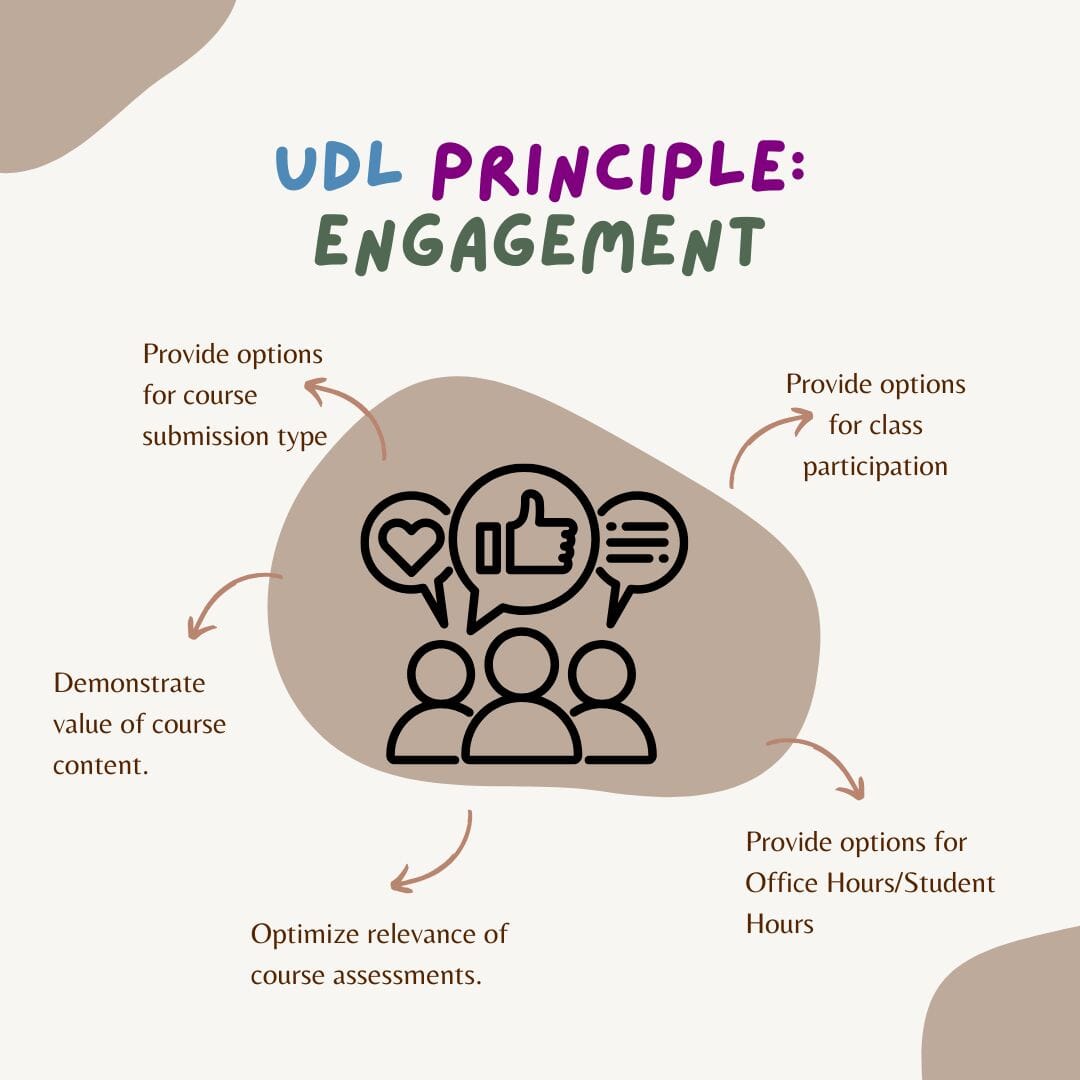
Image 1: Options for adhering to UDL principles for Engagement: 1. Provide options for course submission type 2. Demonstrate value of course content 3. Optimize relevance of course assessments 4. Provide options for office hours/student hours 5. Provide options for classroom participation
Students differ in the ways that they perceive and comprehend information that is presented to them. Some students grasp information quicker or more efficiently through visual or auditory means, while others prefer to read and annotate printed text. Learning, and transfer of learning, occurs when multiple representations are used, because they allow students to make connections within, as well as between, concepts. In short, there is not one means of representation that will be optimal for all learners; providing options for representation in your course materials is essential. 5 Below are a few options for incorporating multiple means of representation into your course.
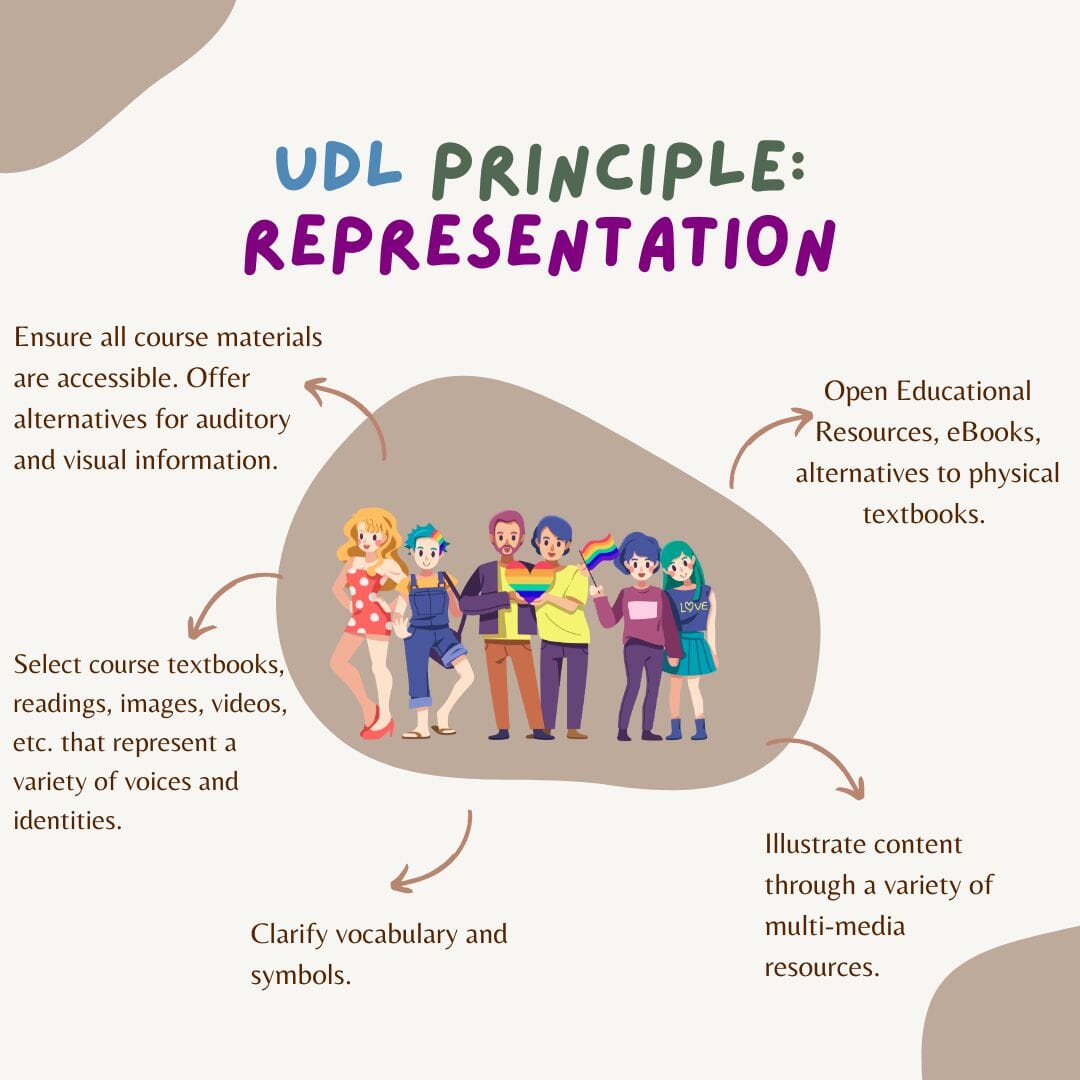
Image 2: Ways to provide multiple means of representation: 1. Ensure all course materials are accessible. Offer alternatives for auditory or visual information 2. Select course textbooks, readings, images, videos, etc. that represent a variety of voices and identities 3. Clarify vocabulary and symbols 4. Illustrate content through a variety of multi-media resources 5. Open Education Resources, ebooks, alternatives to physical textbooks.
Students differ in the ways that they can navigate a learning experience and express what they know. In reality, there is not one means of action and expression that will be optimal for all learners; providing options for action and expression is essential. It is important to provide a number of ways for students to demonstrate their knowledge so that you can evaluate if they have fully attained course learning outcomes and achieved their learning goals.
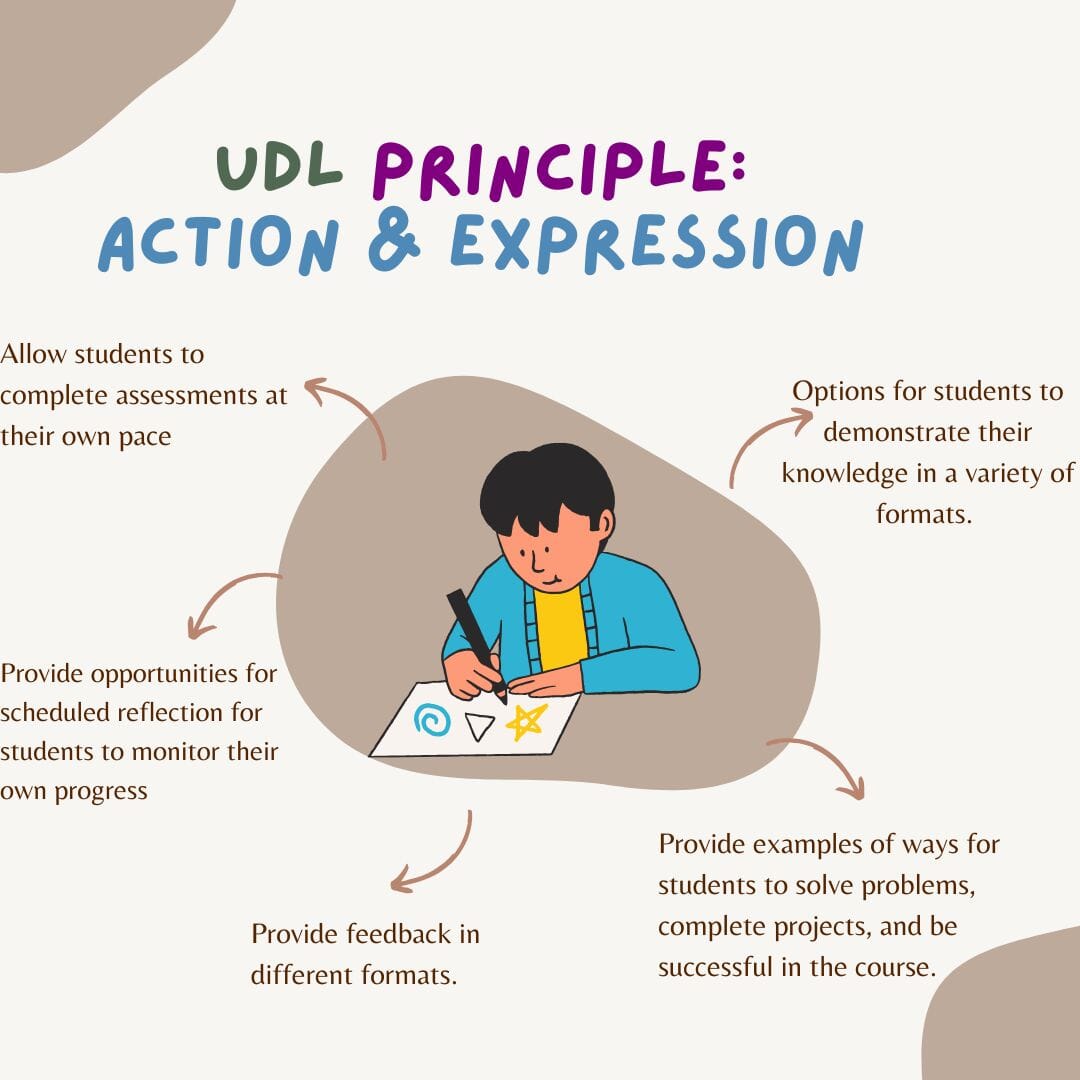
Image 3: You can provide multiple means of action & expression by: 1. Allowing students to complete assessments at their own pace 2. Provide opportunities for reflection and progress monitoring 3. Provide feedback in different formats 4. Provide examples of ways for students to solve problems, complete projects and be successful in the course.
References:
- About universal design for learning. CAST. (2022, February 8). Retrieved September 6, 2022
- Action & Expression. UDL.. (2018, January 12). Retrieved September 6, 2022
- CAST. (2022, September 1). Retrieved September 6, 2022
- Engagement. UDL. (2018, January 12). Retrieved September 6, 2022
- Representation. UDL. (2018, January 12). Retrieved September 6, 2022
- The UDL guidelines. UDL. (2022, September 2). Retrieved September 6, 2022
What is UDL?
Websites about UDL
- CAST – About Universal Design for Learning
- Universal Design For Learning In Higher Education
- What is UDL?
- Mowhawk College - Universal Design for Learning
- AHEAD (Ireland) - Universal Design for Learning
- AHEAD (Ireland) - UDL Framework Explained
- The Goodwin Institute for Learning Innovation - UDL Video Series
- Cornell University Center for Teaching Innovation – Universal Design for Learning
- Georgetown University – Universal Design for Learning
- CNDLS, Georgetown University. Inclusive Pedagogy Toolkit.
- Technologies in Learning and Teaching – Syllabus Accessibility Statements
- University of Oregon – Universal Design for Learning
- Iowa State University – Universal Design for Learning
Media about UDL
- Accessibility and UDL [Video]
- Innovation at the Margins [Video]
- UDL and Assessment [Video]
- UDL in Higher Education [Video]
- UDL and the Brain: Teacher Vlog [Video]
- UDL and Retention [Video]
- Neuroscience and UDL [Video]
- Think UDL [Podcast]
- UDL in 15 Minutes [Podcast]
- Goodwin Teaches: Universal Design for Learning Stories in Higher Education [Podcast]
Updated: 10/23/2026 03:15PM