
Composer Portrait:
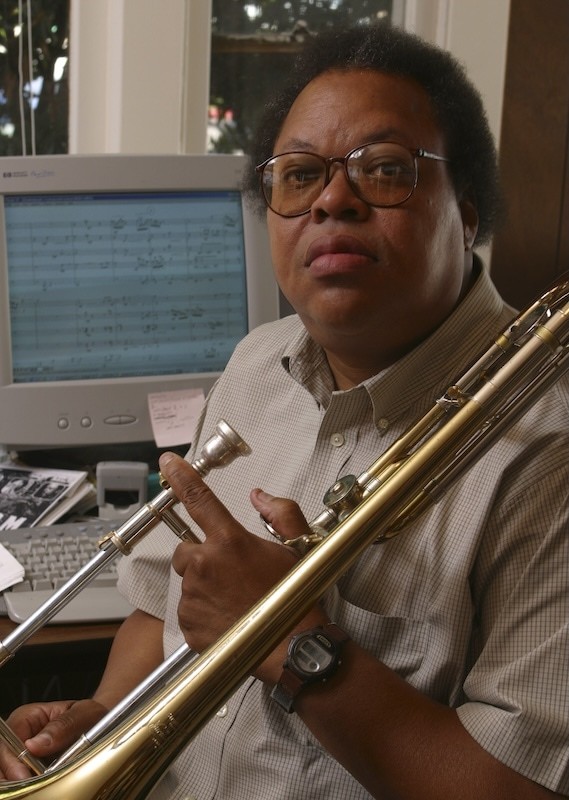
George Lewis
by the DMA in Contemporary Music cohort
Tuesday, September 29, 2026
8:00 P.M. Bryan Recital Hall
Moore Musical Arts Center
Program
Shadowgraph, 5 (1977)
Jared Beu, Cole Habekost, Chris Harris, Will Hermanowski, Martha Hudson, Jake Loitz, Gloria Pan, Sam Valancy
Emergent (2014)
Shannon Lotti (DMA '26), flute
Endless Shout (1994)
Stephen Eckert (DMA '26), piano
Un petit brouillard cérébral (2020)
Cole Habekost, violin
Oraculum (2016)
Wesley Nielsen, trombone
Thistledown (2012)
Zihua Ma, violin; Liam Battle, cello; Francisca de Castanheiro de Freitas, piano; Jacob Koch, percussion
The DMA Composer Portrait series is made possible with support from the MidAmerican Center for Contemporary Music, Dean William Mathis, the Composition area, and Department of Musicology, Ethnomusicology, Composition, & Theory
Program Information
"George Lewis is one of the most formidable figures in modern music: a composer of international renown, a legendary improvising trombonist, a computer-music pioneer, a professor at Columbia, a stalwart of the Black avant-garde collective known as the Association for the Advancement of Creative Musicians." —Alex Ross, The New Yorker
George Lewis (b.1952, Chicago, Illinois) is the Edwin H. Case Professor of American Music at Columbia University. He is a member of the Association for the Advancement of Creative Musicians (AACM), a Fellow of the American Academy of Arts and Sciences and the American Academy of Arts and Letters, and a Corresponding Fellow of the British Academy, as well as a member of the Akademie der Künste Berlin. Further honors include the Doris Duke Artist Award, a MacArthur “Genius” Fellowship, and a Guggenheim Fellowship. He is the author of A Power Stronger Than Itself: The AACM and American Experimental Music (University of Chicago Press), and the co-editor (with Harald Kisiedu) of Composing While Black: Afrodiasporic New Music Today/Afrodiasporische Neue Musik Heute(Wolke-Verlag). Lewis is a Yamaha Artist and is regarded as a pioneer in the creation of improvising computer programs using generative artificial intelligence. He holds honorary doctorates from the University of Edinburgh, Harvard University, the University of Pennsylvania, Oberlin College, the School of the Art Institute of Chicago, New England Conservatory, New College of Florida, Birmingham City University, and the Curtis Institute of Music. (Bio courtesy Wise Music Classical)
Shadowgraph, 5 is the last in a series of works for "creative orchestra" that I made between 1975 and 1977. There is no centralized score or conductor, and instrumentation is relatively open. Any number or combination of performers, from solo to full orchestra, can realize the piece's task instructions, choosing them as needed. The work is open to performers from any musical tradition, including those that do not regularly include improvisative modes of performance. Extensive prior experience with improvisation, while welcome, does not necessarily confer an advantage. The duration of the piece is determined by real-time negotiation and consensus. The success of a given performance of this work will be less a question of individual freedom than of the assumption of personal responsibility for the sonic environment. When performed well, Shadowgraph, 5 becomes a meditative evocation of weather. The work was composed for the AACM Big Band.
Emergent, written for Claire Chase's Density 2036 project, addresses Edgard Varèse's avowed preference for sound-producing machines over sound-reproducing ones by productively conflating the two. The combination of relatively long digital delays, interactive digital spatialization, and timbre transformation transforms the fully scored flute material into a virtual, quasi-improvisative orchestral space, creating a dance among multiple flutists following diverse yet intersecting trajectories in which nonlinearity is invoked and uncertainty is assured. Rather than presenting the redundant truism of a composer "working with time," this work is created in dialogue with my deliberate misprision of Varèse's stated intention for his 1958 Poème électronique to introduce "a fourth [dimension], that of sound projection" to music. Varèse's statement seems to obliquely invoke the notion of spacetime, an interpretation supported by a 1968 account of one of the composer's dreams that suggests the related notion of quantum teleportation as well as the sound of my piece: "He was in a telephone booth talking to his wife, who was at the time in Paris. His body became so light, so immaterial, so evanescent that suddenly, limb by limb, he disintegrated and flew away toward Paris, where he was reconstructed, as though all his being had become spirit."
Endless Shout is part of an open-ended, striated network of sonic codes that announce membership in what literary theorist Houston A. Baker Jr. calls the "blues matrix." Baker's notion of "blues utterance" presents a living, mutable, mobile, noisy, unstable, vibrant—and ultimately infinite set of possibilities. The work pays homage to the great stride and boogie-woogie pianists: James P. Johnson, Luckey Roberts, Willie "The Lion" Smith, Thomas "Fats" Waller, Albert Ammons, Pete Johnson, Meade Lux Lewis, Dorothy Donegan, and Winifred Atwell. Endless Shout is dedicated to Muhal Richard Abrams (1930–2018), whose passion for the music of these brilliant artists led me to a deeper understanding of their impact on world culture, while provoking me to reinterpret blues utterance in the light of my own present-day experience. The piece was commissioned by the pianist Frederic Rzewski, who gave the first performance at the Ijsbreker (Amsterdam) in March, 1994.
The work is organized in four movements, performed with suitable short pauses between them.
I. Smashing Clusters
II. The Slowest Drag
III. Intercessions
IV. Doin’ the Hicty-Dicty
Un petit brouillard cérébral (A little brain fog): One of the frequent topics around composing under pandemic lockdown conditions involved a hopeful, optimistic gloss. People very confidently said, "Well, here you are, you're at home, you can't go anywhere. So you're going to get all this work done." Well, it turned out that many people didn't get the work done. For some reason it was difficult to stay tuned in. A French colleague of mine called this simply "la maladie."
There's always somebody who can overcome these things relatively easily, but I wasn't one of those. In fact, it was only in the last few weeks before the piece was due that I was able to even think about writing it. But you have to try to make something. So I made recourse to the age-old American trope of depiction, from Blind Tom to Amy Beach to Charles Ives to Duke Ellington. The piece itself is an example of Ellington's "tone parallels," providing a sense of what it was like to be swimming around in the brain fog, fighting for focus.
The affective substrate for Oraculum comes from two related sources: divination and voice. Near the end of her life, my mother became occupied with filling spiral notebooks with odd sets of numbers. I wondered what this activity might symbolize — or portend. Then I came across her collection of "dream books." The 19th century produced a large variety of such pamphlets, including the apocryphal "Napoleon's Oraculum," purportedly discovered in an Egyptian royal tomb, translated from the hieroglyphic, and adopted by Bonaparte himself in military engagements. But my mother's dream books were very different from Napoleon's. For her, a 1950s participant in the Great Migration of the descendants of former slaves from the rural American South, a boulder of salt was required in encountering interpretations such as, "If you dream of a Negro, your desires will be unfulfilled." In contrast, the notion of the oracular led me to the trope of the trombone as God's voice, variously attributed to Beethoven, Brahms, Martin Luther, James Weldon Johnson, and Hildegard of Bingen, who called herself "die Posaune Gottes." The notion of the trombone as the ultimate voice, the cryptic word of the oracle, allows me free rein in my musical imagination.
Thistledown: Written for and premiered by Ensemble Either/Or in 2012, the title of the work is drawn from Greg Bear's novel Eon (1985), in which a team sent to investigate the sudden appearance of an enormous asteroid in Earth's skies discovers that the asteroid is in fact a human-built starship from their own future, which has now overlapped with their present. Named "Thistledown" by its builders, the asteroid contains various chambers, including a highly evolved city, but the seventh chamber, a human technological construct called "The Way," appears to stretch beyond the dimensions of the asteroid, leading to parallel universes that render irrelevant the notion of a single, final destination for the starship's journey. Analogously, my piece could be said to present a number of chambers that listeners may visit and inhabit. Each chamber possesses its own character, while overlapping temporally with others to present a rough and smearing future at ironic odds with the fragility implied by the work's title, and continually deferring all teleological reckoning.
—George Lewis
The DMA in Contemporary Music at BGSU
The DMA in Contemporary Music program at BGSU develops versatile musicians through a concentrated focus on contemporary music. The degree is grounded in the applied study of music performance or composition, and multidisciplinary seminars in culture, digital media and music cognition. Its flexible curricular programming fosters critical analysis, creative examination, pedagogical training, professional development and traditional as well as nontraditional performing experiences. Graduates of the program have been recipients of major grants and awards and maintain leadership positions at the forefront of contemporary music around the world as performing musicians, scholars, and teachers. More information about the DMA program is available here.
Updated: 09/29/2026 03:58PM