
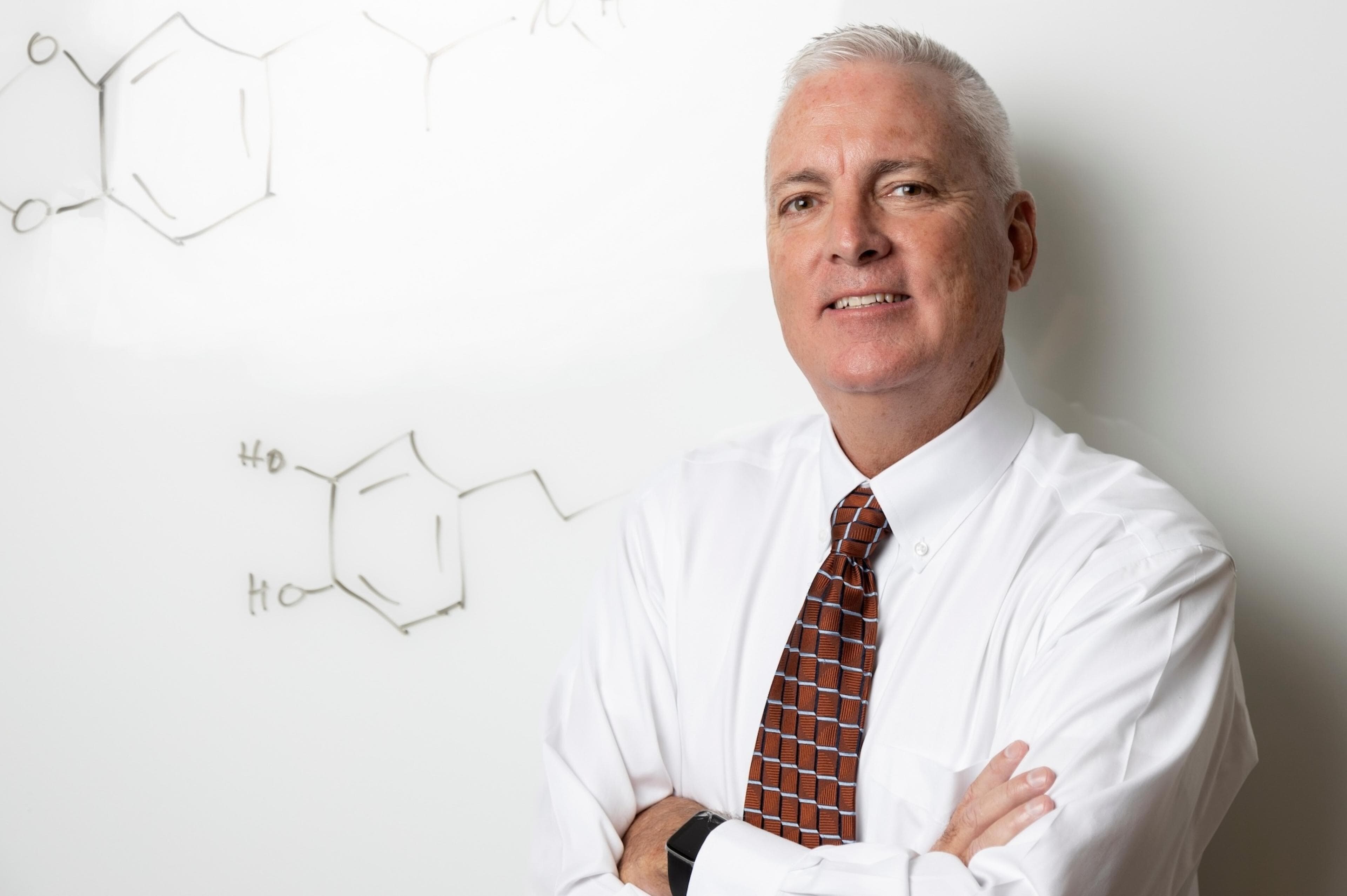
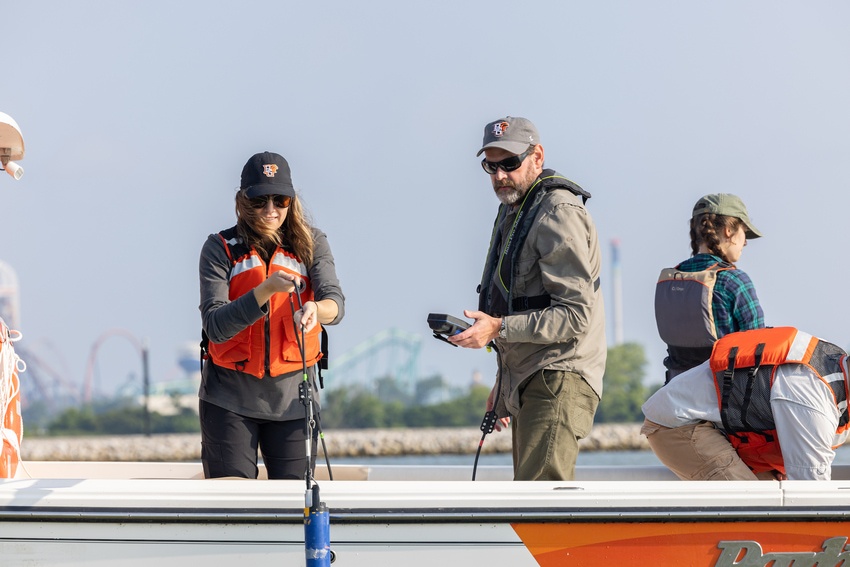
BCI Eminent Scholar Jon Sprague, R.Ph., Ph.D., is working with the Ohio Attorney General's Bureau of Criminal Investigation to help alert first responders and other medical personnel about the dangers of a potent opioid appearing in the state. (BGSU photo)
BGSU Department of Forensic Science’s partnership with the Ohio Attorney General’s Bureau of Criminal Investigation provides statewide reach
Jon Sprague, R.Ph., Ph.D., the BCI Eminent Scholar at BGSU, is leading the educational push to alert physicians and other healthcare providers about cychlorphine, a highly potent synthetic opioid even more dangerous than fentanyl.
Key Highlights
Researcher: Jon Sprague, R.Ph., Ph.D.
Position: BCI Eminent Scholar
Speciality: Pharmacology, toxicology
BGSU researcher helps identify emerging drug threat in Ohio
BCI chemists came to Jon Sprague, R.Ph., Ph.D., for help identifying a powerful compound called cychlorphine, a compound 10 to 40 times more powerful than fentanyl that has started appearing in Ohio.
Educating communities about cychlorphine
Sprague is providing educational information to the medical community and general public about the dangerous compound, which can take several doses of naloxone to reverse.
Helping shape Ohio drug policy
As part of the University's partnership with the Ohio Attorney General's office, Sprague played a key advisory role that helped Ohio pass the first "pharmacophore rule" law in 2014.
“When clandestine laboratories make these pills, there is no quality assurance whatsoever. It’s really a Russian Roulette game you play with these tablets: You never know exactly what you’re getting.”
JON SPRAGUE, R.Ph., Ph.D.
BCI EMINENT SCHOLAR AT BGSU







When chemists at the Ohio Bureau of Criminal Investigation (BCI) came across a dangerous drug they had not seen before, they sought out an expert at Bowling Green State University to help identify the compound and inform the state’s emergency medical community.
A powerful synthetic opioid called cychlorphine – which can be anywhere from 10 to 40 times more potent than fentanyl – has started appearing in illicit street drugs in Ohio, seemingly the latest ‘new’ compound.
For Jon Sprague, R.Ph., Ph.D., the BCI Eminent Scholar at the BGSU Center for the Future of Forensic Science, cychlorphine’s appearance was simply the latest chapter of the same story – a powerful opioid arrives, looks to be structurally different from any of its predecessors and creates shock among the people who encounter it.
“The chemists at BCI began to see this new compound and came to me and said, ‘What is this?’” Sprague said. “I started working with them to help get something out in the literature to let physicians and other healthcare providers know about this ‘new’ compound that is more potent than fentanyl and may take more than one dose of naloxone to reverse it.
“With this one, we can’t treat it like a standard opioid overdose.”
Sprague, in collaboration with BCI and Mercy Health, authored one of the first scholarly case reports on the drug in the journal Clinical Toxicology in an effort to help the medical community understand that they may encounter a patient who has ingested a compound even stronger than fentanyl.
BGSU, which maintains a partnership with the Ohio Attorney General’s Office and is home to an on-campus Ohio BCI crime lab, has played a unique, enduring role in helping its home state combat the opioid crisis.
Sprague played an integral role in helping Ohio become the first and only state to pass “pharmacophore rule” legislation, which first went into effect in 2014 and has seen modifications in recent years.
The Federal Analogue Act, passed in 1986, previously defined controlled substances based on their chemical structures. Years later, that language provided a technicality under which new synthetic drugs could thrive faster than lawmakers could classify them as controlled substances.
Clandestine labs manufacturing synthetic opioids could take a known compound and simply add one ketone – a compound with a carbonyl group – and create something structurally different. As synthetic opioids became more prevalent street drugs in the 2010s, labs easily created new compounds that acted exactly like a similar drug in practice, but were not, by letter of the law, classified substances.
“The Federal Analogue Act said it had to be structurally similar, so a true chemist is going to see that ketone and say it’s no longer structurally similar. A pharmacologist looks at it and knows it makes very little to no difference – it’s still going to participate in binding to the drug target,” Sprague said. “For years, we played this game where we were always behind.”
Ohio’s fentanyl pharmacophore law preempts the creation of new synthetic opioids by automatically classifying compounds with the fentanyl pharmacophore as Schedule I controlled substances. Cychlorphine, which was first synthesized in the 1950s and deemed too potent for widespread use, is the exact type of compound the law was designed to combat.
Sprague said education on these compounds – for medical professionals, law enforcement and the general public – is paramount. Given the lack of precision in illicit drugs, users who believe they are taking a known compound like Xanax or Adderall can, in fact, be ingesting lethal doses of synthetic opioids, powerful tranquilizers like xylazine or both.
Sprague said even one interaction with a compound as powerful as cychlorphine, often acquired through dark web channels that appear and disappear in a matter of hours, can be fatal.
“When clandestine laboratories make these pills, there is no quality assurance whatsoever,” he said. “There’s no measuring. It’s using a spatula to dole it out, so you may get a tablet that is 100% cychlorphine and another tablet that’s pure filler.
“It’s really a Russian Roulette game you play with these tablets: You never know exactly what you’re getting.”
The message Sprague said he hopes to get to medical professionals in Ohio and beyond is to be even more aggressive with their usage of naloxone when they have a patient displaying the opioid overdose triad: depressed breathing, pinpoint pupils and unconsciousness.
Due to cychlorphine’s potency, Sprague said saving someone’s life could take several doses of naloxone.
“You have to assume you have a very potent, fentanyl-like drug, and begin to push naloxone like you’ve not pushed before,” Sprague said. “That may be the biggest thing to get across: even if you’ve stopped at a certain point previously, don’t with this one. Keep pushing.”
Related Stories
Updated: 09/25/2026 01:43PM