
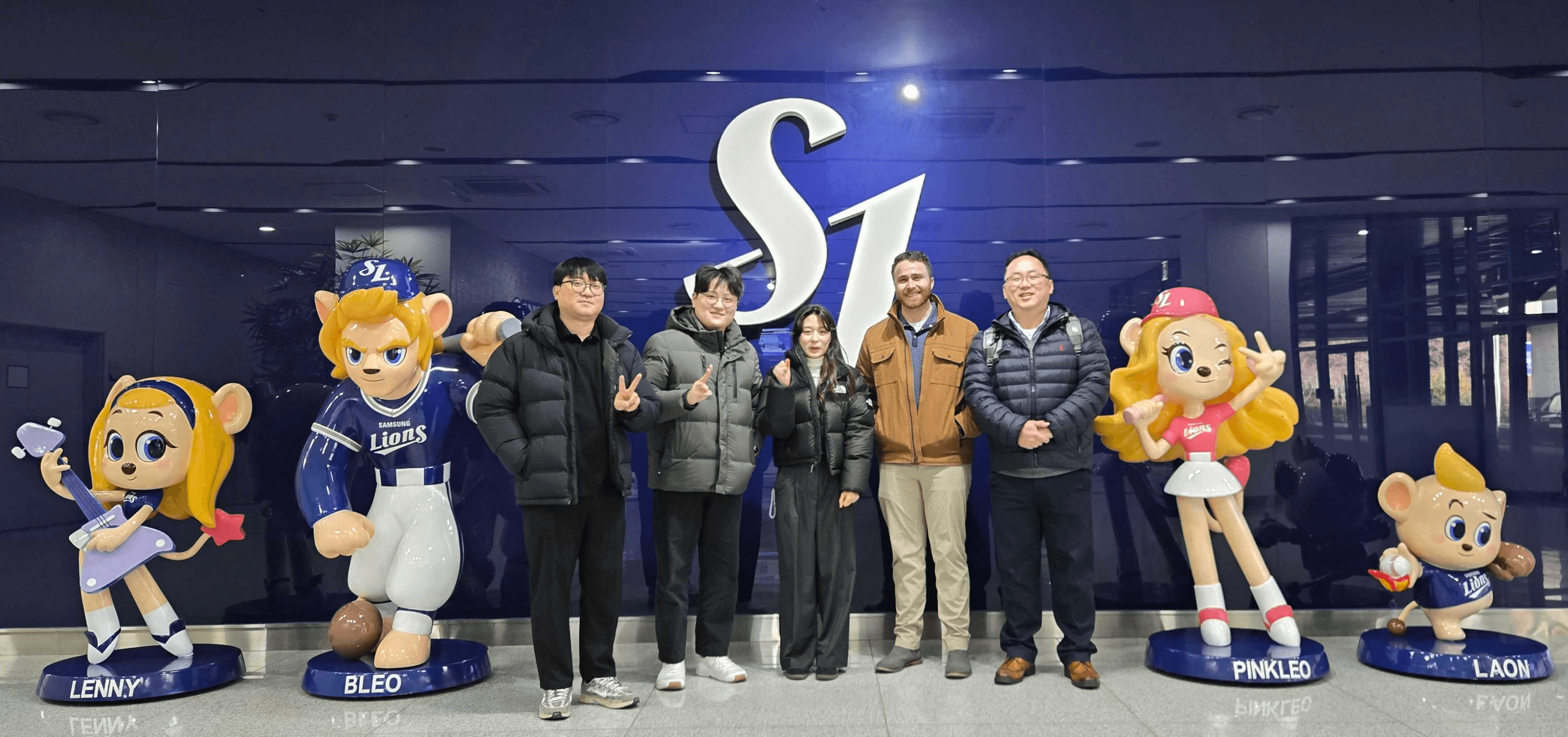
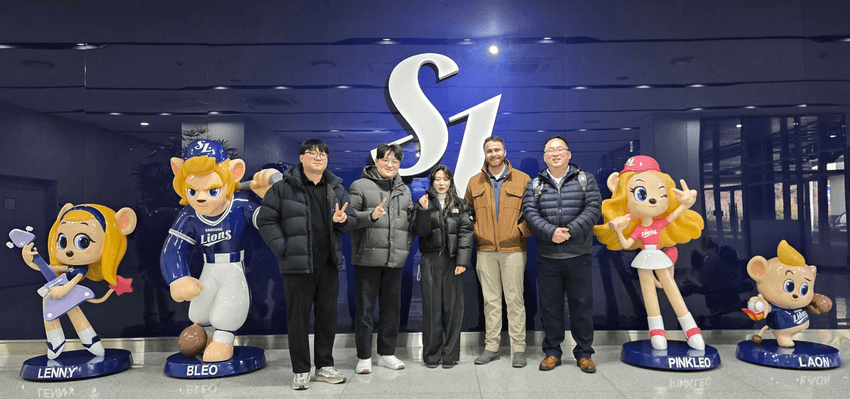
BGSU associate professor of computer science JK "Jake" Lee, Ph.D., right, visited South Korea as part of his work with the Samsung Lions of the Korean Baseball Organization. (Contributed photo)
The Samsung Lions, one of the top teams in the Korean Baseball Organization, asked JK “Jake” Lee, Ph.D., to analyze their sprawling dataset using machine learning and artificial intelligence
When the Samsung Lions of the Korean Baseball Organization needed an analytical boost, the club came to Bowling Green State University faculty member JK "Jake" Lee, Ph.D. The Fulton Associate Professor of computer science at BGSU, Lee used machine learning and artificial intelligence to analyze a massive dataset and devise practical actions the team can use on the field.
Key Highlights
Faculty member: JK "Jake" Lee, Ph.D.
Research specialty: Machine learning, AI applications, data visualizations
Partnership: Samsung Lions of the KBO
Answering the call from around the world
The Samsung Lions came to Jake Lee with a big request: turning the club's massive collection of pitch-by-pitch data over many years into a statistical analysis that could provide the team with useful information.
Combining research and baseball
Lee, whose research expertise includes machine learning and various applications of artificial intelligence, used his acumen inside professional sports to help the Samsung Lions make informed decisions on things like matchups, the batting order or when to use a pinch hitter.
A renowned history at Bowling Green
BGSU offers data science at every academic level: a data science specialization within the bachelor’s degree in computer science, a master’s degree in data science and a Ph.D. in data science, and it was the very first school in Ohio to offer a bachelor's degree in computer science in 1969.
“In the past, teams would look at this pitcher because of x, y, z, or send out the hitter because his numbers are high, no matter who the pitcher is. We were hoping machine learning could pick up things that the traditional statistical analysis might not see.”
JK "JAKE" LEE, PH.D.
FULTON ASSOCIATE PROFESSOR
CHAIR, BGSU COMPUTER SCIENCE DEPARTMENT



More than 6,000 miles away from Ohio, a professional baseball team is leaning on the analytical expertise of a Bowling Green State University computer science faculty member to gain a competitive advantage.
JK “Jake” Lee, Ph.D., the David and Amy Fulton Professorship associate professor and the chair of the BGSU Computer Science Department, collaborated with the Samsung Lions of the Korean Baseball Organization to combine his research acumen with baseball.
The club came to Lee with a big request: turn a massive dataset into practical information that can help the team’s on-field performance.
“The idea was to use the player data they had – like the speed the pitcher threw the ball or the angle it came in – and use machine learning and AI,” Lee said. “The first part of the system is to teach AI the rules and the play mechanism of baseball, and the second part would be to come up with some useful information that the team can use.”
The Lions finished the regular season with 83 wins, a nine-game improvement from last season and their most since 2015, and placed second in the KBO’s 142-game regular season. After defeating the Kia Tigers in the playoff semifinal over the weekend, the club advanced the Korean Series, the KBO’s equivalent of the World Series.
The club originally reached out to Lee to help the team devise ways to use data to make more informed decisions. One natural advantage of baseball is that every move can be tracked, leading to accurate incoming data that provides a quality foundation for data scientists.
Lee, whose research deals with machine learning and AI applications, data visualizations and pattern recognition, among other things, was a natural fit for baseball.
“Baseball has cleaner datasets than most other sports data, so we had a pitch-by-pitch dataset – every single pitch for many years,” Lee said. “Data scientists look at baseball as a clean dataset to create a system.”
Baseball games present thousands of permutations at any given moment, so the team is leaning on Lee’s expertise to create recommended actions based on various game situations. The idea behind machine learning within the analysis is to find data points and trends that humans might otherwise miss, Lee said, and give the team more information on how to strategize against a particular pitcher, when to use a pinch hitter or how to structure the batting order.
For example, conventional wisdom in baseball suggests that a manager should favor his right-handed hitters against an opposing team’s left-handed starting pitcher. In the vast majority of cases, left-handed hitters fare worse against left-handed pitchers, an advantage for the team in the field.
But general rules do not always apply equally – and the analysis can look at every available matchup and each player individually to make decisions.
Hypothetically, if the dataset were to reveal that a particular left-handed hitter abnormally displays better underlying power metrics against left-handed pitchers – higher exit velocity and higher launch angles that lead to home runs – the analysis might suggest he should not only be playing against the left-handed starter, but he should be higher in the batting order to maximize the number of times he could bat while the starter is in the game.
Finding the useful kernels of information within the vast expanse of numbers is ultimately what Lee trained machine learning to do.
“In the past, teams would look at this pitcher because of x, y, z, or send out the hitter because his numbers are high, no matter who the pitcher is,” Lee said. “We were hoping machine learning could pick up things that the traditional statistical analysis might not see.”
Bowling Green – home to the first computer science undergraduate program in Ohio – has been at the forefront of the field for years.
BGSU offers data science at every academic level: a data science specialization within the bachelor’s degree in computer science, a master’s degree in data science and a Ph.D. in data science. The department also offers bachelor’s degrees in computer science and software engineering with a specialization in cybersecurity, and a master’s degree in computer science, programs that have attracted students, faculty and collaborators from around the world.
“We were up front in the race because not a lot of universities offered a Ph.D. in data science,” he said. “At the time we created the Ph.D., we were the only school in the nation that offered undergraduate, master’s, and doctoral data science programs.”
Baseball is one of many areas where these data science methods can be applied, and the work with the Lions extended Lee’s research to professional sports, where the Lions hope data-informed decisions can help them sustain success on the field.
“Similar to other research we do in the field of data science, the idea is that a machine learning algorithm might be able to see things that we can’t,” Lee said. “Many sports teams are trying to do something similar: they want to find the things that cannot be found by humans.”
Related Stories

Updated: 11/03/2026 02:21PM