

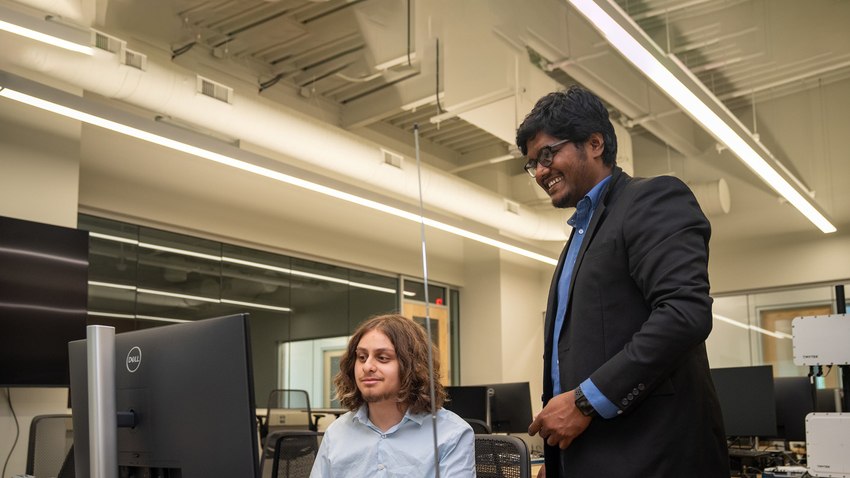
Nicholas Sauer and Fynn Beard '26, pictured at the College of Engineering and Innovation Design Day, developed an aviation research project through CURS funding that earned national recognition. (Contributed photo)
Fynn Beard '26 and Nicholas Sauer became the first-ever BGSU students to win honors from the prestigious ACRP Design Competition
Two Bowling Green State University students, Fynn Beard '26 and Nicholas Sauer, entered a project originally sponsored by the BGSU Center for Undergraduate Research and Scholarship into a prestigious national competition, at which they won a second-place award for their look into airport safety. Working with their faculty advisors in the BGSU School of Aviation, the pair examined multiple ways to make uncontrolled airports safer for air traffic.
Key Highlights
Students: Fynn Beard '26 and Nicholas Sauer
Program: Aviation
Award: Second place in ACRP University Design Program
Improving airport safety
As aviation students, Fynn Beard '26 and Nicholas Sauer recognized a safety issue worthy of more research: many U.S. airports do not have air traffic control.
Supporting undergraduate research
Beard and Sauer received initial funding from CURS, then refined their research project with the help of expert faculty in the School of Aviation.
Exploring new air traffic control solutions
Beard and Sauer researched the idea of merging remote and mobile air traffic control, a possible answer to upgrade safety at uncontrolled airports.
“Getting the data to prove this was a problem was difficult, but as flight students, we knew this was a problem. We wanted to see what we could do to make it better.”
NICHOLAS SAUER
BGSU SENIOR





As aviation undergraduates at Bowling Green State University, Fynn Beard ’26 and Nicholas Sauer identified a problem in their field and used a research project to explore the issue further.
Months later, the pair earned national recognition for their work.
Beard and Sauer became the first-ever BGSU students to submit a packet to the prestigious Airport Cooperative Research Program (ACRP) University Design Competition, a program of the Transportation Research Board (TRB) of the National Academies of Sciences, Engineering and Medicine.
The competition challenges students to work with advisors to consider innovative approaches and find pragmatic solutions to issues facing airports. Beard and Sauer’s project – which competed against engineering and technology teams from elite universities across the United States – placed second in the airport safety, operations and maintenance challenge, for which they were awarded a cash prize, a certificate and a plaque for the University.
With the aid of expert aviation faculty advisors and initial funding from the BGSU Center for Undergraduate Research and Scholarship, Sauer and Beard proposed a forward-thinking solution to a significant problem: many airports lack air traffic control.
“A lot of people who aren’t in the aviation industry don’t realize that the majority of airports in the United States don’t have air traffic control,” said Sauer, who hails from Dayton. “At uncontrolled airports, it’s completely up to the pilots to keep themselves safe.”
Working with their faculty advisors in the BGSU School of Aviation, assistant professor Shantanu Gupta, Ph.D., and associate professor Jacob Shila, Ph.D., Beard and Sauer examined multiple ways to make uncontrolled airports safer for air traffic.
Their initial ideas considered remote air traffic control, a system that uses cameras and sensors to send information elsewhere, and mobile air traffic control, through which the operation can be moved as needed – eventually combining the two ideas into a coherent design solution.
“We took both of those designs and merged them together,” said Beard, a Toledo native. “We wanted to know, ‘Can you do this and move it from airport to airport, wherever you might need it?’”
The process of completing an undergraduate research project provided an extra career boost to both students, who not only earned a significant honor for their effots, but also experienced the same feeling as many professional researchers when they discovered there was not much existing material on their proposed topic.
When Beard and Sauer began their literature review and accumulation of existing data, they found the information they sought wasn’t being collected at the type of airports they wanted to study — a sure sign they were onto something.
“Honestly, the lack of information was surprising,” Beard said. “As we were going through the project, we kept finding information was more difficult to find from these uncontrolled airports.”
Sauer and Beard added another layer to the research that could help both uncontrolled airports and future researchers.
They addressed the lack of air traffic control with a merged system, but also proposed that data collected from the system could be tracked and analyzed with artificial intelligence – providing key insight into uncontrolled airports.
“We gave more uses for this system than just providing air traffic control,” Sauer said. “With the AI element, that is going to be a big part of the data collection. There aren’t people at these uncontrolled airports that can monitor data, but AI certainly can.”
For uncontrolled airports, federal authorities only publish operations data, which tracks takeoffs and landings.
Entering the project into the ACRP competition and earning national recognition became a pleasant surprise for Beard and Sauer, who began their research idea as a means to make uncontrolled airports safer places.
“We knew that our main audience and the target for this was these types of airports,” Sauer said. “We know how many operations happen per year at uncontrolled airports, but they don’t publish information on near mid-air collisions or runway incursions. At controlled airports, air traffic control is there and monitoring all of this.
“Getting the data to prove this was a problem was difficult, but as flight students, we knew this was a problem. We wanted to see what we could do to make it better.”
The student’s award became the latest success at BGSU, where undergraduate research recently reached record levels. Many students gain a new understanding of their degree programs through research and other scholarly activities during a CURS project, which often jumpstarts career success.
Glenn Davis, Ph.D., the vice president of student engagement and success, said students who undertake a project as undergraduates often develop enduring skills and knowledge.
“A CURS project allows you to work in depth in one area that certainly helps you excel in your degree program, but what you’re also learning are skills that are transferable to many other areas,” Davis said. “It’s about knowledge creation: you identify your specific topic, develop an approach, learn how to present your findings and work closely with a faculty member.
“It’s a great experience for anybody who tries it.”
Related Stories
Updated: 09/29/2026 07:34PM