
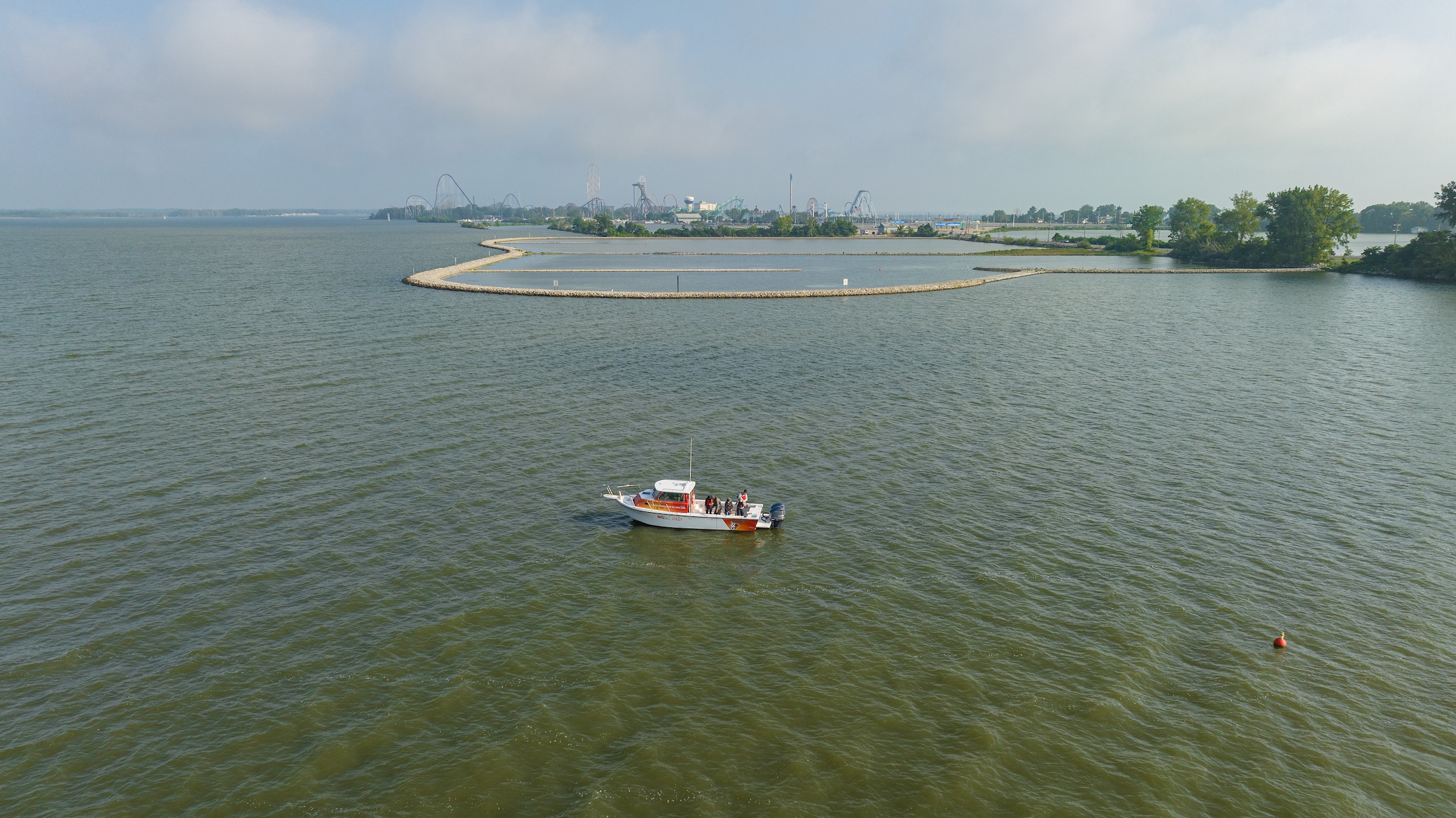
BGSU research could help farmers cut fertilizer costs and reduce Lake Erie algal blooms
Estimated Reading Time:
Mir Md Tasnim Alam’s thesis project could have wide-ranging applications for farms, both saving farmers money and mitigating algal blooms
A research idea that began as a Bowling Green State University geology student’s pragmatic thesis project could be a winning solution for farmers and the Lake Erie watershed alike.
Mir Md Tasnim Alam '24, a native of Bangladesh who came to Bowling Green to study under Anita Simic Milas, Ph.D., a professor in the School of Earth, Environment and Society, discovered his research interests applied to northwestern Ohio’s biggest environmental issue: algal blooms in Lake Erie. The overuse of synthetic fertilizers contributes to nutrients – mostly nitrogen and phosphorus – entering water sources and fueling algal blooms.
With the guidance of Milas – who also connected Alam to Jochem Verrelst, a researcher from Valencia University in Spain – Alam developed the idea to use satellite and drone imagery to conduct a geospatial analysis of nutrients on farm fields, a dataset that can give farmers a pinpoint reading of exactly where their fields need fertilizer, directly addressing the issue of nutrient runoff and reducing a major expense for farms.
“We have a lot of agricultural land in this part of Ohio, so we want to know where to put chemicals, and just as importantly, where not to put chemicals,” Alam said. “If you have a plot of land, some areas don’t need fertilizer to grow corn or soybeans or whatever you’d like to grow. In some areas, you might need to apply chemicals. We need to know those areas.”
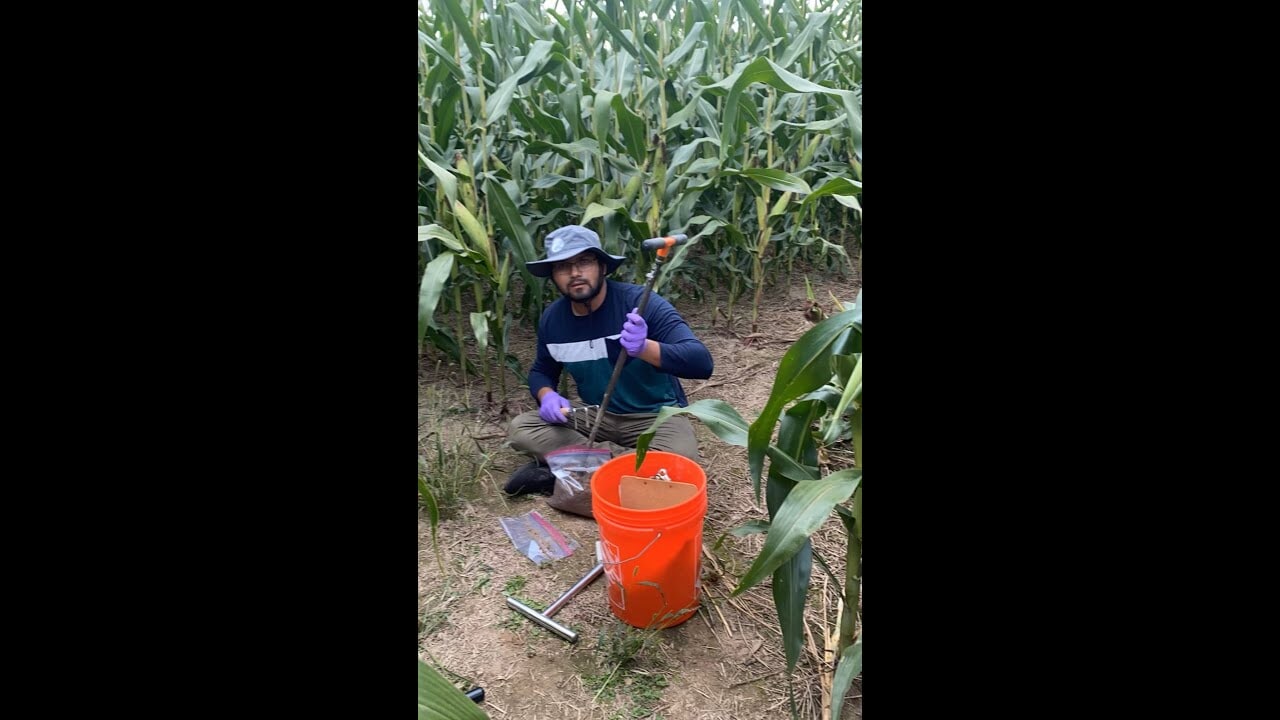
Alam’s innovative research led to a full-time role at Satelytics, a Perrysburg-based software company that specializes in geospatial analysis, whose origins began at BGSU.
Water quality research at BGSU is world-renowned, but Alam’s project addressed the issue of agricultural runoff from a new angle.
Historically, determining the nutrient levels on farm fields has been a tedious and imperfect process. Farmers could determine chlorophyll levels in their corn plants only by taking corn leaves, sending them to labs to be ground and waiting weeks for the results.
But with acres of farmland, a sampling of a few dozen leaves is often not enough to paint a full picture of where a field needs nutrients.
Satellites and drones, however, can map full fields quickly and accurately, data which Alam combines with other forms of data analysis like machine learning, advanced mathematics and deep learning. Images collected by satellites and drones are far more precise than the human eye, which can see a fraction of their counterparts in the sky.
“Satellites can give us so much more information than our eyes can,” Alam said. “Satellites can see hundreds of different bands, while our eyes can only see bands of red, green and blue. With that information, we can know exactly where to put fertilizer.”
The result is a map that proves invaluable for farmers: exact locations of where they need chemical applications.
The data allows a farmer to pay up front for maximum efficiency, thereby saving costs in the long run through applying less fertilizer.
“In that map, you will know which portions of your agricultural land have high or low levels of chlorophyll, nitrogen and phosphorus,” he said. “If you are a farmer, what you would do previously is apply the same amount of phosphorus fertilizer over your entire land. But with that map, you can see which parts of your land already have enough phosphorus, so you don’t need to put fertilizer there.”
Alam called himself “very thankful to Bowling Green and to Antia” for allowing him license to explore the project in depth, which already has paid personal and professional dividends and could be a key piece of the puzzle for the Lake Erie watershed.
During his time at BGSU, Alam’s complex research began with a simple idea: helping address an issue of great importance.
“The biggest problem we face in this part of Ohio is algal blooms,” Alam said. “If we can help reduce the use of fertilizers, pesticides and herbicides, it not only helps the environment, it helps farmers reduce their costs and helps all residents of Ohio.
“Everyone would win in this situation, so it really started when we just asked how we could help fix this.”
Related Stories


Media Contact
Michael Bratton | mbratto@bgsu.edu | 419-372-6349
Updated: 06/29/2026 06:02PM