
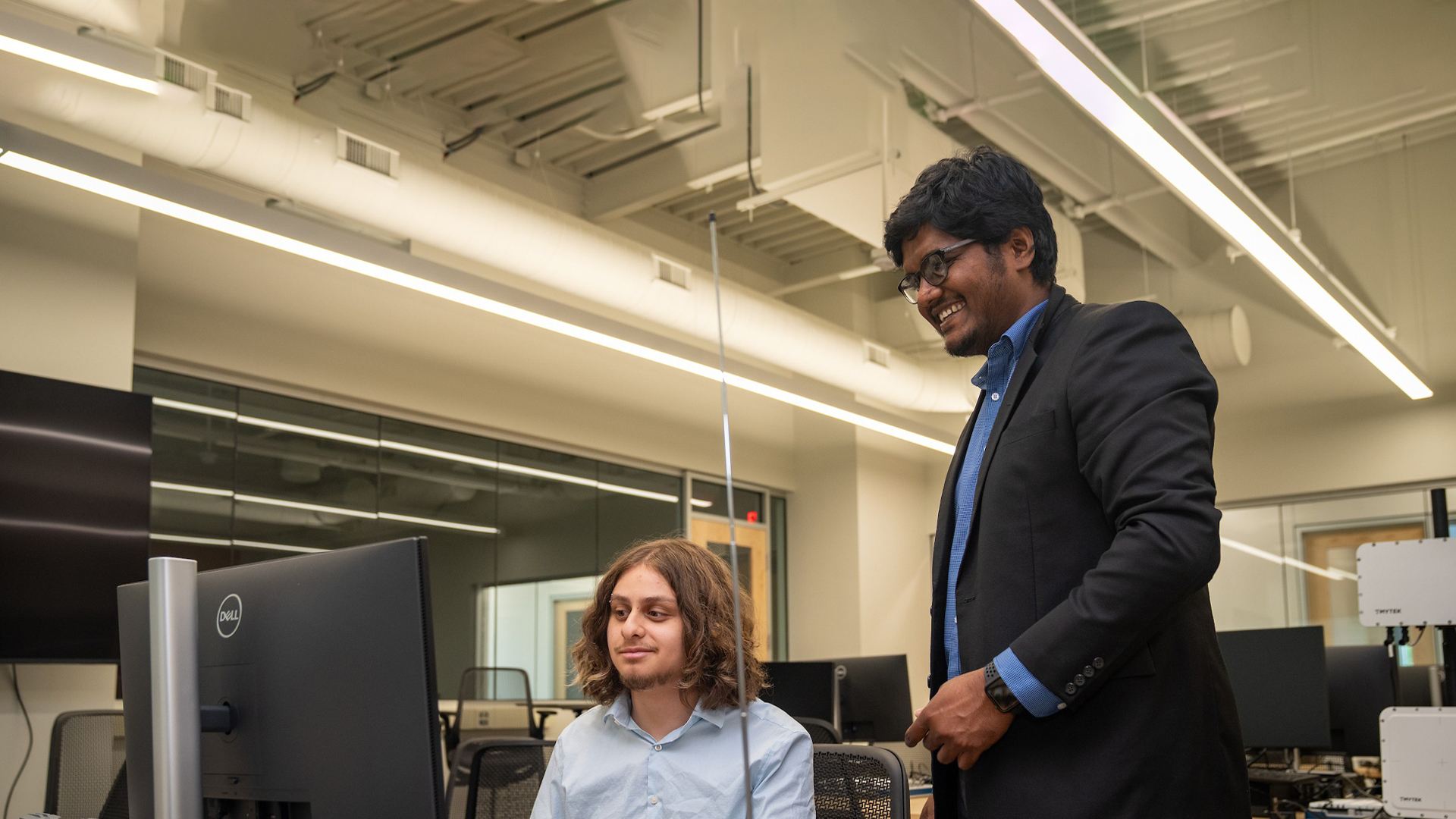
Dulaj Heshan Gunasinghe, Ph.D., right, is leading 6G research that will affect the next decade of technology. (BGSU photo/Haven Conn '22)
Dulaj Heshan Gunasinghe, Ph.D., an associate engineering professor, is leading the next-gen 6G research while mentoring undergraduate student Markvin Ceballo-Quinones
As the world prepares for the sixth generation of mobile communications technology, Bowling Green State University researchers are at the forefront, helping to develop intelligent wireless systems that can communicate more efficiently, reliably and securely. Dulaj Heshan Gunasinghe, Ph.D., an associate engineering professor, is leading the next-gen 6G research while providing undergraduate engineering student Markvin Ceballo-Quinones with crucial hands-on experience with state-of-the-art technology.
Key Highlights
Student: Markvin Ceballo-Quinones
Major: Manufacturing and mechanical engineering
Research: 6G technologies
Not too small...Not too big
BGSU is proving once again that it is big enough to have the resources needed to conduct impactful research, but small enough to offer research opportunities to undergraduate students.
Hands-on experience with state-of-the-art technology
Using advanced research equipment from a global company specializing in 5G and 6G communication platforms, Ceballo-Quinones is gaining hands-on experience with emerging technologies in 6G, artificial intelligence and intelligent wireless systems.
Research for the future
Future wireless networks will not simply connect devices. They will also enable applications such as autonomous vehicles, smart factories, intelligent robotics, extended reality and remote healthcare.
"The work we do today at BGSU will help shape the wireless infrastructure that industries and consumers will rely on over the next decade."
DULAJ HESHAN GUNASINGHE, PH.D.
ASSISTANT PROFESSOR OF ENGINEERING, BGSU






As the world prepares for the sixth generation of mobile communications technology, Bowling Green State University researchers are at the forefront, helping to shape the future of wireless infrastructure.
The research, being led by engineering professor Dulaj Heshan Gunasinghe, Ph.D., aligns with the goals of the telecommunications industry and companies developing next-generation wireless technologies.
“Wireless communication has become the foundation of nearly every aspect of modern life. From smartphones and connected vehicles to manufacturing plants and healthcare systems, society depends on fast, reliable and secure wireless connectivity,” Gunasinghe said. “As the number of connected devices continues to grow, current communication technologies will eventually reach their limits. We believe 6G represents the next major evolution in wireless communications by providing significantly higher data rates, lower latency, greater reliability and the ability to integrate communication with sensing and artificial intelligence.
“The work we do today at BGSU will help shape the wireless infrastructure that industries and consumers will rely on over the next decade.”
Markvin Ceballo-Quinones, a junior majoring in manufacturing and mechanical engineering, is taking an active role in the next-gen 6G research, a key differentiator of the Bowling Green experience, where undergraduate students have opportunities to conduct relevant research alongside expert faculty members.
Ceballo-Quinones chose BGSU, nationally ranked for student experience, for the opportunity to conduct meaningful research as an undergraduate student.
“BGSU has exceeded my expectations since stepping on campus. The sheer size of the campus creates opportunities, but the small research teams and resources provided to students are nothing short of amazing,” he said. “Research in a STEM field is something I didn’t think I’d have access to this early in my career. BGSU offers so many support systems for students, from advisors to large labs. Undergraduate research has truly been an invaluable experience."

Using advanced research equipment from a global company specializing in 5G and 6G communication platforms, Ceballo-Quinones is gaining hands-on experience with emerging technologies in 6G, artificial intelligence and intelligent wireless systems. This exposure to fields that are expected to shape the future workforce is equipping him with the skills employers demand.
“At BGSU, students can work directly with faculty, use state-of-the-art 6G research equipment and contribute to projects that have the potential to influence future wireless communication systems,” Gunasinghe said. “I believe this hands-on experience is what makes Bowling Green's engineering education truly transformative and prepares our students to become the next generation of innovators.”
While traditional communication algorithms often struggle to adapt quickly enough to changing channel conditions and user demands, artificial intelligence and machine learning enable communication systems to continuously learn from their environment and make intelligent decisions in real time. At BGSU, researchers are using artificial intelligence to make wireless communication systems faster, more reliable and more efficient.
“Ceballo-Quinones is taking an active role in the research, developing simulation models, analyzing system performance and studying wireless propagation and communication algorithms,” Gunasinghe said. “These intelligent algorithms can significantly improve network performance while reducing energy consumption and computational complexity.
“AI is expected to become a core component of future wireless networks, making this research and Ceballo-Quinones’ efforts increasingly important.”
The goal of this research is to develop intelligent wireless systems that can communicate more efficiently, reliably and securely while also sensing their surrounding environment. Gunasinghe said future wireless networks will not simply connect devices; they will also enable applications such as autonomous vehicles, smart factories, intelligent robotics, extended reality and remote healthcare.
Industry impact:
- Smart manufacturing can use intelligent wireless networks to connect robots, sensors and automated production systems with extremely low latency and high reliability.
- Intelligent transportation systems will benefit from improved communication between vehicles, infrastructure and pedestrians, enabling safer and more efficient autonomous driving.
- Telecommunications companies are developing future wireless networks that will require advanced beamforming, programmable wireless environments and AI-driven optimization techniques.
- Healthcare, agriculture, defense, logistics and smart cities are also expected to benefit from these technologies as wireless connectivity becomes increasingly intelligent and adaptive.
As research progresses, Gunasinghe hopes to expand collaborations with industry partners and pursue externally funded research projects that bridge academic research with real-world applications.
In the meantime, Ceballo-Quinones plans to take advantage of this unique opportunity and prepare for his future career.
“I’d love to work on technology that improves the way we live and how we move forward in the world,” he said. “I’m incredibly grateful to Dr. Gunasinghe for this opportunity to be a part of this research. This experience reminded me why I love the STEM field and has been unforgettable for my career and for me as a person.”
Related Stories


Updated: 08/10/2026 06:22PM