
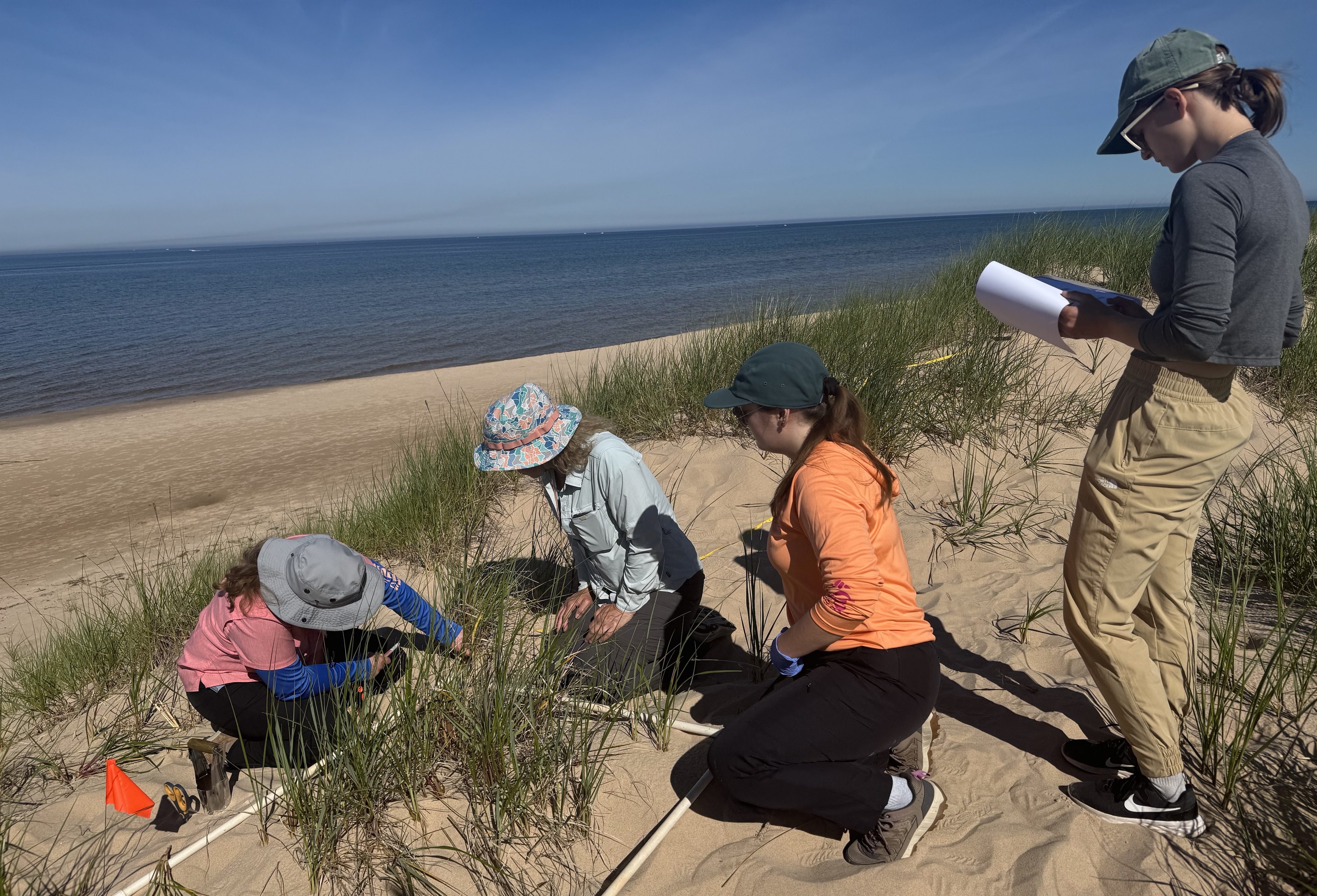
BGSU researchers are contributing to a project that is examining how environmental changes impact American beachgrass, an important species for fighting erosion along the Lake Michigan coast. (Contributed photo)
Professor Sarah Emery, Ph.D., leads BGSU research team in understanding how American beachgrass could play a starring role in ‘green infrastructure’
By studying how American beachgrass responds to environmental changes, BGSU professor Sarah Emery, Ph.D., is providing insight into fighting coastal erosion along the coast of Lake Michigan.
Key Highlights
Professor: Sarah Emery, Ph.D.
Research expertise: Plant ecology
Project location: Lake Michigan coast
Addressing an issue
Because water levels in the Great Lakes vary from year to year, coastal erosion is a growing problem, especially along Lake Michigan.
Lake life
BGSU is home to the Center for Great Lakes and Watershed Studies, an interdisciplinary group of scientists who research shared freshwater systems.
Turning green
Beachgrass can play a key part in green infrastructure, as it helps stabilize sandy coastlines more effectively than human-made interventions.
“We’re hoping to build a more resilient coastline, and in Michigan, that means thinking about the dunes and using green infrastructure where we can. We’re taking a few different approaches to learn how beachgrass can be more successful, which we think can really help future restoration efforts.”
SARAH EMERY, PH.D.
BGSU PROFESSOR
DIRECTOR, CENTER FOR GREAT LAKES AND WATERSHED STUDIES







One of the keys to preventing shoreline erosion along Lake Michigan could be one of the simplest, yet most resilient species in the Great Lakes footprint.
Bowling Green State University professor Sarah Emery, Ph.D., the director of the Center for Great Lakes and Watershed Studies (CGLWS), is studying how American beachgrass responds to environmental changes in the dunes of Lake Michigan, where it plays a major, if unheralded, role.
While humans can go great lengths to combat fluctuating water levels with man-made solutions, Emery said dunes have a naturally occurring species in beachgrass that could be a pivotal ally in coastline restoration efforts.
“Sand dunes are really the first line of defense in changing lake levels, which are very dynamic,” Emery said. “They can be very high one year and very low the next, and that causes a lot of shoreline erosion.
"That leaves us the option of either creating very hard infrastructure like a seawall to stop that erosion, or we can try green infrastructure like beachgrass that is better able to stabilize sandy shorelines.”
In collaboration with Michigan Technological University associate professor Erika Hersch-Green, Ph.D., and funded by Michigan Sea Grant, Emery and the BGSU team spent multiple days traveling the western coast of Michigan to gain a comprehensive portrait of the species’ current status near Lake Michigan.
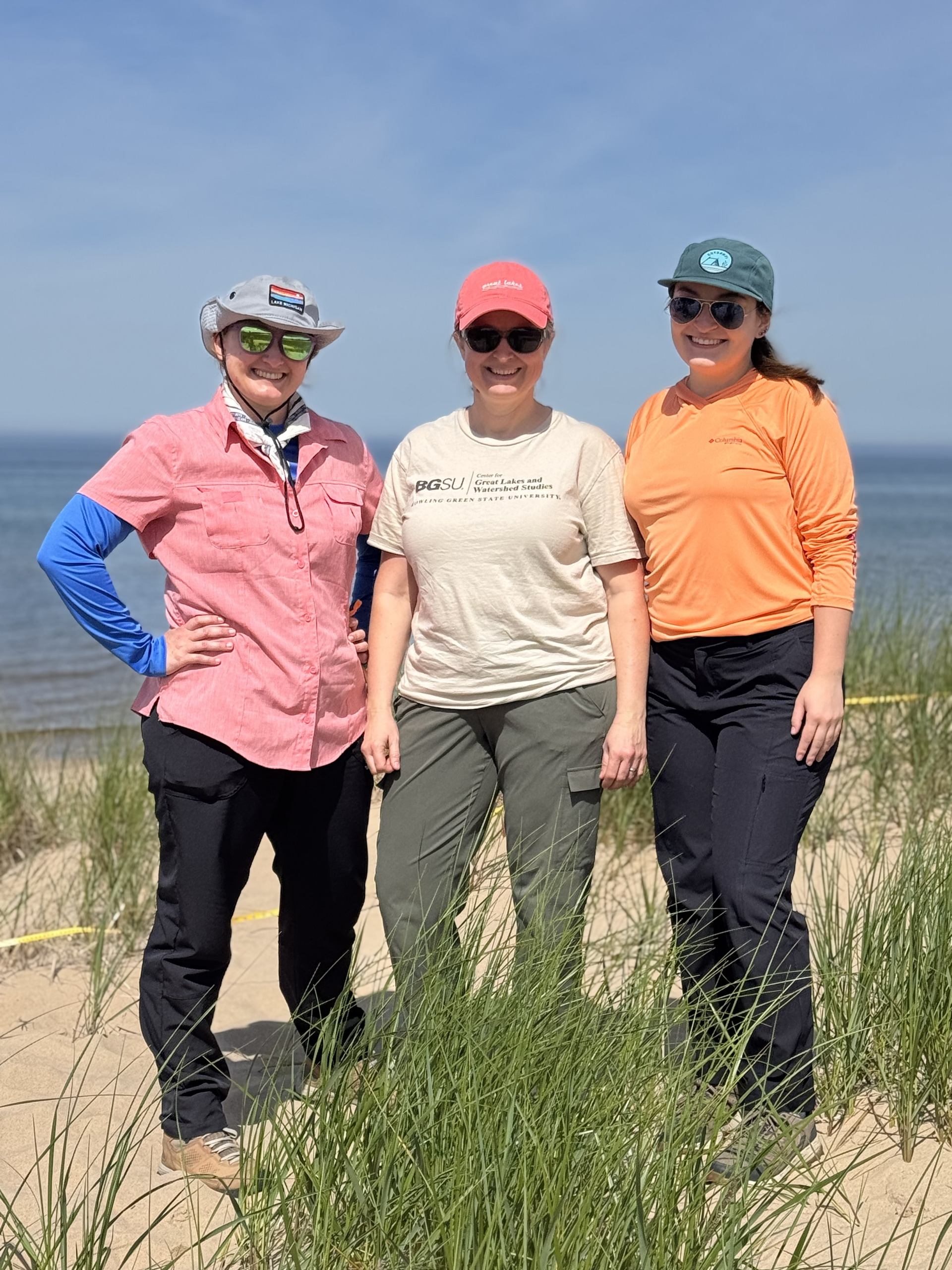
Along with post-doctoral researcher Shannon Walker, Ph.D., and graduate student Alexa Gudelman, Emery’s team collected plant and soil core samples from 22 different Michigan state parks – more than 300 plants in total – and will spend the rest of the summer and fall completing leaf scans and analyzing above-ground and below-ground traits.
A better understanding of American beachgrass should provide insight into how the species will react to changes as it does its most important job.
“The Great Lakes can experience drastic storms through the seasons, and the sand dunes act as the main buffer for inland habitats and development on the coasts,” Gudelman said. “American beachgrass is known as an ‘ecosystem engineer,’ as it plays an essential role in building up the dunes, both above and below ground, to anchor the sand in place. Beachgrass is holding down the fort for the whole coastline.”
Under Emery’s direction, Gudelman’s thesis project will use soil core samples from the field to study the symbiosis between beachgrass and the extraradical hyphae of arbuscular mycorrhizal fungi – microscopic threads that funnel nutrients to beachgrass and help stabilize the sand — across sites with different levels of atmospheric nitrogen deposition.
For Gudelman, a native of Sylvania, a suburb of Toledo, the chance to learn in Emery’s lab has been exactly what she hoped to find in graduate studies: a meaningful application of plant ecology to the Great Lakes.
“Graduate studies have been such a pleasant surprise for me because I never thought I could learn so much in such a short amount of time,” she said. “I’m really thankful to be getting all this hands-on experience. Wherever life takes me after this, I know I’ll be equipped with valuable skills in and out of the lab and the field.”
Researchers are also propagating more than 150 potted beachgrass samples in a series of greenhouse experiments to learn how it reacts to different variables.
Overall, the research team hopes to come away with data that can help land management entities identify the most effective strategies for helping the species thrive in a habitat where its success is vital.
“Dune grass is the main ecosystem engineering species that helps stabilize sand,” Emery said. "It actually loves to be buried by sand and grows faster when it’s buried, which helps slow erosion. Even as water levels rise, its root system helps keep sand in place.”
Ohio has done similar restoration efforts with wetlands, projects to which researchers and students at BGSU are also contributing. Most of Lake Erie is developed and has hard infrastructure, but as the state redevelops wetlands, it is hoping to increase the resilience of Lake Erie’s coastline.
Doing the same in Michigan requires a deeper understanding of the state’s intricate dune systems, Emery said.
“We’re hoping to build a more resilient coastline, and in Michigan, that means thinking about the dunes and using green infrastructure where we can,” Emery said. “We’re taking a few different approaches to learn how beachgrass can be more successful, which we think can really help future restoration efforts.”

Related Stories

Updated: 07/22/2026 01:45PM