
Marriage-Divorce Ratio in the U.S.: Geographic Variation, 2024
Family Profile 32, 2025
Author: Krista K. Westrick-Payne
This family profile updates previous profiles on the marriage-divorce ratio (Eickmeyer, 2015; Loo, 2023; Marino & Juteau, 2022; Reynolds, 2020; Schweizer, 2019a & 2019b; Westrick-Payne, 2022; Westrick-Payne, 2024; Wu, 2017) and examines national, regional, and state variation in the ratio of marriages to divorces. Using recent American Community Survey (ACS) data, we calculate national and state level marriage-divorce ratios by dividing the number of women’s marriages by the number of women’s divorces for a given population in a given year. Data for these estimates come from the most recent release of the American Community Survey and represent the year 2024. The margins of error (at a 90% confidence interval) were also calculated and presented alongside the ratios.
U.S. Marriage-Divorce Ratio, 2024
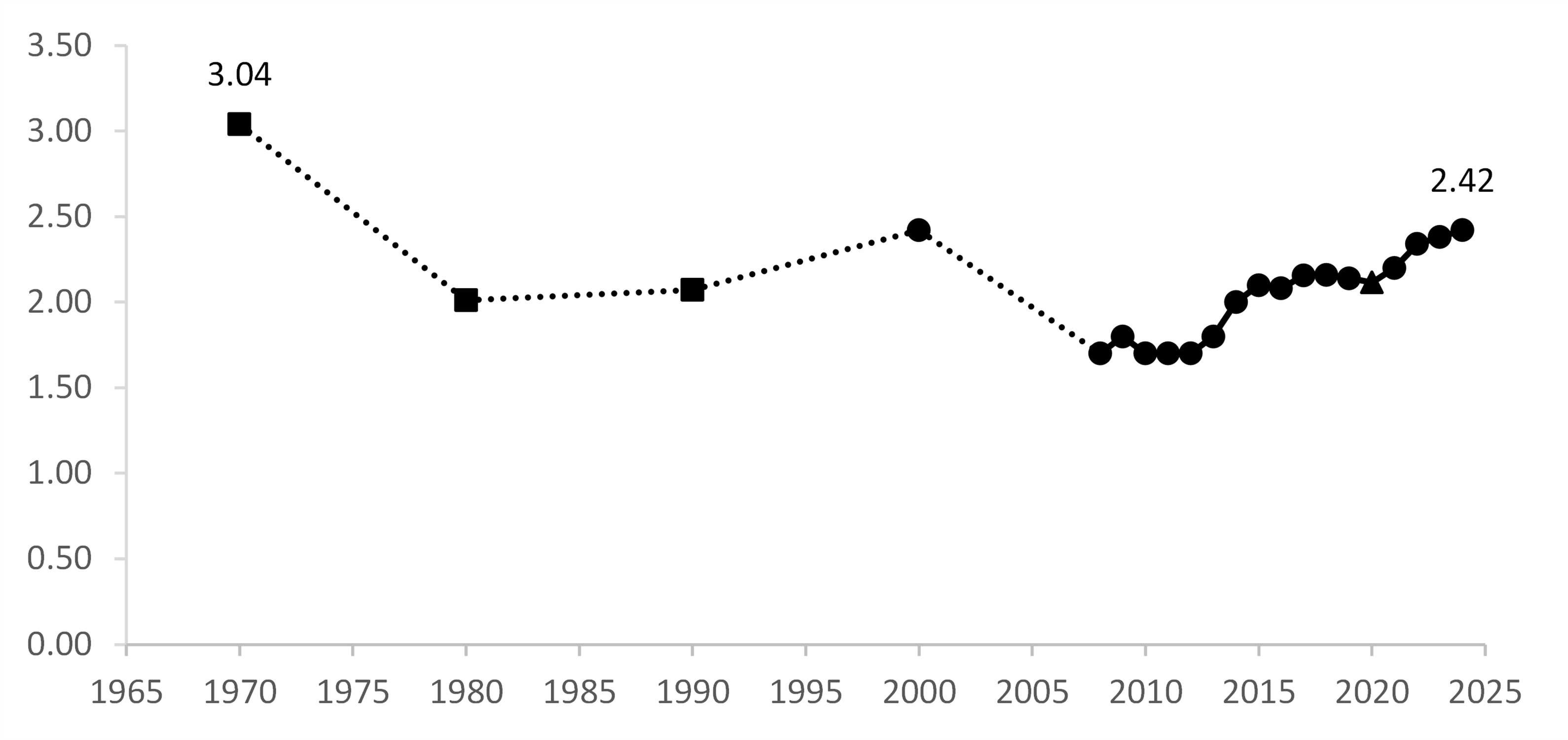
- In 2024 there were 2,390,482 marriages and 986,810 divorces in the last year. This represents a marriage-divorce ratio of 2.42. which is slightly higher than the ratio of 2.38 observed in 2023.
- The ratio remained stable from 2015 through 2021 ranging from 2.10 to 2.16, meaning approximately two marriages for every one divorce (FP-22-27). The most recent data from 2024 indicates another uptick and represents the largest marriage to divorce ratio since the ACS began collecting information on recent marriage and divorce experience in 2008.
Figure 1. Women’s Marriage-Divorce Ratio, 1970-2024
Five Highest and Lowest Marriage-Divorce Ratios, 2024
Figure 2. Women's Highest and Marriage-Divorce Ratios, 2024
| Rank | State | Ratio |
| 1. | District of Columbia | 3.77 |
| 2. | Idaho | 3.48 |
| 3. | Utah | 3.21 |
| 4. | Kansas | 3.13 |
| 4. | New Jersey | 3.04 |
| USA | 2.42 | |
| 47. | Mississippi | 1.82 |
| 48. | New Hampshire | 1.73 |
| 49. | Rhode Island | 1.68 |
| 50. | Vermont | 1.50 |
| 51. | Delaware | 1.44 |
Source: NCFMR analyses of American Community Survey 1-year estimates, Tables B12001, B12501 & B12503, 2024
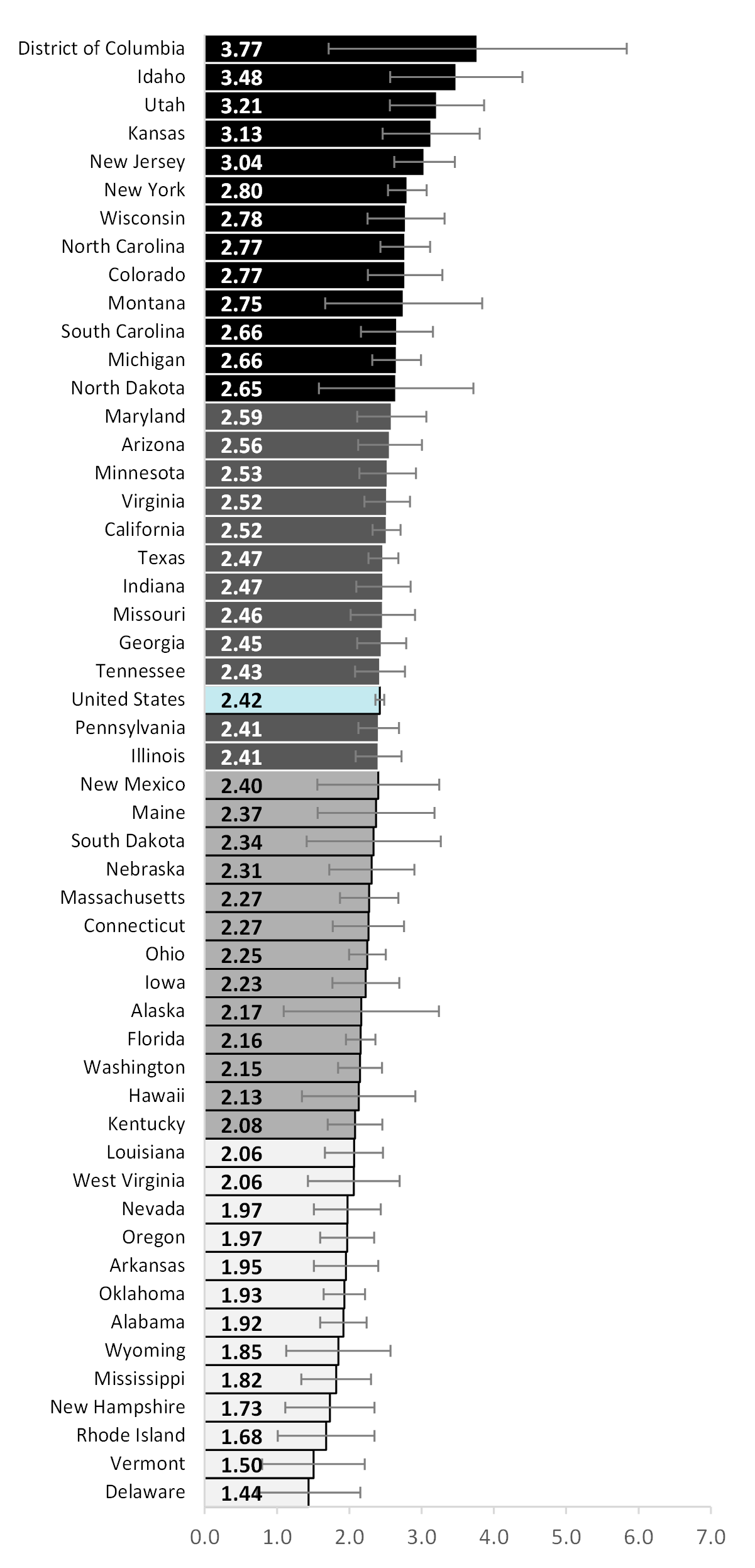
- In 2024 all states had a greater number of marriages than divorces. Washington D.C. (3.77), Idaho (3.48), Utah (3.23), Utah (3.21), Kansas (3.13), and New Jersey (3.04) had the highest marriage-divorce ratios in 2024.
- The states with the lowest marriage-divorce ratios were Mississippi (1.82), New Hampshire (1.73), Rhode Island (1.68), Vermont (1.50), and Delaware (1.44).
State Rankings in Marriage-Divorce Ratios, 2024
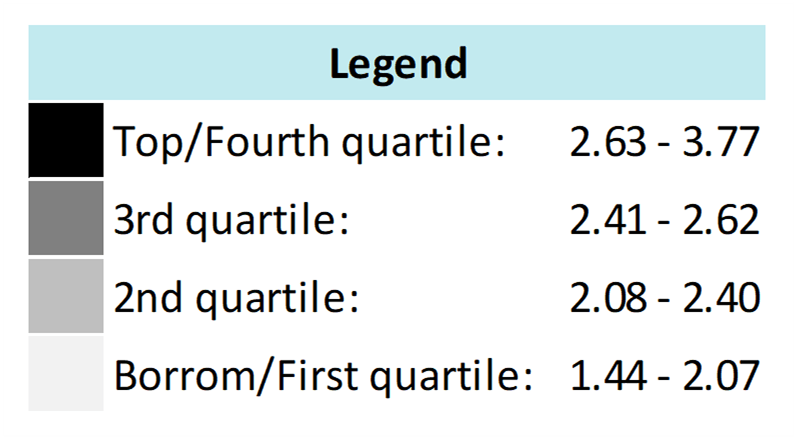
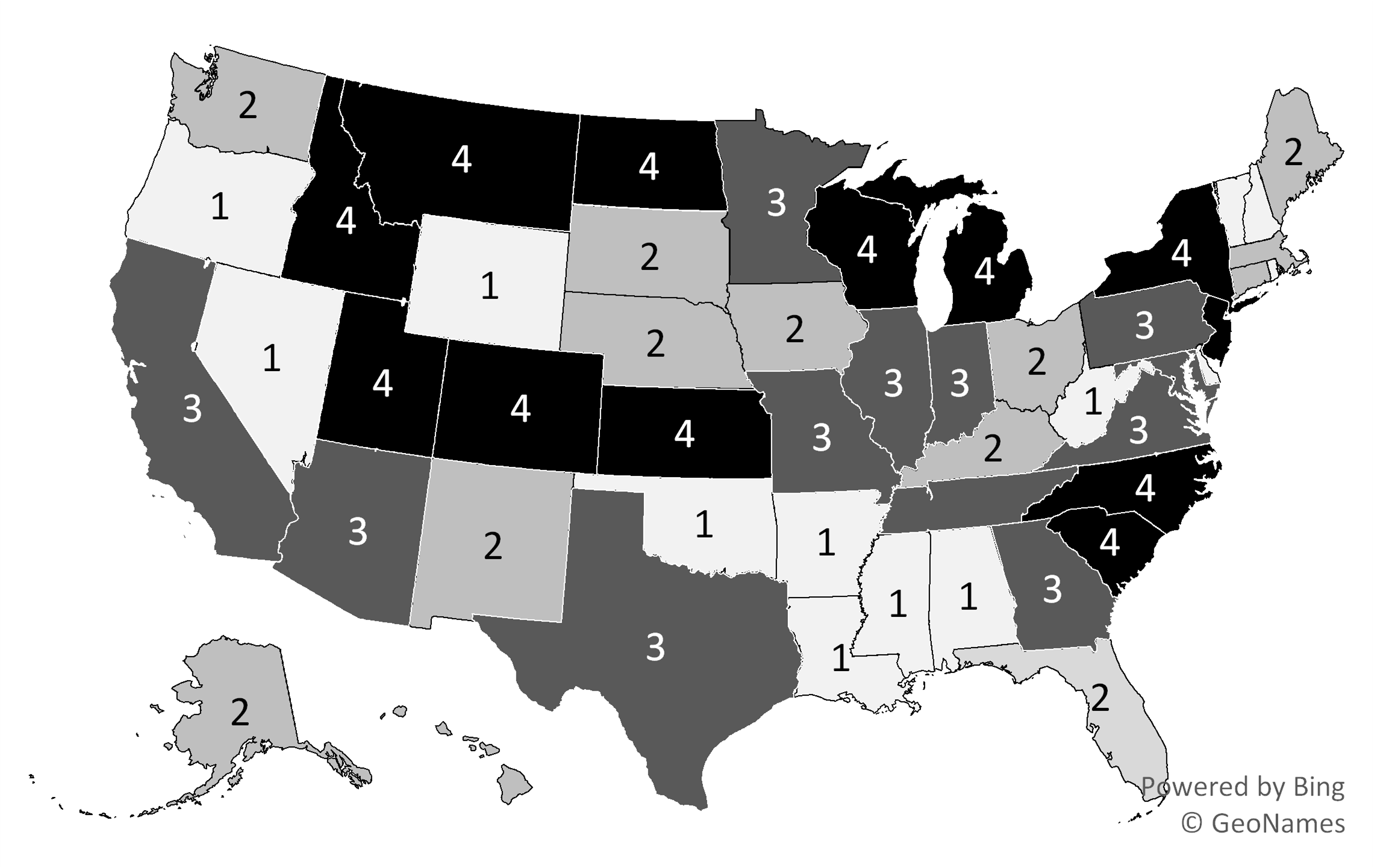
- The states with the highest marriage-divorce ratios and representing the top quartile in 2024 had ratios of at least 2.63 marriages per 1.0 divorces.
- The states with the lowest marriage-divorce ratios and representing the bottom quartile in 2024 had 1.44 to 2.7 marriages per 1.0.
Figure 3. State-Level Women’s Marriage-Divorce Ratios by Quartile, 2024
Regional Variation in Marriage-Divorce Ratios, 2024
- Generally, in 2024, states in the Midwest and West exhibited high marriage-divorce ratios with more than three-in-ten (31-33%) of their states falling in the top/fourth quartile. In the Midwest, an additional one-third (33%) of their states fell in the third quartile.
- Slightly more than one-fifth (22%) of Northeastern states were found in the top/fourth quartile, whereas one-third (33%) were in the lowest/first quartile.
- Generally, Southern states had low marriage-divorce ratios. They clustered in the bottom/first quartile with 41%. However, 29% fell in the third quartile.
Figure 4. Regional Variation of Women's Marriage-Divorce Ratios, 2024
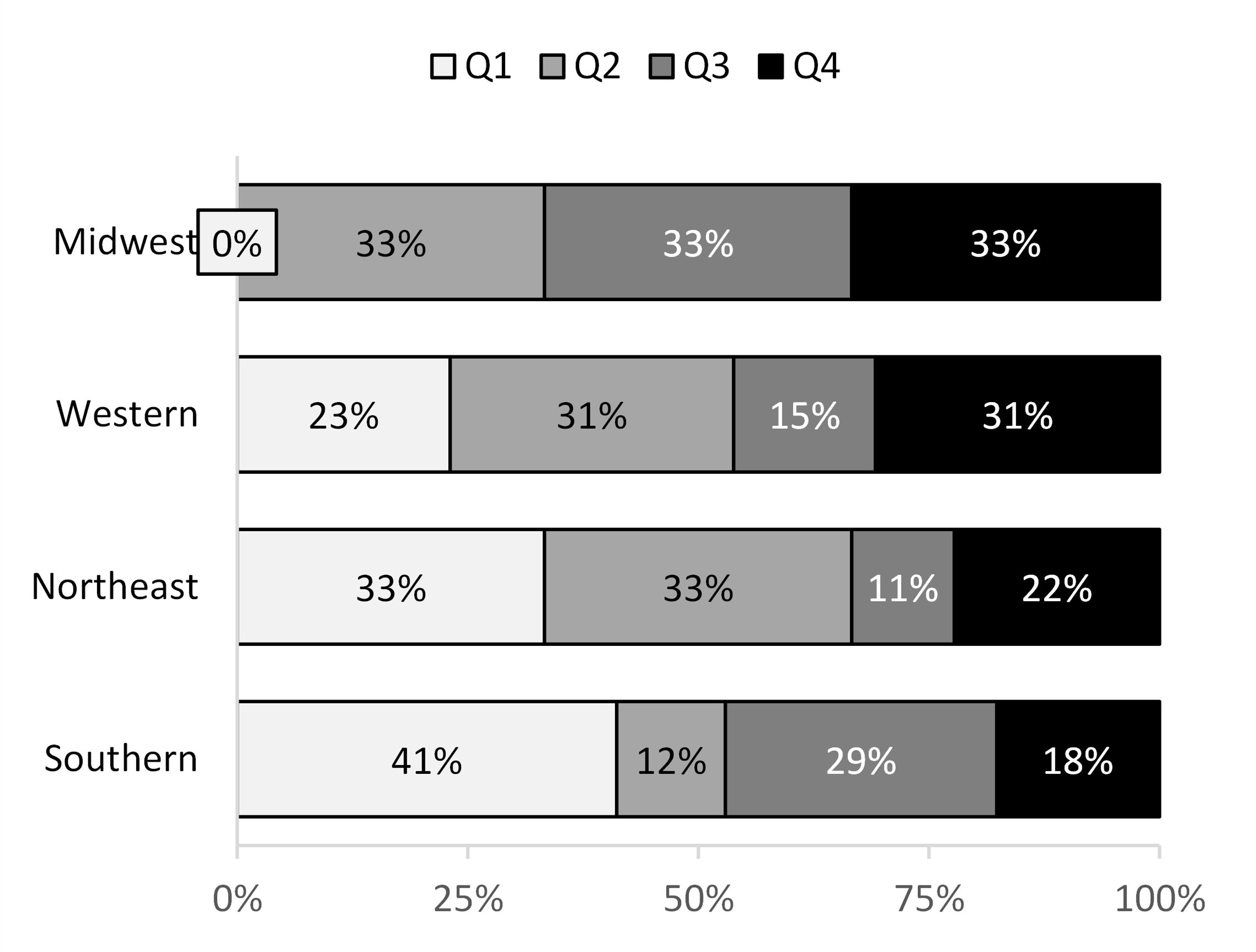
Figure 5. State-level Map of Women’s Marriage-Divorce Ratios in the U.S., 2024
Data Sources:
Clarke. S. C. (1995). Advanced report of final marriage statistics, 1989 and 1990. Monthly Vital Statistics Report, 42(12). National Center for Health Statistics. https://www.cdc.gov/nchs/data/mvsr/supp/mv43_12s.pdf
National Center for Health Statistics (1974). Summary report final marriage statistics, 1970. Monthly Vital Statistics Report, 23(2), Supp. 1. U.S. Department of Health, Education, and Welfare. https://www.cdc.gov/nchs/data/mvsr/supp/mv23_02s1acc.pdf
National Center for Health Statistics (1977). Advance report of final divorce statistics, 1975. Monthly Vital Statistics Report, 26(2), Supp. 2. U.S. Department of Health, Education, and Welfare. https://www.cdc.gov/nchs/data/mvsr/supp/mv26_02s2acc.pdf
National Center for Health Statistics (1983). Advance report of final marriage statistics, 1980. Monthly Vital Statistics Report, 32(5), Supp. U.S. Department of Health and Human Services. https://www.cdc.gov/nchs/data/mvsr/supp/mv32_05s.pdf
National Center for Health Statistics (2001). Births, marriages, divorces, and deaths: Provisional data for January-December 2000. National Vital Statistics Report, 49(6), Associated Table 3. Department of Health & Human Services, Center for Disease Control and Prevention. https://www.cdc.gov/nchs/data/nvsr/nvsr49/nvsr49_06.pdf
U.S. Census Bureau (2024). American Community Survey, 2008 - 2024 1-Year Estimates [Table B12001]. Retrieved from: https://data.census.gov/cedsci/table?q=B12001&tid=ACSDT1Y2021.B12001
U.S. Census Bureau (2024). American Community Survey, 2008 - 2024 1-Year Estimates [Table B12501]. Retrieved from: https://data.census.gov/cedsci/table?q=B12501&tid=ACSDT1Y2021.B12501
U.S. Census Bureau (2024). American Community Survey, 2008 - 2024 1-Year Estimates [Table B12503]. Retrieved from: https://data.census.gov/cedsci/table?q=B12503&tid=ACSDT1Y2021.B12503
U.S. Census Bureau (2021). American Community Survey, 2020 1-year Experimental PUMS
References:
Eickmeyer, K.J. (2015). Marriage to Divorce Ratio in the U.S.: Geographic Variation, 2014. Family Profile, FP-15-19. Bowling Green, OH: National Center for Family & Marriage Research. https://www.bgsu.edu/content/dam/BGSU/college-of-arts-and-sciences/NCFMR/documents/FP/eickmeyer-mar-div-ratio-us-geo-2014-fp-15-19.pdf
Loo, J. (2023). Divorce rate in the U.S.: Geographic variation, 2022. Family Profiles, FP-23-25. Bowling Green, OH: National Center for Family & Marriage Research. https://doi.org/10.25035/ncfmr/fp-23-25
Marino, F. A. & Juteau, G. (2022). Marriage-to-divorce ratio in the U.S.: Geographic variation, 2021. Family Profiles, FP-22-27. Bowling Green, OH: National Center for Family & Marriage Research. https://doi.org/10.25035/ncfmr/fp-22-27
Reynolds, L. R. (2020). Marriage to Divorce Ratio in the U.S.: Geographic Variation, 2019. Family Profiles, FP-20-26. Bowling Green, OH: National Center for Family & Marriage Research. https://doi.org/10.25035/ncfmr/fp-20-26
Schweizer, V. (2019a). Marriage to Divorce Ratio in the U.S.: Geographic Variation, 2017. Family Profiles, FP-19-03. Bowling Green, OH: National Center for Family & Marriage Research. https://doi.org/10.25035/ncfmr/fp-19-03
Schweizer, V. (2019b). Marriage to Divorce Ratio in the U.S.: Geographic Variation, 2018. Family Profiles, FP-19-24. Bowling Green, OH: National Center for Family & Marriage Research. https://doi.org/10.25035/ncfmr/fp-19-24
Westrick-Payne, K. K. (2022). Marriage-to-divorce ratio in the U.S.: Geographic variation, 2020. Family Profiles, FP-22-09. Bowling Green, OH: National Center for Family & Marriage Research. https://doi.org/10.25035/ncfmr/fp-22-09
Westrick-Payne, K. K. (2024). Marriage-Divorce Ratio in the U.S.: Geographic variation, 2023. Family Profiles, FP-24-27. Bowling Green, OH: National Center for Family & Marriage Research. https://doi.org/10.25035/ncfmr/fp-24-27
Wu, H. (2017). Marriage to Divorce Ratio in the U.S.: Geographic Variation, 2015. Family Profiles, FP-17-01. Bowling Green, OH: National Center for Family & Marriage Research. https://www.bgsu.edu/content/dam/BGSU/college-of-arts-and-sciences/NCFMR/documents/FP/wu-mar-to-div-ratio-2015-fp-17-01.pdf
Suggested Citation:
Westrick-Payne, K. K. (2025). Marriage-Divorce ratio in the U.S.: Geographic variation, 2024. Family Profiles, FP-25-32. Bowling Green, OH: National Center for Family & Marriage Research. https://doi.org/10.25035/ncfmr/fp-25-32


Updated: 07/08/2026 07:40PM