
Thirty-five Years of Changing Cohabitation Experience in the U.S., 1987-2022
Family Profile No. 26, 2025
Authors: Wendy D. Manning & Krista K. Westrick-Payne
This Family Profile documents shifts in the percentage of women who have ever cohabited over the past thirty-five years (1987 to 2022). Due to the relatively short duration of cohabiting unions (about 2 years), it is important to examine changes in women's experiences of cohabitation and not just their status at the time of interview (Lamidi, Manning, & Brown, 2019). To provide over three decades of cohabitation trends, we draw on two published articles (Bumpass & Lu, 2000; Kennedy & Bumpass, 2008), Family Profile 17-02 (Hemez & Manning, 2017), and analyses using the recently released National Survey of Family Growth (NSFG). Estimates for 2017 come from the 2015-2019 NSFG cycle and estimates for 2022 are derived from the newly released 2022-2023 NSFG cycle. For more information on the NSFG, see the 2022-2023 Cycle of National Survey of Family Growth and the NSFG web page (NCHS, 2024). All analyses are weighted based on recommendations by NCHS. An age restriction of 19-44 is imposed to allow comparisons across a long-time horizon. The mode of interview prior to 2022 was in person and changed to mixed mode in 2022/23 so caution is required when comparing trends over time. However, the patterns are not dramatically different based on mode and differences are noted below.
Changes in the Share of Women Who Ever Cohabited
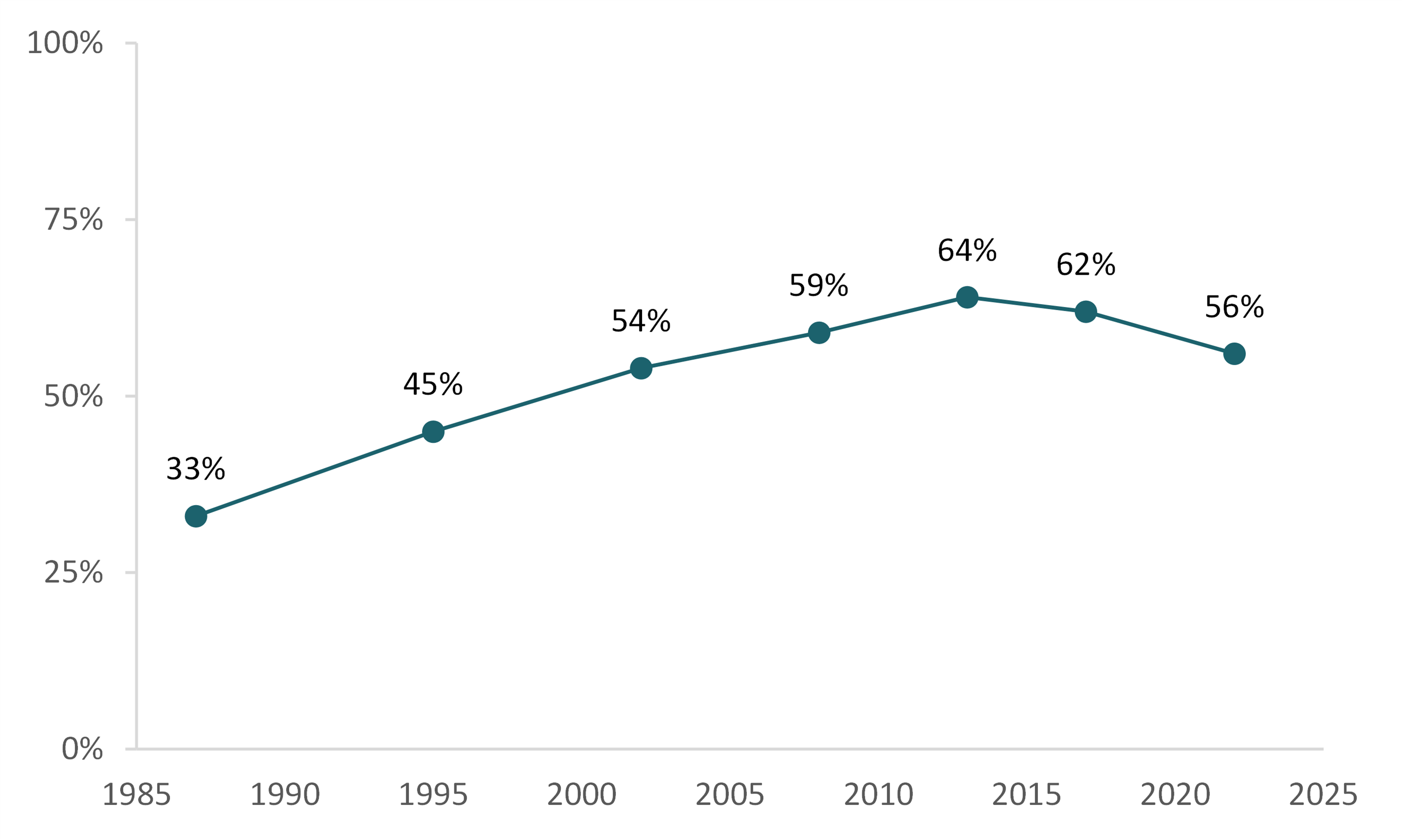
- The percentage of women who had ever cohabited steadily increased from 1987 through 2013. In 1987, one-third of women (aged 19-44) had ever cohabited. By 2013, that number approached two-thirds (64%).
- Over the last ten-plus years, a decline in cohabitation emerged. Recently, 56% of women reported they had ever cohabited.[1]
- In 2022, among women who ever cohabited, most (64%) have done so with only one partner. About one-third of women had lived with two or more partners.
[1] Levels of ever cohabiting based on mode were not significantly different. In person interview levels where 58% and on-line were 55%.
Figure 1. Changes in the Share of Women (19-44) Who Ever Cohabited, 1987-2022
Race & Ethnicity
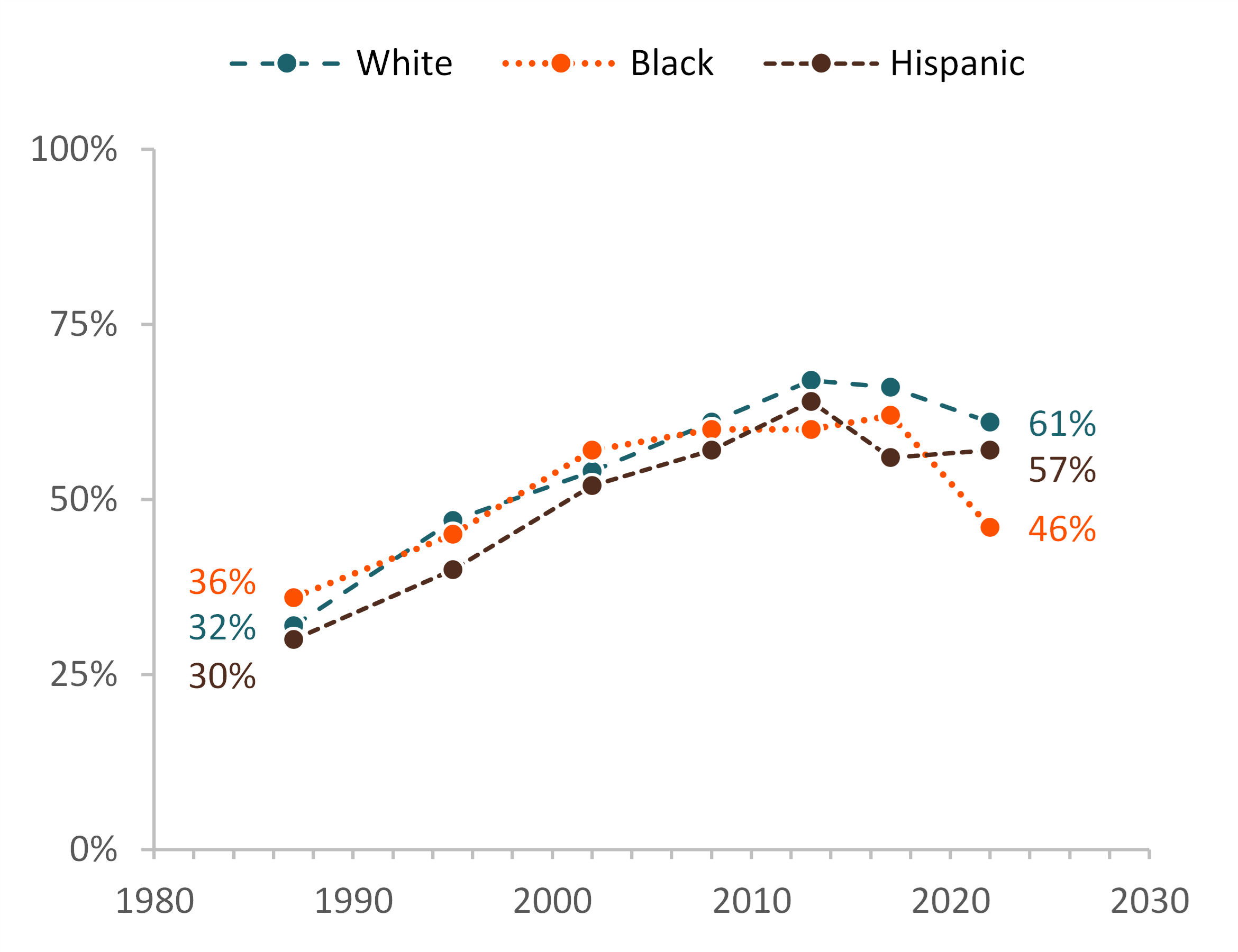
- From 1987 through 2013, the share of women who had ever cohabited increased for Whites, and Hispanics. Among Blacks, the increase continued through 2017.
- In 2022, three-fifths (61%) of White women had ever cohabited compared to 57% of Hispanic women and 46% of Black women. [2]
- Over the past five years, the share of women with cohabitation experience declined for White and Black women. Among Hispanic women it remained relatively unchanged.
[2] Mode of interview is not related to White or Hispanic women's reports of ever cohabiting. Mode of interview is negatively related to Black women's odd of ever cohabiting. 53% of Black women interviewed in person ever cohabited.
Figure 2. Change in the Share of Women (19-44) Who Ever Cohabited, by Race and Ethnicity Status, 1987-2022
Educational Attainment
Figure 3. Change in the Share of Women (19-44) Who Ever Cohabited, by Educational Attainment, 1987-2022
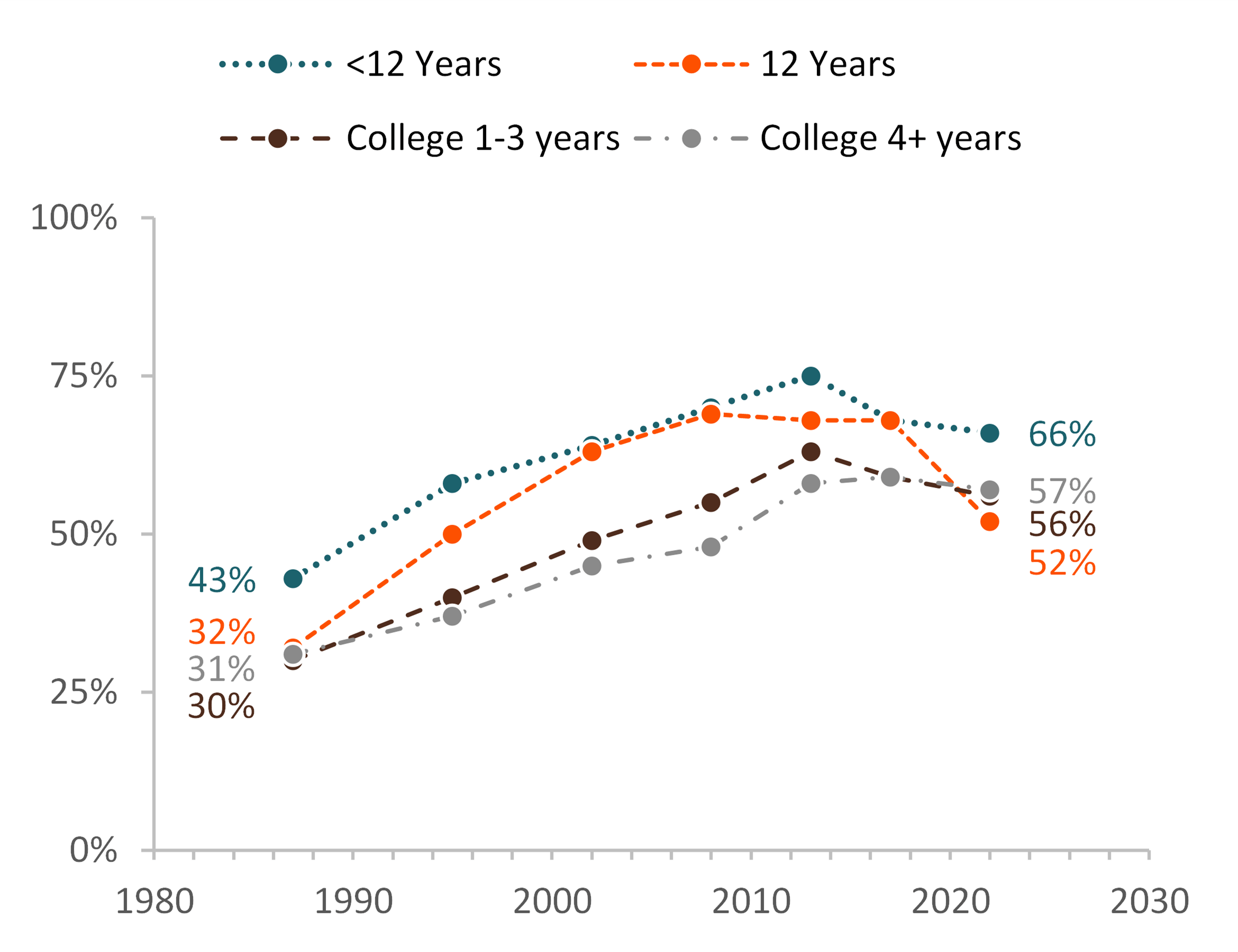
- The share of women aged 19-44 who had ever cohabited increased among all educational attainment groups until recently. There is a new educational convergence in cohabitation experience. [3]
- The largest share of women who ever cohabited in 2022 was among those with less than a high school diploma at 66%. Although they had the highest share in 2022, this figure represents another decline since a peak of 75% in 2013.
- Similar shares (56-57%) of women with some post-high school education (with or without a college degree) had ever cohabited.
- In 2022, slightly more than half (52%) of women with a high school diploma had ever cohabited. This was the smallest share observed among all educational attainment groups examined.
[3] Mode of interview is only related to ever cohabit for women with less than 12 years of education. The share is higher for those who were interviewed in person.
Data Source:
National Center for Health Statistics (NCHS). 2015-17, 2017-19, and 2022-23 National Survey of Family Growth Public-Use Data and Documentation. Hyattsville, MD: CDC National Center for Health Statistics. Retrieved February 7, 2025. https://www.cdc.gov/nchs/nsfg/index.htm
References:
Bumpass, L., & Lu, H. (2000). Trends in cohabitation and implications for children's family contexts in the United States. Population Studies, 54, 29-41. https://doi.org/10.1080/713779060
Hemez, P., & Manning, W. D. (2017). Twenty-five years of change in cohabitation experience in the U.S., 1987-2013. Family Profiles, FP-17-02. http://www.bgsu.edu/ncfmr/resources/data/family-profiles/hemez-manning-25-years-change-cohabitation-fp-17-02.html
Kennedy, S., & Bumpass, L. (2008). Cohabitation and children's living arrangements: New estimates from the United States. Demographic Research, 19, 1663-1692. https://doi.org/10.4054/DemRes.2008.19.47
Lamidi, E. O., Manning, W. D., & Brown, S. L. (2019). Change in the stability of first premarital cohabitation, 1983-2013. Demography, 56, 427-450. https://doi.org/10.1007/s13524-019-00765-7
National Center for Health Statistics. (2020). 2017–2019 National Survey of Family Growth public-use data and documentation. https://www.cdc.gov/nchs/nsfg/nsfg_2017_2019_puf.htm
Suggested Citation:
Manning, W. D., & Westrick-Payne, K. K. (2025). Thirty-five years of change in cohabitation experience in the U.S., 1987-2022. Family Profiles, FP-25-26. Bowling Green, OH: National Center for Family & Marriage Research. https://doi.org/10.25035/ncfmr/fp-25-26


Updated: 10/06/2026 07:24PM