
Academic Support Executive Summary – Spring 2025
Bowling Green State University (BGSU) undergraduate Student Learning Analysts (SLAs) from the Office of Academic Assessment conducted this assessment project. The SLAs designed a focus group protocol to discover what support students have received or needed to help them achieve academic success both inside and outside the classroom. The SLAs facilitated four virtual focus groups with a total of 19 participants from varying class standings and majors from four colleges. Out of the 19 participants, 42.11% (n = 8) self-identified as female, 52.63% (n = 10) self-identified as male, and 5.26% (n = 1) self-identified as non-binary. From the race/ethnicity information the participants provided, 68.42% (n = 13) self-identified as White/Caucasian, 15.79% (n = 3) self-identified as African American/Black, 5.26% (n = 1) self-identified as Arab, 5.26% (n = 1) self-identified as Black/White/Asian, and 5.26% (n = 1) self-identified as Chinese. Zoom was used as the online meeting platform, and the focus groups were recorded. These recordings were then transcribed and analyzed. The steps in the analysis process included: 1) open coding, 2) focused coding, and 3) identifying themes and subthemes.
Five major themes emerged: 1) Resources, 2) Classes, 3) Personal Connections, 4) Personal Success, and 5) Recommendations. These themes provided insight into students’ experiences and resources offered to support their academics at BGSU.
1. Resources – Participants discussed programs and services offered by the University or classes.
- Awareness – Students mentioned how or where they learned about resources.
- Helpfulness – Participants talked about how useful different resources were.
- Variety – Students commented on the number, amount, and assortment of resources available.
A student spoke about their overall impression of resources:
I'd say they're both useful and accessible, like every time that I went I was able to get whatever question I had or problem like helped or addressed or fixed so. And then also for accessibility, I feel like they're,... well-advertised and like talked about so that you know that they exist, so that's good. (T1, L29-32)
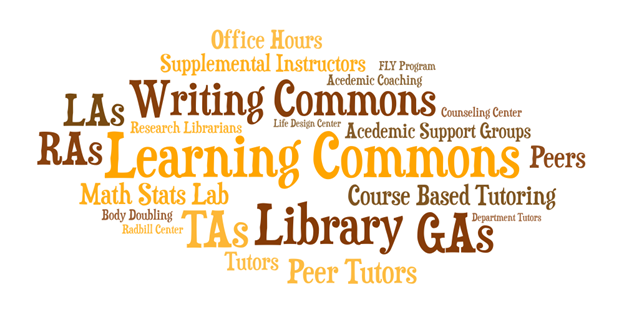
Below is a word cloud presented with resources participants mentioned throughout the focus groups. The size of the word directly corresponds to how often the word was mentioned by students, illustrating which resources these students were aware of.
2. Classes – Students talked about various facets of academics that influence how they experience their classes.
- Availability – Participants mentioned scheduling of classes and timing of office hours.
- Expectations – Students discussed how different standards in teaching style and grading, perceptions about engagement, along with the shift from high school assumptions, affected their classes.
- Communication and Support – Participants expressed how faculty share information and support students through office hours, emails, tailored support, and outside resources.
A student described the different feel of certain classes:
I've had classes that have been very lecture-based. I mean, you sit down in a class, they tell you a lecture, and then afterward if you have questions, I mean, go to those resources. And I've had other classes that have been very group-based, like one of my classes is entirely, we're in a group... and we're supposed to be getting our resources from each other. And the teacher will kind of work with our entire group at once based off of what we need. And they have a very different feel between those individual lecture-based and those group work classes. (T4, L194-204)
3. Personal Connections – Participants discussed forming relationships with people who influenced their academic and college experience.
- Community – Students explored how different social groups, such as student organizations and learning communities, have impacted their college experience.
- Peers – Participants talked about how their relationships or experiences with other students, including friends, group project members, study groups, major-related groups, etc., affected their time at college.
One student talked about how their personal relationships helped them create connections in the academic world:
Honestly, also just, like, building relationships with your professors and networking and stuff, and, like, the conversations you have with other students about the work you want to do. ...I remember, I was talking to someone else, and … now we're like business partners in the future because we just had that, like, conversation about our majors. So, it's also like communicating with other students. (T1, L153-159)
4. Personal Success – Students talked about aspects of life that impacted how they succeed and/or view academic success.
- Knowledge and Understanding – Participants discussed how they understand course content and how learning leads to success.
- Growth – Students reflected on their past experiences and how they led to success.
- Taking Initiative – Participants talked about putting in work to succeed, including self-teaching, being responsible, and working outside of class.
- Balance – Students discussed how they manage time between their personal life and school responsibilities.
One student from the focus groups discussed how success looks different for everyone:
...People view [success] differently. And the way people view it is 100% okay. What might be success in my eyes might be different for someone else, and I think that's kind of the point. When you look at, like, life design classes, I think that's kind of what they kind of touch on. So, it's really subjective and it's something that everyone has to kind of figure out for themselves. (T3, L424-428)
5. Recommendations – Students discussed suggestions about both the University and the support it provides for its students as well as for other students on how to succeed in college.
This participant discussed how they would like BGSU to focus more on learning and knowledge rather than just obtaining a degree:
...I think it just goes to show how much the whole college environment is really geared towards, like, that turnaround of getting students in and getting them out with a degree as soon as possible, that focus on the return on investment. I would much rather see a focus on like the knowledge and what you're actually learning here during your time because it's not like BG is deficient in any of those resources... It's just that they don't really talk about it as much... (T4, L589-595)
For more information about this assessment project, contact Dr. Jessica M. Turos from the BGSU Office of Academic Assessment at jmturos@bgsu.edu.
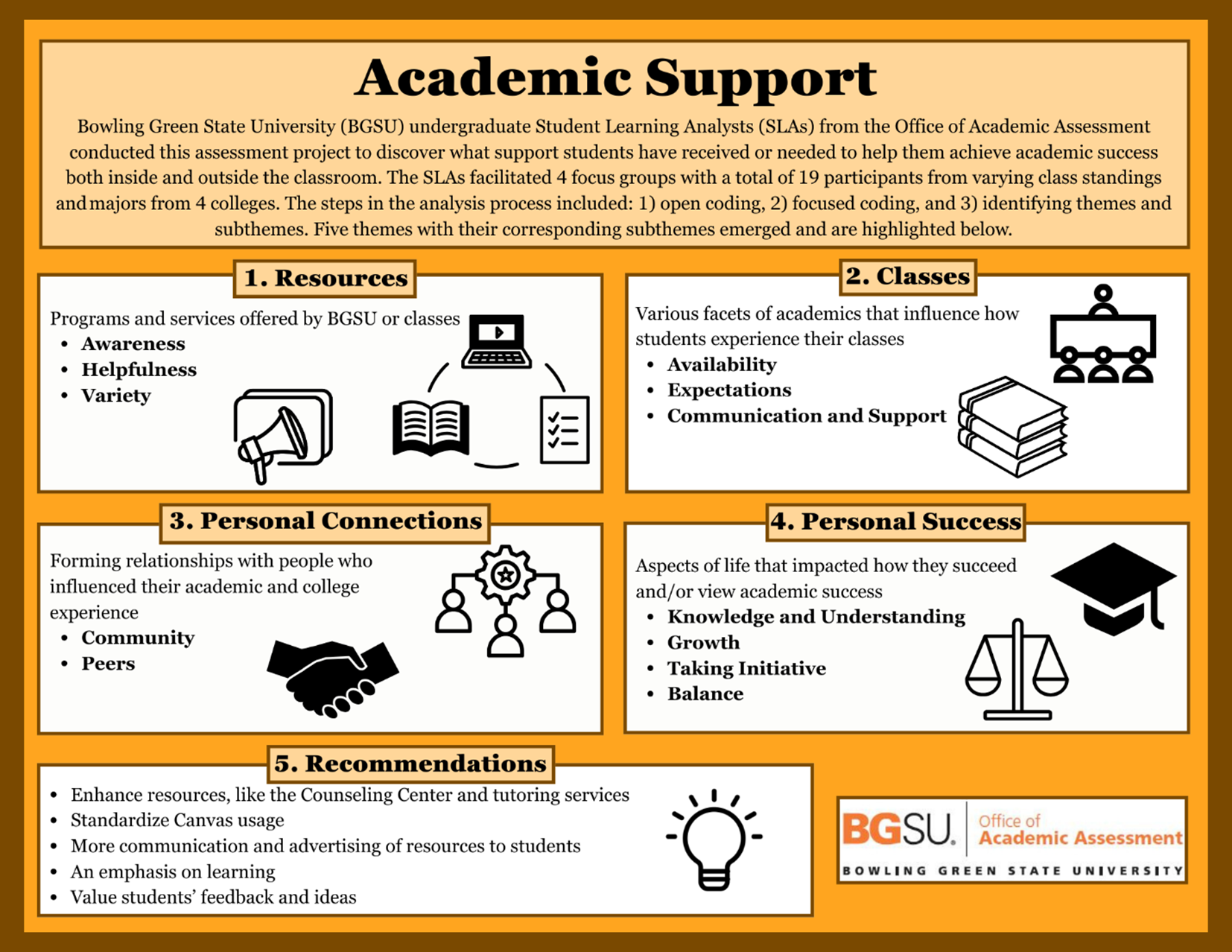
Infographic Below is an infographic that provides a visual representation on the academic support assessment project.
Infographic
Updated: 03/19/2026 05:59PM