
Financial Well-Being Executive Summary – Fall 2025
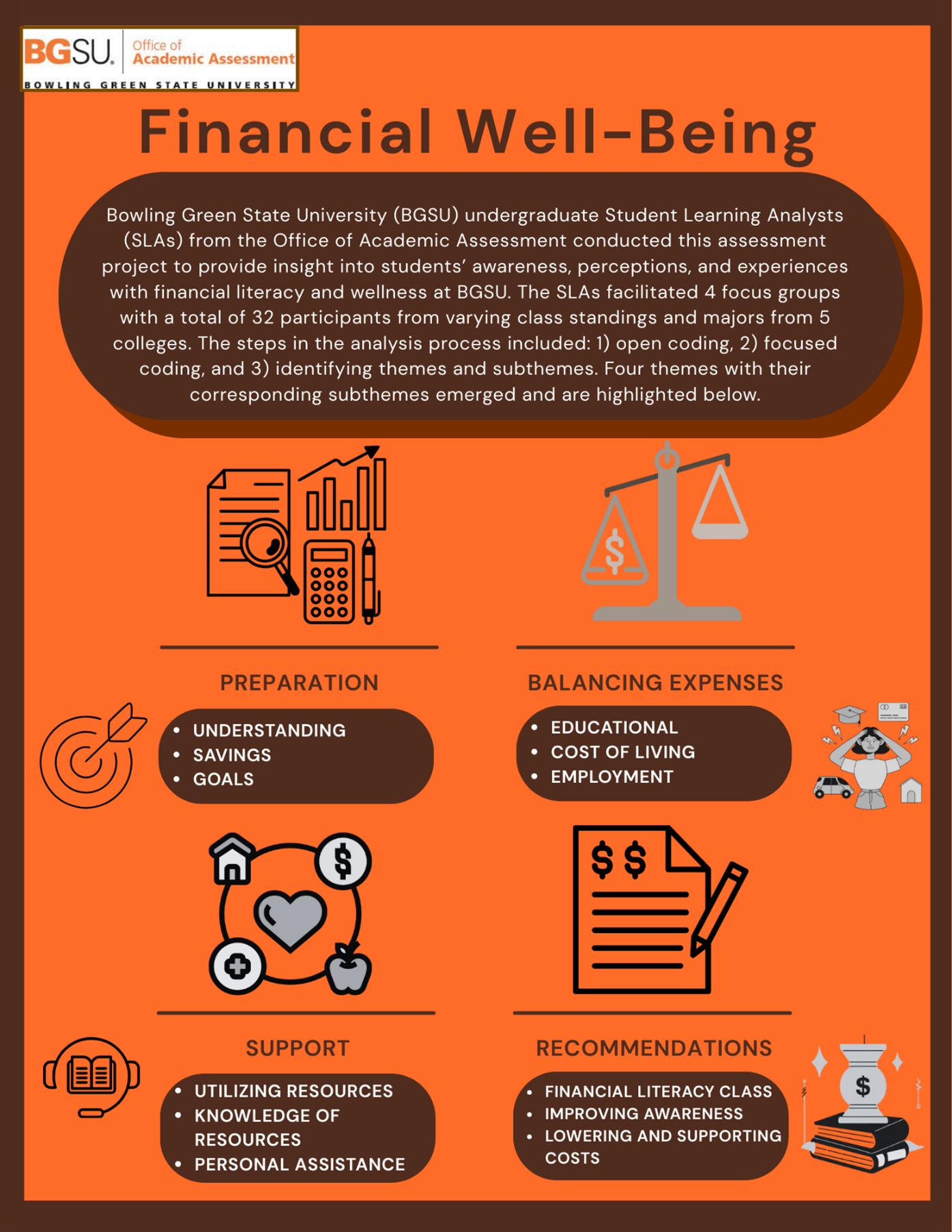
Bowling Green State University (BGSU) undergraduate Student Learning Analysts (SLAs) from the Office of Academic Assessment conducted this assessment project. The SLAs designed an assessment project to provide insight into students’ awareness, perceptions, and experiences with financial literacy and wellness at BGSU. The SLAs facilitated four virtual focus groups with a total of 32 participants from varying class standings and majors from five colleges. Out of the 32 participants, 68.75% (n = 22) self-identified as female, 25.00% (n = 8) self-identified as male, 3.13% (n = 1) self-identified as non-binary, and 3.13% (n = 1) preferred not to say. From the race/ethnicity information the participants provided, 78.13% (n = 25) self-identified as White/Caucasian, 12.50% (n = 4) self-identified as Black/African American, 3.13% (n = 1) self-identified as Asian/White, 3.13% (n = 1) self-identified as Mixed (Black/White), and 3.13% (n = 1) self-identified as White Hispanic. Zoom was used as the online meeting platform, and the focus groups were recorded. These recordings were then transcribed and analyzed. The steps in the analysis process included: 1) open coding,
2) focused coding, and 3) identifying themes and subthemes.
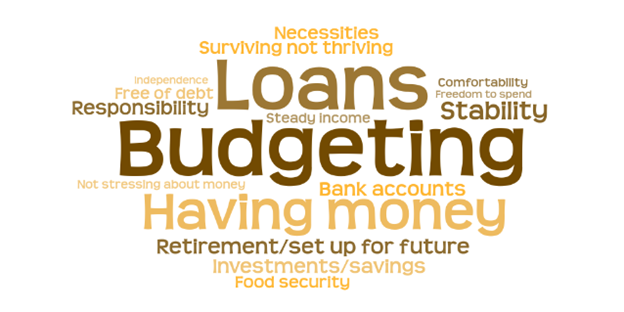
At the beginning of the focus groups, students were asked, “What is a word or phrase that comes to mind when you hear financial well-being?” Below is a word cloud highlighting their responses. The size of the word/phrase directly corresponds to how often it was mentioned by students, with larger words/phrases being said more often.
Additionally, the SLAs put together a list of financial well-being resources offered by BGSU that they discovered through both student responses and prior research. These resources and their corresponding websites were shared with the participants following the focus groups.
Four major themes emerged: 1) Preparation, 2) Balancing Expenses, 3) Support, and
4) Recommendations. These themes provided insight into students’ awareness, perceptions, and experiences with financial literacy and wellness at BGSU.
1. Preparation – Students discussed the personal steps they did or did not take for their financial well-being.
- Understanding – Participants expressed their knowledge or lack of knowledge in financial well-being, as well as needing to take the initiative to learn about and use financial resources.
- Savings – Students discussed their banking and personal strategies for saving money, along with knowing how to budget.
- Goals – Participants shared their financial stability future plans, including not being in debt, having enough money to buy a house and other big purchases, and supporting a family.
This student saved their money in high school and from their jobs to be prepared for college:
I felt very prepared. I saved up a lot of money in high school and worked a lot of jobs in high school to be able to afford to come to school and, like, also afford everything else I need to buy at school, so I felt prepared. (T4, L96-98)
2. Balancing Expenses – Participants discussed how they were impacted by costs and income.
- Educational – Students talked about school expenses, including tuition, books, supplies, and fees.
- Cost of Living – Participants discussed various living expenses, including food, rent, medical, transportation, and entertainment.
- Employment – Students shared their challenges and experiences with student employment, how they balance their schedules, and managing money between work, school, and life.
This student talked about balancing different aspects of their college expenses:
I think that I was pretty prepared. ... But coming here, I realized that I had to really just pay for everything myself, so when I had got my first refund check, I kind of blew it. And I didn't have a job my freshman year. I was just, like, really excited, like, I can get this. And I got all of my necessities, but, after that first semester, I realized that I have to pay for a lot of things by myself, and, like, yeah, my parents would sometimes give me $50 here and there, but that wasn't nothing. So, after that first semester, definitely learned really quickly that, yeah, we gotta save up and prioritize our money. But I've gotten a job since and stayed with the job. (T3, L176-185)
3. Support – Participants explored the ways BGSU has supported or did not support students’ current and future financial well-being.
- Utilizing Resources – Students discussed their experiences using programs and tools, including the Falcon Food Pantry, ReStore, career preparation support, and scholarships.
- Knowledge of Resources – Students communicated information about their awareness of BGSU resources.
- Personal Assistance – Participants discussed receiving advice and help from others, including family members, scholarship advisors, and financial advisors.
This student talked about their overall positive experience with their finances at BGSU:
I've had really positive experiences even, like, going to talk to people about, like, something on my billing that didn't look right, or I had a question, like, ‘What is this charge?’ Like, they don't judge me or anything like that, like, it's been in general, like, a really positive experience. (T1, L61-64)
4. Recommendations – Participants provided a variety of suggestions for BGSU related to financial literacy and well-being.
- Financial Literacy Class – Participants gave suggestions for a financial literacy course or training. They suggested it be required or optional and either a new course or added to existing courses.
- Improving Awareness – Students recommended increasing financial literacy and well-being through events and communication strategies, such as emails, websites, and print materials.
- Lowering and Supporting Costs – Participants suggested lowering the cost of food on campus and providing well paid student employment opportunities to help students’ financial well-being.
One student suggested a course for navigating finances and having guest speakers come in:
That's the first thing that came to mind, is doing like a course that talks about finances and how college students … can navigate it, give them tips and tricks, maybe even, like, little club events or something. They can bring in, like, a guest speaker, you know, someone that's, like, a billionaire, and get people to come. (T3, L408-411)
For more information about this assessment project, contact Dr. Jessica M. Turos from the BGSU Office of Academic Assessment at jmturos@bgsu.edu.
Infographic
Updated: 03/19/2026 05:59PM