
Collaborative Learning Executive Summary - Fall 2025
Bowling Green State University (BGSU) undergraduate Student Learning Analysts (SLAs) from the Office of Academic Assessment conducted this assessment project. The SLAs designed a focus group protocol to gain knowledge about collaborative learning at BGSU. The SLAs facilitated four virtual focus groups with 26 participants from varying class standings and majors from five colleges. Out of the 26 participants, 61.54% identified as female (n=16), 26.92% as male (n=7), 3.85% as non-binary (n=1), 3.85% as transmasc (n=1), and 3.85% preferred not to say their gender (n=1). From the race/ethnicity information participants provided, 73.08% self-reported their race/ethnicity as White/Caucasian (n=19), 19.23% as African American/Black (n=5), 3.85% as Asian (n=1), and 3.85% as White/Asian (n=1). Zoom was used as the online meeting platform, and the focus groups were recorded. These recordings were then transcribed and analyzed.
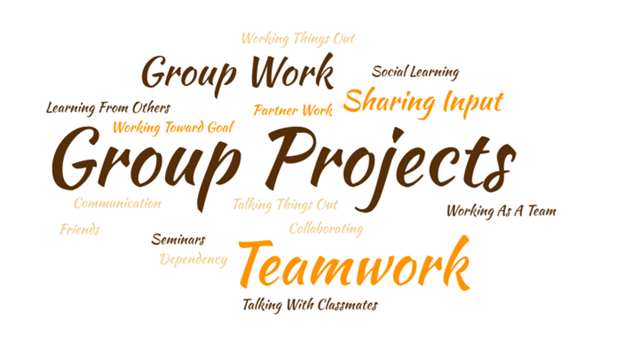
The focus groups started with a question about things that come to mind when hearing the term collaborative learning. Based on the key words from participant responses, a word cloud was created to show their initial thoughts on collaborative learning. Below is the world cloud, with the larger words representing the highest frequency.
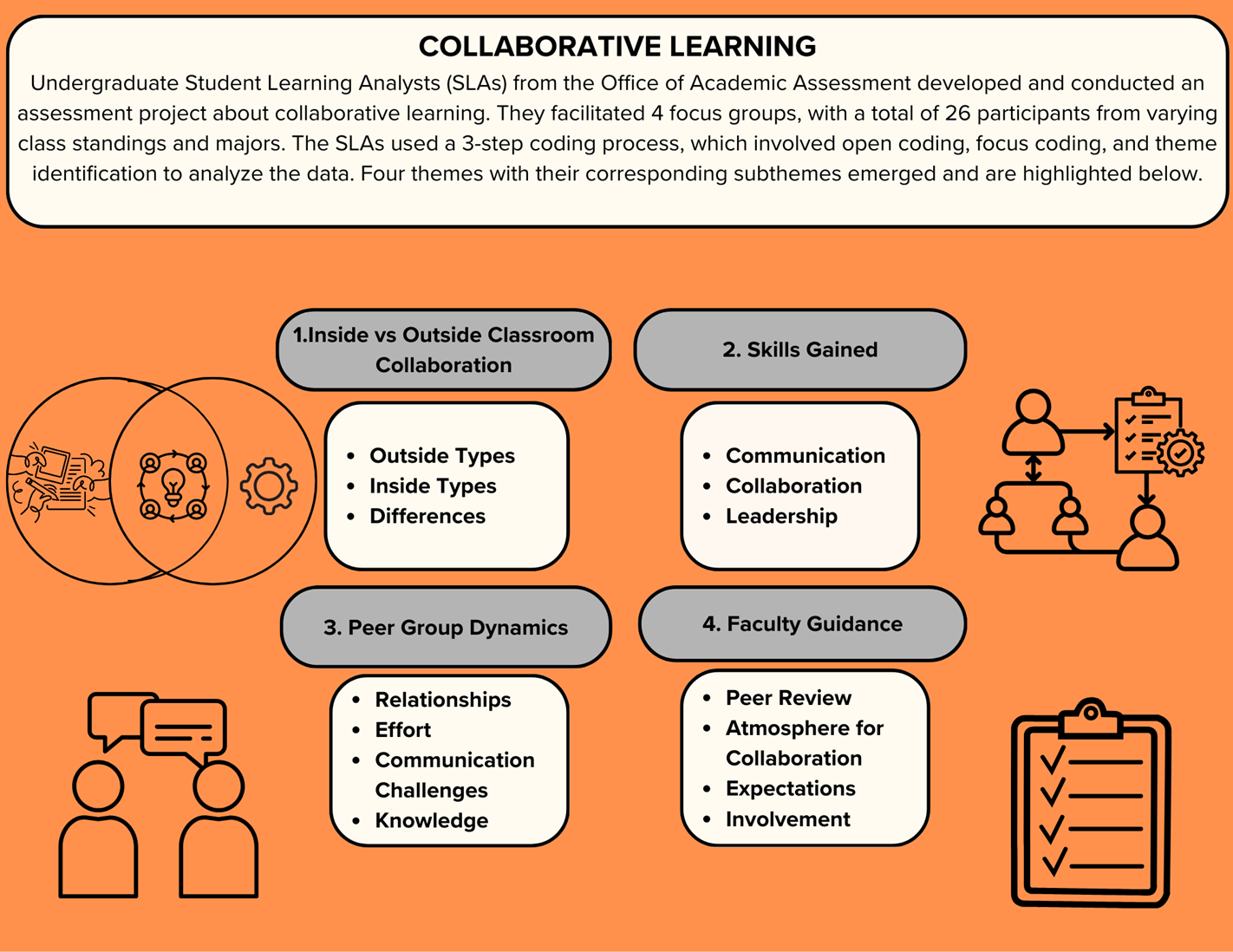
When analyzing the data, the SLAs used a three-step process, which involved open coding, focus coding, and theme identification. Four themes with their corresponding subthemes emerged throughout these discussions and are highlighted below.
1. Inside Versus Outside Classroom Collaboration – Students described and compared types of collaboration in and outside of the classroom, as well as shared their preferences regarding collaborative learning.
- Outside Types – Students talked about collaborative learning experiences outside of the classroom, including religious groups, sports, jobs, student organizations, and volunteering.
- Inside Types – Students discussed collaborative learning experiences inside the classroom, including group projects, group papers, discussion boards, and labs.
- Differences – Participants compared inside and outside the classroom collaborative learning and also identified what they liked and did not like about these experiences.
This student discussed both positive and negative experiences with collaborative learning:
I've had good and bad experiences with collaborative learning. It's definitely better when it's focused in class versus when it's out of class, because everyone has different work schedules. Some people work at universities, some people work…way out there...But more often than not, though, I will say when I'm in a group project, everyone does do their work that they're assigned to do. (T4, L41-46)
2. Skills Gained – Students described the skills they developed in their collaborative experiences or will need to develop for their careers.
- Communication – Participants described talking with others for a purpose and conveying themselves and their ideas as a skill gained from collaborative learning.
- Collaboration – Participants described working with others, learning how to work with others, understanding people, conflict resolution, and understanding others’ ideas.
- Leadership – Students discussed leading groups, teaching, mentoring peers, adaptability, flexibility, and working in different situations as a skill gained from collaborative learning.
This student stated that collaborative learning provides an opportunity to develop a multitude of skills:
I would say it's still a way of, like, building those relationships, meeting more people, learning how to work with different people, learning how to communicate, become a leader, but also… take a smaller role sometimes. Just all the things that were mentioned earlier, I feel like they still translate in some type of way, whether you're in a classroom or not. (T3, L139-140)
3. Peer Group Dynamics – Students described working with other students and interacting with peers in a group setting.
- Relationships – Students discussed the connections they made with peers through collaborative learning and how they work with their peers.
- Effort – Participants discussed their experiences with group members’ willingness to participate and their contributions, as well as different standards and the difficulties of making a project cohesive.
- Communication Challenges – Students discussed communication issues that arose in their collaborative learning experiences, such as scheduling conflicts and a lack of communication between group members.
- Knowledge – Participants discussed how group members help each other learn and issues with a lack of knowledge in a collaborative learning experience.
This student talked about peer dynamics in working with a group:
I feel like it's really nice, like, being able to complete something as a group in general, knowing that everybody is on kind of a similar page and are, like, they're going for one goal. Also, just, the camaraderie that comes from it. Just, being a team and being able to actually hear people's ideas, hopefully, like, when you're in a group like that. I love ideas. So, it's nice to be able to look at things from a different light. (T3, L45-47)
4. Faculty Guidance – Students described things faculty do or could do to support collaborative learning experiences.
- Peer Review – Students discussed providing feedback to other students, their experiences with peer reviewing, and creating opportunities for evaluation of their collaborative learning experiences.
- Atmosphere for Collaboration – Students talked about teaching styles, faculty creating opportunities for collaboration, as well as the structure and set up of projects.
- Expectations – Students talked about professors setting clear expectations for projects, creating guidelines, and finding the balance for leeway in the project.
- Involvement – Students talked about being able to ask questions to professors, as well as how professors check in with students during group work and talking to them about their collaborative learning experiences.
One student talked about the important role faculty play in the collaborative learning experience:
I feel like, when they set good guidelines, it's so much easier to have a good experience in learning collaboratively...if somebody in your group's not pulling their part, you're allowed to report that. And I feel like that's totally fair, because I know a lot of times, I feel like professors aren't able to really see what's going on in the group versus, like, when you're actually in it. So, just setting, like, good guidelines, and also, I feel like, maybe allowing people to choose their own groups... (T2, L129-140)
Participants provided recommendations on creating an atmosphere for collaboration, offering more collaborative learning experiences, balancing group and independent work, incorporating peer reviews during group projects, continued faculty support during group projects through check-ins, and communicating clear guidelines while supporting students’ creativity.
For more information about this assessment project, please contact Dr. Jessica M. Turos, Associate Director of the BGSU Office of Academic Assessment, at jmturos@bgsu.edu.
Infographic
Updated: 03/19/2026 09:38PM