
Student Use and Awareness of AI Executive Summary – Spring 2024
Bowling Green State University (BGSU) undergraduate Student Learning Analysts (SLAs) from the Office of Academic Assessment conducted this assessment project. The SLAs designed a focus group protocol to gain insight into students’ knowledge, use, and experience with AI. The SLAs facilitated four focus groups with 21 participants from varying class standings and majors from five colleges. Out of the 21 participants, 57.14% (n = 12) self-identified as male, 38.1% (n = 8) self-identified as female, and 4.76% (n = 1) self-identified as transgender male. From the race/ethnicity information the participants provided, 80.95% (n = 17) self-identified as White, 9.52% (n = 2) self-identified as African American/Black, 4.76% (n = 1) self-identified as Arab, and 4.76% (n = 1) self-identified as Biracial. Zoom was used as the online meeting platform, and the focus groups were recorded. These recordings were then transcribed and analyzed. The steps in the analysis process included: 1) open coding, 2) focused coding, and 3) identifying themes and subthemes.
The first question asked was, “How would you define artificial intelligence, otherwise known as AI?” Students in all focus groups provided their own definitions of AI with many referring to concepts like machine learning, databases, generated content, and algorithms. The SLAs compiled a definition of AI based on participants’ responses: a technological tool or software which mimics humans’ ability to use information to accomplish tasks, such as answering questions, sorting information, brainstorming, making content, etc.
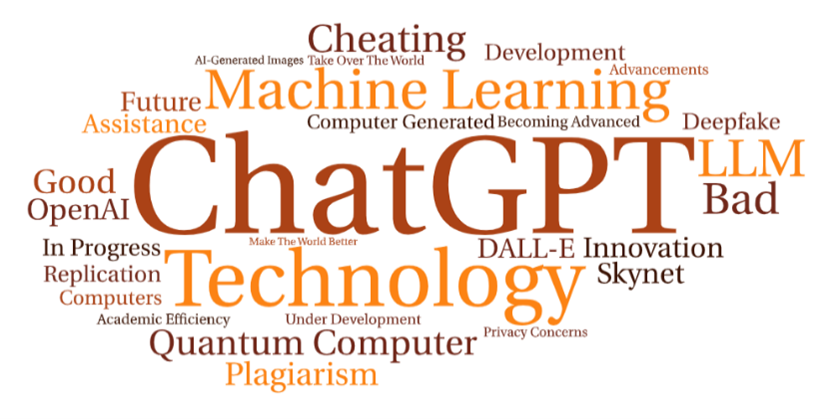
Students were asked the survey question, “What words or phrases come to mind when you hear artificial intelligence (AI)?” Their responses are detailed in the word cloud below, with the larger the word the more often it was said.
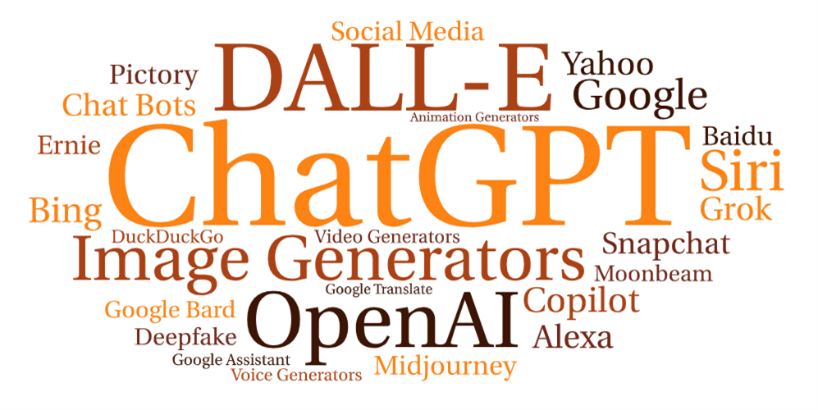
Throughout the focus group, students also talked about the different AI tools that they used or were aware of. The following word cloud that documents these AI tools:
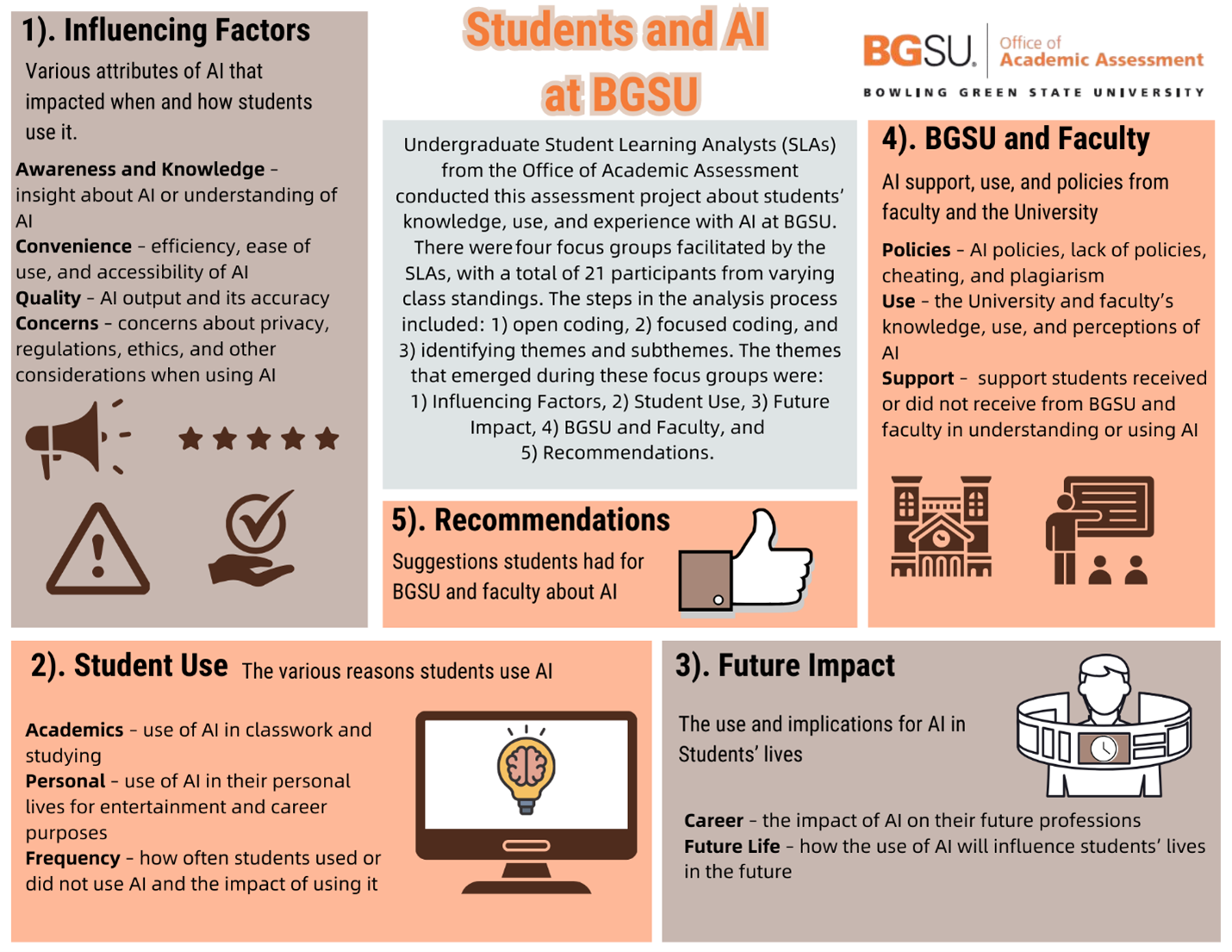
As further data analysis took place, five major themes emerged: 1) Influencing Factors,
2) Student Use, 3) Future Impact, 4) BGSU and Faculty, and 5) Recommendations. These themes provided insight into understanding students’ knowledge, use, and experience with AI. The themes also assisted in understanding how students are using AI in both their personal lives and in their academic careers.
- Influencing Factors – Students discussed various attributes of AI that impacted when and how they use it.
- Awareness and Knowledge – Students talked about when they have gained insight about AI or expressed an understanding of AI.
- Convenience – Participants discussed the efficiency, ease of use, and accessibility of AI.
- Quality – Students shared their thoughts about AI output and its accuracy.
- Concerns – Students shared their concerns about privacy, regulations, ethics, and other considerations when using AI.
Providing an overall quote for this theme, a student talked about what they consider when deciding to use AI generated output:
I think I decide whether to use that output based on, like, either how well it answered my prompt or how trustworthy I think it is. Like, if I can double check what it kind of gave me to different sources and, like, verify that's kind of what I wanted to say and what I think is right. And that's kind of how I decide if I want to use it or not. (T1, L184-187)
- Student Use – Participants talked about the various reasons for using AI.
- Academics – Students discussed the use of AI in classwork and studying.
- Personal – Students discussed the use of AI in their personal lives for entertainment and career purposes.
- Frequency – Students discussed how often they used or did not use AI and the impact of using it.
This student used AI several times in a week, depending on their workload:
I'd say I'm probably using it several times a week. It also just depends on, like, what my current, like, load is, and what I'm doing, and if I think it's appropriate to use it. But I would say, on average, probably a couple of times a week. (T1, L141-143)
- Future Impact – Students discussed the use and implications for AI in their futures.
- Career – Students talked about the impact of AI on their future professions.
- Future Life – Students discussed how the use of AI will influence their lives in the future.
A student discussed how AI may grow in the future and how students should prepare for this development:
AI is picking up. I think of it as a train that's starting to move on the tracks. I mean, I'd say, ‘Hop on.’ Because I feel like once it gets too far it’s gonna, you know, get really complicated. So, I'd say, ‘Learn it now. Understand it now.’ Because in the future it's just going to start going faster. If you're not on it, it might be hard to get on it. (T2, L513-516)
- BGSU and Faculty – Students discussed AI support, use, and policies from faculty and the University
- Policies – Students discussed their thoughts and experiences with AI policies, lack of policies, cheating, and plagiarism.
- Use – Students discussed the University and faculty’s knowledge, use, and perceptions of AI.
- Support – Students talked about the support they received or did not receive from BGSU and faculty in understanding or using AI.
This student talked about a lack of assistance from the University in understanding AI:
I’ve felt very little support from BGSU, like as a whole. There have been a few teachers who recommend using it for certain things. Like, my … teacher… showed some people how to get into it and how to use it for certain things. But honestly, they've been pretty hands off. (T2, L470-473)
- Recommendations – Students talked about suggestions they had for BGSU and faculty about AI. Student recommendations were related to clarifying AI policies, providing educational experiences and resources for faculty and students, and implementing AI within the university.
This participant spoke about how they would like to see AI incorporated into their coursework:
Since I think it's gonna be, kind of like, the way the future and... it's gonna be probably [in] most occupations, I'd be curious to, like, see professors... kind of, combine that with their current content, and find ways to utilize it and integrate it with their work. And also just see that the University is, like, willing to find academic ways forward with using AI and not just closing it out because it's unfamiliar. (T1, L449-453)
For more information about this assessment project, please contact Dr. Jessica M. Turos, Associate Director of the BGSU Office of Academic Assessment, at jmturos@bgsu.edu.
Infographic
Updated: 03/19/2026 05:59PM