
Student Success Executive Summary - Spring 2026
Bowling Green State University (BGSU) undergraduate Student Learning Analysts (SLAs) from the Office of Academic Assessment conducted this assessment project. The SLAs designed a focus group protocol to gain insight into students’ perceptions of what it means to succeed in and after college and their experiences with student success at BGSU. The SLAs facilitated four virtual focus groups with 21 participants from varying class standings and majors from five colleges. Of the 21 participants, 57.1% self-identified as female (n=12), 23.8% as male (n=5), 9.5% as non-binary (n=2), 4.8% as transmasc (n=1), and 4.8% preferred not to say their gender (n=1). From the race/ethnicity information participants provided, 66.7% self-reported their race/ethnicity as White/Caucasian (n=14), 23.8% as African American/Black (n=5), 4.8% as Hispanic (n=1), and 4.8 as Mixed (n=1). Zoom was used as the online meeting platform, and the focus groups were recorded. These recordings were then transcribed and analyzed.
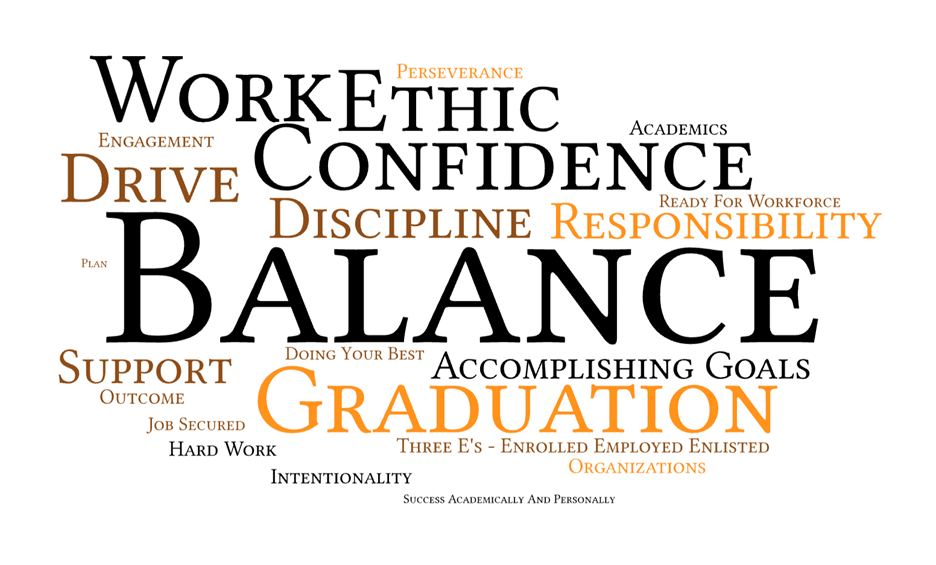
The focus groups began with a question about what words or phrases come to mind when thinking of student success. Based on the keywords from participant responses, a word cloud was created to show their initial thoughts on student success. Below is the word cloud, with larger words representing the highest frequency.
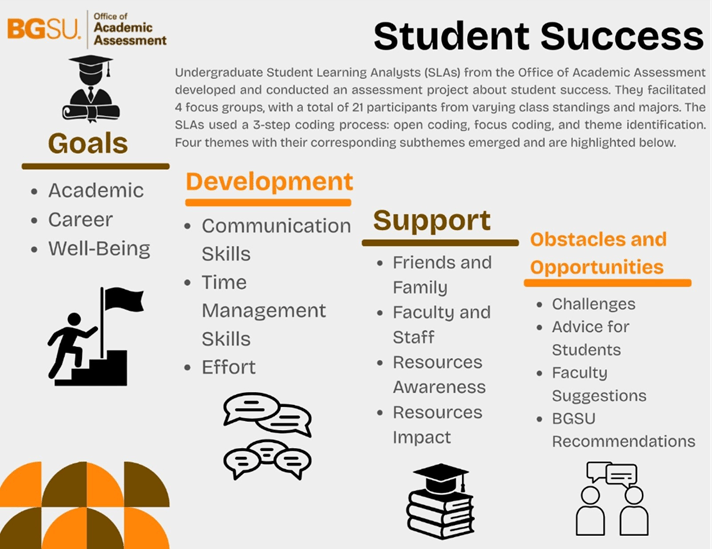
When analyzing the data, the SLAs used a three-step process, which involved open coding, focus coding, and theme identification. Four themes with their corresponding subthemes emerged throughout these discussions.
1. Goals – Students talked about their vision for the future, what they want to achieve in order to be successful, and how they define success.
a. Academic – Students discussed key aspects of achieving their goals, including academic progress and gaining experiences through internships and volunteer opportunities.
b. Career – Students discussed how their future careers play a role in how they define success.
c. Well-Being – Students discussed how maintaining their mental health, happiness, and personal balance plays an important role in achieving success.
This student mentioned their thoughts on success:
I would say, accomplishing your goals no matter what, like, you want to reach in the future. Just setting your bar really high and trying to get to your goals. (T2, L12-13)
2. Development – Students discussed putting effort into learning skills that are helpful to their success and elaborated upon those skills.
a. Communication Skills – Students discussed developing communication, networking, and connection skills.
b. Time Management Skills – Students discussed learning to manage and balance their time, as well as developing organizational skills.
c. Effort – Participants talked about the time and attention they put in, as well as using what they have learned.
A student discussed their skill development as a resident advisor:
I think for me is being a resident advisor, being able to learn a lot more about, like, leadership skills and, how to make, like, inclusive programming and stuff like that for students. Which in this focus group, like, clearly, it's impacted everyone in a positive way. So, yeah, that's helped me grow a lot. (T1, L171-174)
3. Support – Students discussed who and what helped them succeed throughout their college experience.
a. Family and Friends – Students talked about the impact their family, friends, and other support groups have on their success.
b. Faculty and Staff – Students discussed how faculty and staff, such as professors, teaching assistants, graduate assistants, advisors, and campus supervisors, contribute to their success.
c. Resources Awareness – Students noted where they learned about different resources, including programs, events, and services, that have helped them succeed.
d. Resources Impact – Students went into detail about how different programs, events, and services they used were beneficial to their success.
One participant communicated the need for support from others:
I think for me, it's just the general support system around. So, whether that's, like, in your personal life, or, like in the school system, it's just that support system can impact the way that you get to your goals and how quickly you get to them. (T1, L64-66)
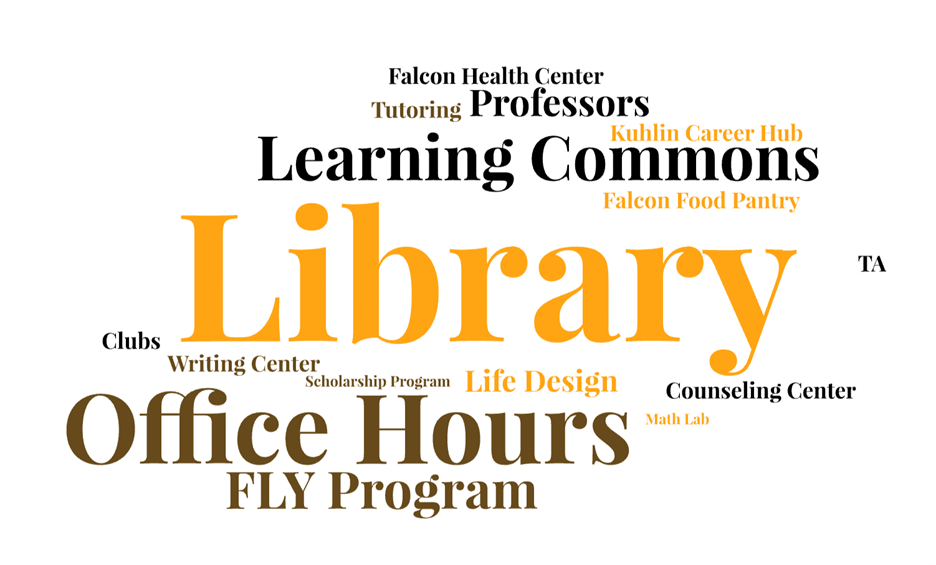
Throughout the focus groups, students noted where they learned about different resources that have helped them succeed. In the word cloud below, different resources students mentioned are shown, with the larger the word, the more often it was mentioned.
4. Obstacles and Opportunities – Participants discussed obstacles to their success and recommendations they had for their peers, faculty, and BGSU.
a. Challenges – Students discuss obstacles that impact their student success, such as motivation, amount of work, other priorities, mental health, and attendance policies.
b. Advice for Students – Participants shared advice for other students to help them be successful in their education.
c. Faculty Suggestions – Students shared what faculty can do to help students be more successful in their academics, including being accommodating and offering support resources like study sessions.
d. BGSU Recommendations – Participants shared their suggestions for BGSU to do or continue that will help students succeed, including promoting resources and organizations, connecting students to companies, and being more accessible.
This student suggested more promotion of opportunities at BGSU:
I feel all of the opportunities are there, I just feel maybe the problem, if there would be a problem, lies in promoting these opportunities to a wider student audience. Like, I feel sometimes…when I talk about stuff, people who have been here for 3, 4 years like me, are like I had no clue that was a thing. I had no clue that was something I could do. So, you know, the things are there, but getting the word out about the things is maybe something that could be improved upon. (T3, L225-228)
For more information about this assessment project, please contact Dr. Jessica M. Turos, Associate Director of the BGSU Office of Academic Assessment, at jmturos@bgsu.edu.
Infographic
Updated: 07/09/2026 03:54PM