
Student Belonging and Engagement in Studies Executive Summary - Spring 2022
Bowling Green State University (BGSU) undergraduate Student Learning Analysts (SLAs) from the Office of Academic Assessment conducted this assessment project. The SLAs designed a focus group protocol to gain insight about student engagement and belonging in classes and studies. We wanted to learn about students' perspectives on comfortability in participating in a classroom environment. There were four focus groups facilitated by the SLAs, with a total of 30 participants from varying class standings and majors from five different colleges. Out of the 30 participants, 70.00% identified as female (n=21), 20.00% identified as male (n=6), 3.33% identified as genderqueer (n=1), 3.33% identified as non-binary (n=1), and 3.33% identified as transgender female (n=1). From the race/ethnicity information participants provided, 83.33% self-reported their race/ethnicity as White (n=25), 13.33% as African American/Black (n=4), and 3.33% as Mixed/English and Persian (n=1). Zoom was used as the online meeting platform, and the focus groups were recorded to ensure that all information was properly documented. These recordings were then transcribed and analyzed. At the beginning of each focus group, the SLAs asked participants about their thoughts on engagement and belonging. Below is a summary of their responses.
Belonging: having people and a safe space where you can express yourself comfortably, along with having mutual respect within a community.
Engagement: actively participating in a community and utilizing opportunities to expand your skill set.
The SLAs used a three-step coding process, which involved open coding, focus coding, and theme identification. Throughout these discussions, five themes with their corresponding subthemes emerged and are highlighted below.
- Student and Professor Relationships – Participants reflected on how professors treat and interact with students.
- Fundamentals – Students talked about the importance of faculty being open-minded and respecting identities.
- Empathy and Awareness of Students – Students discussed the importance of faculty checking in on students' experiences, including mental and physical health challenges and life.
- Authenticity – Students discussed the importance of faculty being their authentic selves, personable, and approachable both in and out of class.
- Fundamentals – Students talked about the importance of faculty being open-minded and respecting identities.
A student talked about how a professor could be intentional about acknowledging identities: I think on the first day [of class] I really like when they go through the attendance sheet and then ask you, ‘Do you have a nickname? What would you like to be called by?’. [Then,] they write it down and make a note. One teacher pulls it up every time, even if [they] know your name, it's just to make sure. (T4, L284-287)
- Student Introspection- Students talked about how they engaged with the class and content.
- Distractions to Learning – Students talked about what inhibited their intake of content, such as technology, other students, or other factors.
- Learning Assistance – Students discussed methods they used to deepen their understanding of the class content, such as using materials, taking notes, or asking questions.
- Peer Support – Student discussed the helpfulness of other students in their ability to learn.
- BGPs – Students examined the value and feelings towards general education courses.
This participant described the variety of thinking that students have: ... I feel like there's a lot of diversity because anybody can be creative in a different sense of way. So, I feel like that really stands out to me because I'm not stuck. That not everyone's the same because that would be very boring to me. So, having people with different minds and having people from different backgrounds always helps, which makes the students interesting. (T2, L186-190)
- Teaching Style – Students talked about the different teaching methods faculty exhibited and how they preferred to be taught.
- Interactive – Students discussed how they liked when professors were passionate about the content, incorporated real world examples, and used visual aids.
- Versatility of Instruction – Students discussed how they appreciated the different ways class time was spent throughout the course.
- Participation – Students talked about how professors asked questions and facilitated and inspired discussion and engagement.
- Organization – Students discussed how they value professors keeping up with syllabus/schedule, staying on topic, and communicating effectively.
A student stated: … Really good feedback is important, even if [it’s] good or bad... Critiques just help me understand, like, what I did wrong and, like, ... what I can fix for the future. (T1, L535-538)
- Course Structure – Students discussed how courses were run and organized (physically, virtually) and how they were laid out.
- Content Outside of Class – Students discussed how professors offered materials and resources outside of class.
- Reminders – Students discussed the importance of updates about content, assignments, expectations, and office hours.
- Adaptation – Students talked about professors acknowledging social cues and adjusting their courses to accommodate students.
- Layout – Students talked about how the class seating arrangement and class size affected them.
This participant preferred when professors asked for and used feedback from students about the class:
... I think it's really helpful when professors take into account your opinions on things, not necessarily that they would have to, like, change everything that they're doing. But sometimes I had professors that, like, realize ... they planned a huge project during, like, a heavy exam week or that we need more help or time to work on it, or something. And to be accommodating to that is really helpful because I can feel like I can spend more time doing it right and that the professor, like, respects that I am trying. I'm just need more time or something ... and I find that that's really helpful that's when they take that into consideration. (T3, L339-345)
- Recommendations – Students discussed things that helped support student engagement and things students want to continue.
A student recommended how a professor can keep them engaged in the classroom: I feel like when you have a ton of homework assignments from a specific class that's more like busy work and then you have to go to that class three times a week. It can be a lot and then you don't really want to pay as much attention in class because it's just so much all the time. But if the homework assignments were fewer or actually built on the topics and were more meaningful in active learning. Then you would want to go to class more and continue learning about the topic, instead of just feeling like overwhelmed by how much information and work is being thrown at you. (T3, L163-168)
For more information about this assessment project, please contact Dr. Jessica M. Turos, Associate Director of the BGSU Office of Academic Assessment, at jmturos@bgsu.edu.
Infographic
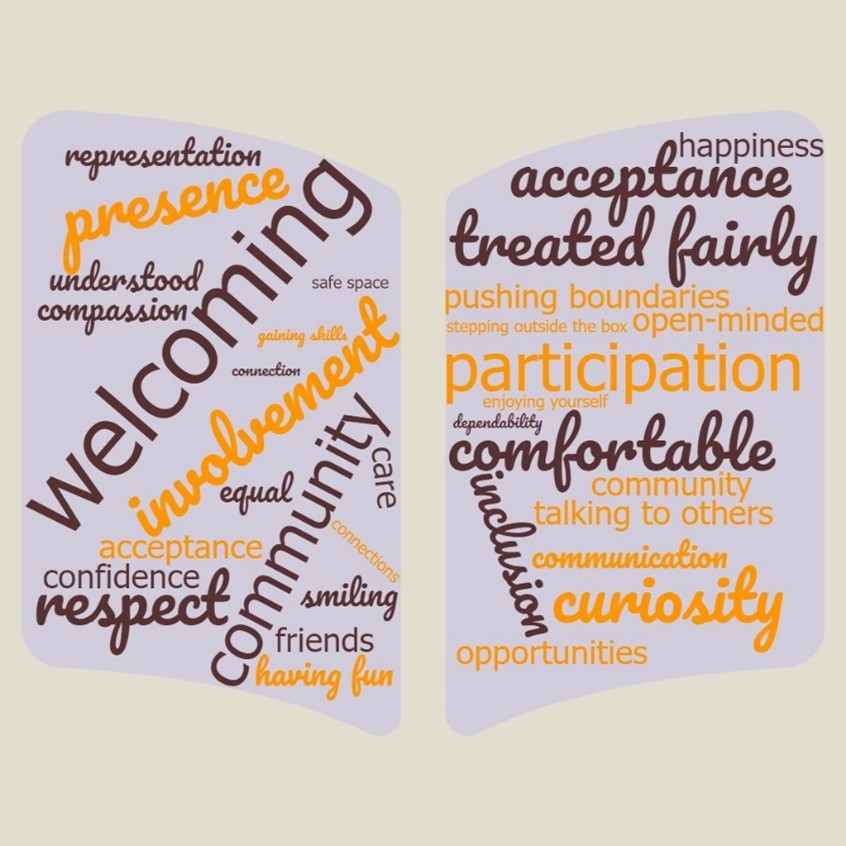
Note: This is a word cloud created to depict the participants’ responses to two questions. The first question was “Belonging looks like...” and the response are highlighted in brown. The second question was “Engagement looks like...” and the responses are highlighted in orange. The larger the word the more frequently it was said.
Updated: 04/07/2026 03:59PM