
Learning Expectations Executive Summary - Spring 2025
Bowling Green State University (BGSU) undergraduate Student Learning Analysts (SLAs) from the Office of Academic Assessment conducted this assessment project. The SLAs designed a focus group protocol to gain knowledge about learning expectations at BGSU. The SLAs facilitated four virtual focus groups with 27 participants from varying class standings and majors from five colleges. Out of the 27 participants, 55.56% identified as female (n=15), 33.33% as male (n=9), 3.70% as non-binary (n=1), 3.70% as transmasc (n=1), and 3.70% did not provide their gender (n=1). From the race/ethnicity information participants provided, 81.48% self-reported their race/ethnicity as White/Caucasian (n=22), 7.41% as African American/Black (n=2), 3.70% as Arabic (n=1), 3.70% as Biracial (n=1), and 3.70% as Nepali American (n=1). Zoom was used as the online meeting platform, and the focus groups were recorded. These recordings were then transcribed and analyzed.
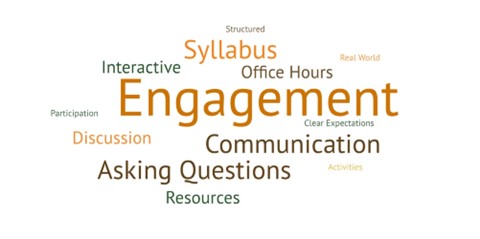
The focus groups started with a question about the characteristics that make an effective college class. Based off the key words from participant quotes, a word cloud was created to show the responses that were emphasized to be important characteristics. Below is the world cloud with the larger words representing the highest frequency.
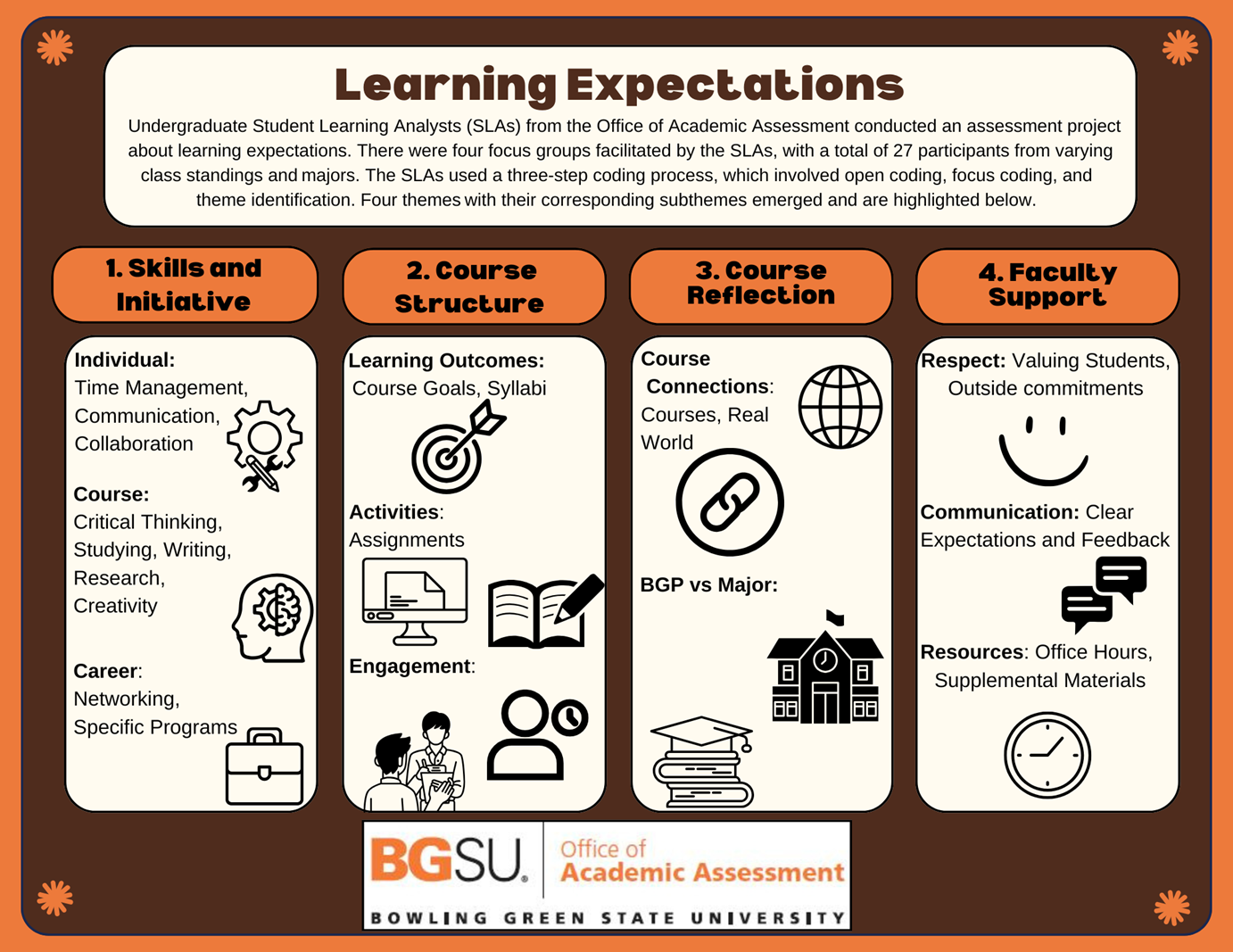
The SLAs used a three-step coding process, which involved open coding, focus coding, and theme identification. Four themes with their corresponding subthemes emerged throughout these discussions and are highlighted below.
1. Skills and Initiative – Students identified their abilities and self-expectations in college courses.
- Individual – Participants discussed skills benefiting their personal life (e.g., time management, communication, collaboration, etc.) and becoming more responsible.
- Course – Students talked about skills benefiting their academic journey (e.g., critical thinking, studying, writing, research, creativity, etc.) and taking classes seriously.
- Career – Students identified real world skills and skills that will benefit their future jobs (e.g., networking, specific programs, etc.).
One student talked about the value of education as it applied to the development of their skills:
...I understand the value of education more. And it's not just about learning content to get it done and get a good grade. It's going to school to have valuable information given to you, and actually make connections with either peers or faculty, or any sort of person that you meet while you're here. (T2, L70-73)
Another student discussed the value of learning throughout one’s life:
I've sort of started to appreciate learning as more of, like, a continuous process, like, I'm going to have after college. I'm going to have the skills to go out into the real world. But I'm still going to be learning, even after college. (T2, L46-51)
2. Course Structure – Students discussed how courses are set up and course expectations.
- Learning Outcomes – Students provided opinions on course goals and syllabi.
- Activities – Participants commented on the use of readings, exams, and assignments in their courses.
- Engagement – Students discussed wanting courses to be engaging, professors being engaged with the material, and professors wanting students to be engaged in class.
One student talked about the teaching activities in their classes:
I think right now, I have a good mix of classes that are like assignment based and classes that are discussion based. And I really think there's value in both of those. I don't really know how to weigh them against each other. I do like my discussion-based classes a lot. And, like, the conversations we have in class, and how we can like, take that kind of time to, like, talk about the parts of the curriculum that, like, interest students most or that they have the most questions about. So, I like how that's more flexible. But it can be harder to keep a good grade in those classes because there will be just a couple graded assignments so like, especially when they don't do, like, a participation grade or anything. So, if you're doing mostly in class discussions, and then you have a few tests. That can be a little bit difficult. So, I do appreciate having more smaller assignments as like progress checks and stuff like that. But I feel like, I also like my classes where they're assignment based. (T4, L116-126)
3. Course Reflection – Students discussed how they thought about their own thinking in courses and their learning expectations.
- Course Connections – Students highlighted the connections between courses and the real world.
- Major vs. BGP – Participants talked about general education, upper-level, and major specific expectations.
A participant talked about their motivation for taking BGP versus major classes:
It seems like BGPs are for students to learn something that they wouldn't seek out in... whatever major that they're in... So, I think that the general expectation is to go to class and learn things that you wouldn't even dream about or think about learning in the first place and how to use such a broad range of information to help you in your major, or whatever you're doing. (T2, L204-208)
4. Faculty Support – Students discussed the ways professors aid, regard, and connect with students.
- Respect – Participants discussed faculty valuing students as people and understanding students have outside commitments.
- Communication – Students talked about fair and timely grading, transparency about course expectations, and clear feedback about performance.
- Resources – Students discussed resources, such as office hours and supplemental materials to support their learning.
One student talked about how their view of faculty support has changed:
I used to think of learning as, like, the student versus the content. But now I feel like I've come to understand that teachers are here as a support. (T2, L60-61)
For more information about this assessment project, please contact Dr. Jessica M. Turos, Associate Director of the BGSU Office of Academic Assessment, at jmturos@bgsu.edu.
Infographic
Updated: 03/19/2026 09:38PM