
Life Design Executive Summary - Spring 2020
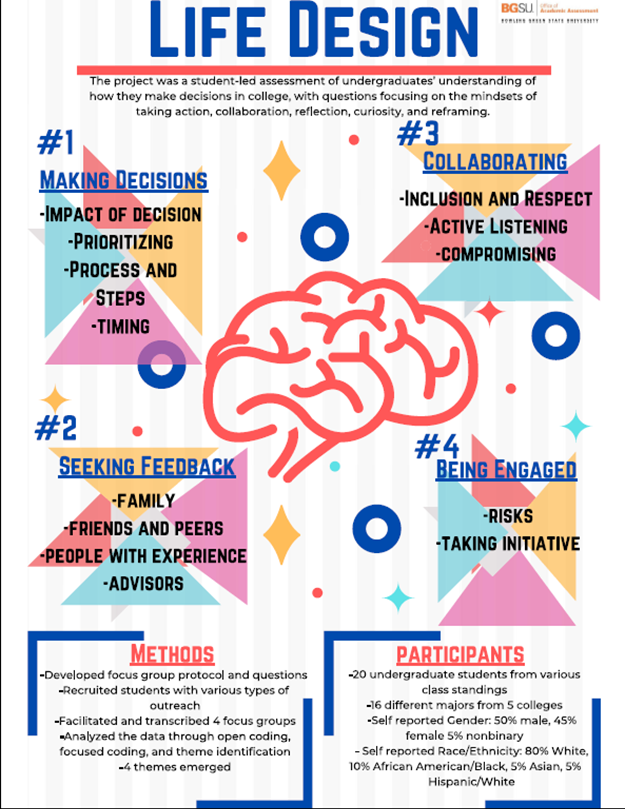
This project was a student-led assessment of Bowling Green State University (BGSU) undergraduate students. It was conducted by a team of undergraduate students identified as Student Learning Analysts (SLAs) from the Office of Academic Assessment. The SLAs designed a focus group protocol to gain an understanding of students' decision-making processes and how that impacts their learning at BGSU. There were 4 focus groups facilitated by the SLAs, with a total of 20 participants from varying class standings and majors from five different colleges. Out of the 20 participants, 50% of the participants identified as male (n=10), 45% identified as female (n=9), and 5% identified as nonbinary (n=1). From the race/ethnicity information participants provided, 80% self-reported their race/ethnicity as White (n=16), 10% as African American/Black (n=2), 5% as Asian (n=1), and 5% Hispanic/White (n=1). Audio recorders were used to ensure that all information was properly documented. These recordings were transcribed and analyzed. The SLAs used a three-step coding process, which involved open coding, focus coding, and theme identification. Throughout these discussions, four themes with their corresponding subthemes emerged and are highlighted below.
- Making Decisions: Students spoke about how they make choices and come to conclusions.
- Impact of Decision: Students spoke about the effects decisions have on the future and future decisions.
- Prioritizing: Students discussed what is important to consider when making decisions for now and the future.
- Process and Steps: Students shared the path of their decision-making process for the present-day or the future.
- Timing: Participants reflected about the time needed to make decisions or not having enough time.
A student explained the impact of their decision to change their major and how it influenced their future involvements: Um my decision [to change my major] kind of impacted like... my whole kind of college career... ‘cause it was a decision of like what I want to take in my path. So, it really made me decide what classes I'm going to take... what involvements I'm going to do, and like what types of jobs are going to help me get into grad school. So, it... positively impacted me because I met a lot of cool people and had a lot of unique experiences because of what I had chosen to do. (T4, L49-53)
- Seeking Feedback: Participants spoke about seeking information and/or expertise about things they are unfamiliar with or want reassurance about from a variety of individuals.
- Family: Students spoke about how they can get honest feedback from the people who know them and their reactions.
- Friends and Peers: Participants explained how these individuals make them feel included, socially accepted, and accountable.
- People with Experience: Students discussed seeking feedback from professors, faculty mentors, and upper-level students who had similar experiences along with those who provided guidance and assistance.
- Advisors: Students spoke about the people who provided guidance on academic programs, scheduling, and future planning.
One student spoke about their experience with seeking feedback from multiple sources for growth: Just talking with my advisors, um my scholarship program advisors as well, my parents, and close friends. I think that has helped me figure out like…. No matter what I was going to do I knew that it was going to forward me into [the] future and help me grow as an individual. (T2, L47-51)
- Collaborating: Students discussed working with others effectively and identifying when to be the leader in the group.
- Inclusion and Respect: Participants shared how including people’s perspectives when working in a group was important.
- Active Listening: Students talked about the importance of listening to what others have to say in a group.
- Compromising: Students discussed having different opinions and working with others to come to an agreement.
A student explained that they like to create an inclusive environment for discussions and allow everyone time to voice their opinions: I think just having space for people with different [thought] processes to be able to like voice their opinions. Like some people think by talking out loud so like they’ll give their ideas right away… But I also like leaving space [and] creating an environment where people that… like [to] take the time to think it through before voicing their opinion have that time to do that. That way, you’re kind of catered towards everybody instead of just the immediate thinkers. (T4, L123-128)
- Being Engaged: Students discussed various decisions that involved effort in their educational experience and personal life.
- Risks: Students talked about doing something they typically would not do or may seem difficult.
- Taking Initiative: Students spoke about assuming responsibility for something or doing something extra to benefit themselves.
One student revealed a proactive mindset that motivated them to respond to the unexpected: ... Just like making the most of like whatever your like put into, like not every situation you're going to be put in in your life is going to be positive, so like you just have to find a way to like make the most of it so you can like get the most out of it and you're not just sitting there wasting your time, so just trying to find a way to help yourself improve while doing that sucky thing. (T4, L74-77)
For more information on this Life Design assessment, please contact Dr. Jessica M. Turos at the BGSU Office of Academic Assessment at jmturos@bgsu.edu.
Infographic
Updated: 03/19/2026 05:59PM