
Student Success Executive Summary - Spring 2019
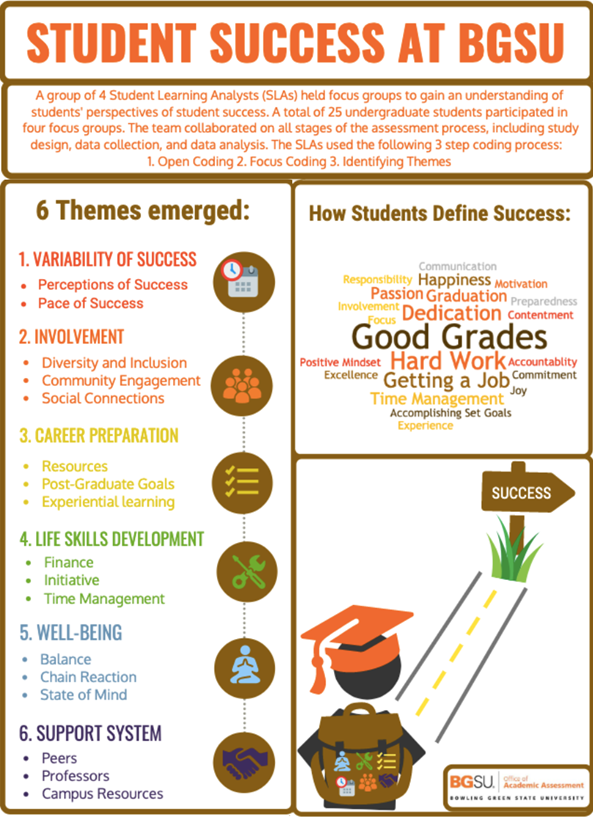
This project was a student-led assessment of Bowling Green State University (BGSU) undergraduate students. It was conducted by a team of students identified as Student Learning Analysts (SLAs) as part of the Office of Academic Assessment. The SLAs designed a focus group protocol to find out what students thought success was in different aspects of their lives and discussed examples of what student success is. There were four focus groups facilitated by the SLAs, with a total of 25 participants from varying class standings and majors. Audio recorders were used to ensure that all information was properly documented. These recordings were transcribed and analyzed. The SLAs used the three-step coding process, which involved open coding, focus coding, and theme identification. The six themes and subthemes are listed below.
- Variability of Success: Students mentioned that success is different for each student, and the time frame to achieve success fluctuates.
- Perceptions of Success: Students expressed that success is individualized and that everyone perceives it differently.
- Pace of Success: There are different time frames to achieve success in any undergraduate career.
One student explained that success has many definitions and that their goals are ever-changing throughout their lifetime: ...Success is fluid, as well as different for everyone. Um, you know, as your goals change and as you reach goals and achieve things, your idea of success will change... Just like remembering that like success is fluid, goals change, and um you know, don’t get too hung up on the one thing you didn’t succeed in or haven’t succeeded in yet, um ‘cause I feel like that can be like a big detriment to what you can succeed in later. (T4, L324-332)
- Involvement: Focus group participants expressed the importance of interacting with others from different backgrounds, being actively engaged in the community, and how campus organizations can assist in student success.
- Diversity and Inclusion: Being exposed to different backgrounds helps contribute to students’ overall success.
- Community Engagement: A strong relationship between campus and the community improves student success.
- Social Connections: Joining organizations creates networking opportunities that contribute to their overall success.
One participant emphasized the importance of getting involved in general and how it can have an impact on student success: I feel like [getting involved] is definitely huge and everything to be successful. It builds connections; it builds networking and everything. You’ll be able to meet with new people; you’ll be able to form connections that can last an entire lifetime. (T4, L70-76)
- Career Preparation: Students shared that utilizing resources and gaining experience prepares them for their future careers.
- Resources: Students utilized campus resources to practice and become more comfortable using skills needed for their careers.
- Experiential Learning: Students participated in experiences outside of the classroom to develop skills needed for the future.
- Post-Graduate Goals: Students engaged in opportunities to reach their goals after graduation.
A student explained how they felt successful when their confidence was developed through attending a job fair: I do think [job fairs] have helped me with like confidence because... I would be so scared to talk to like employers. Or, things like would make me so nervous. But then uh BG like pushing me with the job fair where it is a more of a safe environment, and if you mess up its like not the end of the world, you just talk to them [and] you walk away... that has helped me with my confidence and helping me towards my goals. (T2, L261-266)
- Life Skills Development: Students spoke about developing skills that lead a productive life
- Finance: Awareness and application of finances in student life leads to success.
- Initiative: Students talked about steps that they take in order to be successful.
- Time Management: Students felt successful when they prioritize academics over personal involvement.
One participant explained that using their time effectively contributes to their student success: ...Finding those gaps in time in college, and realizing that you have a couple of hours in between classes to work on things, you can kind of [know] what you’re supposed to be doing, so being able to plan out when I do my work and how much I do at certain times, and planning my down time as well... has been really helpful academically. (T3, L76-83)
- Well-Being: Mental health, physical health, and external factors affect students’ happiness and success.
- Balance: Participants contemplated their limits as a student and a member of the BGSU community.
- Chain Reaction: Students discussed how decisions in the present impact their results in the future.
- State of Mind: Students expressed having a positive mindset and taking time for themselves can lead to success.
A student discussed the importance of making sure they are in the right position in their life: ...If you’re not in a good place, like mentally or physically, like you won’t want to do your homework, you won’t want to do anything, and that’s going to like take you back in your classes and you’re not going to work, and then you don’t have any money to pay your bills, and it’s like, it can all easily crumble if you’re not ok. (T3, L442-445)
- Support System: Participants explained where and how they are finding the support needed to be successful.
- Peers: Students relied on one another to feel connected and successful in their undergraduate careers.
- Professors: Students discussed that the professors who offer resources and opportunities enhanced their success.
- Campus Resources: Students utilized human and physical resources to set them up for success.
A student discussed that BGSU aids in their success from the day they arrive on campus and continues to help even after graduation: And I think, um, when you come for like your SOAR day... and you like sit down with your academic advisor, they really like, lay out like what you’re going to be doing and how it’s going to help you in your career options and your career choices. And so, they’re really like up front and honest with you about what you can do after graduation. And I feel like BG will help in any way they can after you graduate and help you get a job in that because they do care, and they want to see us be successful. (T3, L310-315)
For more information on Student Success, please contact Dr. Jessica M. Turos at the BGSU office of Academic Assessment at jmturos@bgsu.edu.
Infographic
Updated: 03/19/2026 05:59PM