
Higher Order Learning and Learning Strategies Executive Summary - Spring 2017
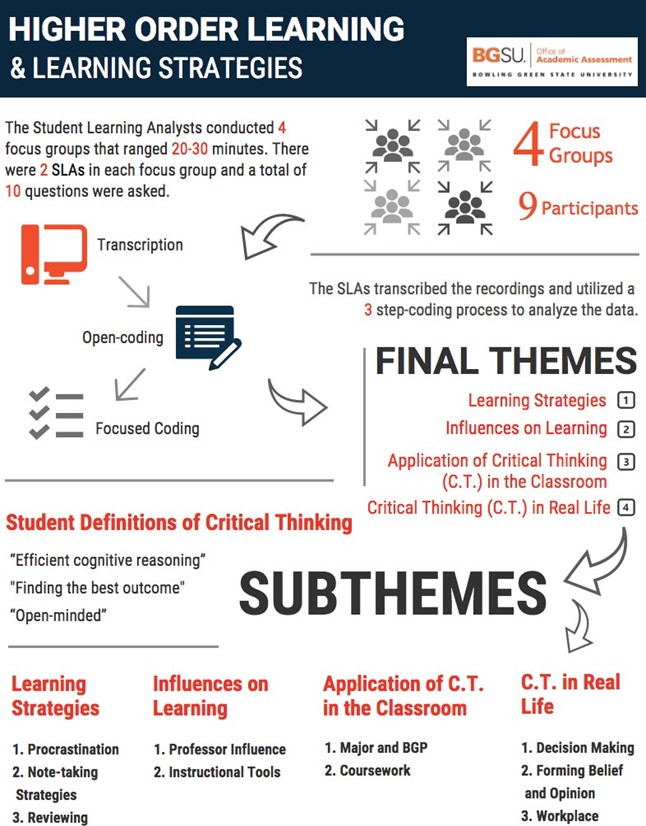
A group of four Student Learning Analysts (SLAs), comprised of undergraduate students from a wide variety of class standings and majors, explored the topic of higher order learning and learning strategies, based on areas of the National Survey of Student Engagement (NSSE). The SLAs collaborated to develop questions for the focus group protocol and then tabled in the Bowen‐Thompson Student Union to recruit participants. Four focus groups were facilitated by the SLAs with a total of nine participants. Following the focus groups, the SLAs transcribed the focus groups and then went through a three-step coding process. These steps included: 1) open coding, 2) focused coding, and 3) an analysis of the focused coding to identify major themes. After combining the codes from each individual SLA, a master code was created, and findings were brought to light. Four major themes emerged with subthemes, along with a compilation of student definitions of critical thinking, and selected quotes were extracted to provide tangible examples.
- Learning Strategies
- Procrastination/Cramming
- Note‐Taking Strategies
- Reviewing
“So, if I have to study for something, I make flashcards a lot of the time. I’ll go through my notes and kind of go through the study guide and figure out what’s going to be on the exam, and I’ll make flashcards and write stuff out so it sticks to memory a little more” (T1, L21‐23).
- Influences on Learning
- Professor Influence
- Instructional Tools
“…I would say my favorite is just…in‐class quizzes, like once a week, or maybe just little short quizzes that are based on your readings and things. Just like a paper quiz, multiple choice or just something that you could write…so you can learn stuff better, you can take a chance to guess at it or check what you know against the teacher’s knowledge” (T2, L158‐164).
- Application of Critical Thinking in the Classroom
- Major and BGP
- Coursework
“…In one of my MIS courses, we do these things called ER diagrams…and what that means is you have to critically think how tables in a database environment relate to each other…so it’s sort of making a logical puzzle and I think that’s pretty heavy on the critical thinking” (T2, L252‐257).
- Critical Thinking in Real Life
- Decision Making
- Forming Belief/Opinion
- Workplace
“I think that…communication and interpersonal skills are important, and also some technical skills, but I think critical thinking is the thing that separates people and what they can do for a company” (T2, L221‐224).
- Critical Thinking
- Student Definition
“Efficient cognitive reasoning” (T2, L214).
“Being willing to change your opinion” (T4, L107).
“Not jumping to immediate conclusions about things…” (T4, L102).
For a copy of the full report, please contact Dr. Jessica Turos, Associate Director, Office of Academic Assessment at jmturos@bgsu.edu.
Infographic
Updated: 03/19/2026 06:00PM