
Students’ Perception of Writing Executive Summary - Fall 2019
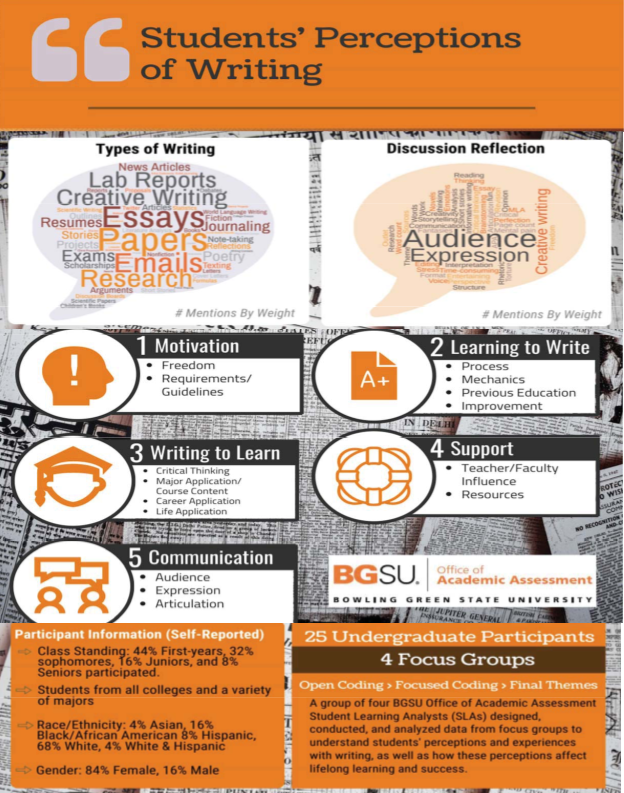
Four undergraduate Student Learning Analysts (SLAs) from the Bowling Green State University Office of Academic Assessment from a variety of class standings and majors conducted focus groups to gain students’ perspectives about their experiences with writing at BGSU and the effects on lifelong learning and success. The SLAs collaborated to develop questions and protocol, recruited participants, and facilitated four focus groups with a total of 25 participants across class standings and majors. These focus groups were recorded in order to preserve the most accurate version of the data. Participants self-identified the following demographic information: 84% [n=21] of the participants self-identified as female and 16% [n=4]as male; 68% [n=17] of the participants identified as White, 16% [n=4] as Black/African American, 8% [n=2] as Hispanic, 4% [n=1] as Asian, and 4% [n=1] as Hispanic/White. After the focus groups, the SLAs transcribed and coded recordings. The steps in this process included: 1) open coding, 2) focused coding, and 3) identifying themes and subthemes. Five major themes emerged with corresponding subthemes and are detailed below:
- Motivation: Students described their main goal behind writing and the reasons why they write.
- Freedom: Students discussed the importance of their ability to write on a topic of choice or about unique things that interest them.
- Requirements/Guidelines: Students talked about teacher or professor-enforced limits or thresholds of any aspect of writing as impacting motivation.
When discussing a choice in writing on a topic of interest, a participant stated: I wrote an essay about The Breakfast Club, the movie, and that was like my favorite essay because I love that movie and the ideas, the aspects, the things that I wrote about you don’t really think about when you first watch the movie. But when you start to depict like the little things in the movie and you write it down and it's like you get the bigger picture and I just loved it. (T2, L53- 57)
- Learning to Write: Students shared the learning experiences that helped them arrive at their current level of writing proficiency.
- Process: Participants talked about the steps a person takes when writing, including drafting, revising, and receiving feedback.
- Mechanics: Students listed and explained components of writing, such as format, spelling, grammar, and capitalization.
- Previous Education: Students discussed their writing experiences prior to coming to BGSU (e.g., K-12, a different institution) and how it influenced their current writing skillset.
- Improvement: Students noted the steps and skills they have learned to enhance their writing quality and comfort over time at BGSU.
A student shared: ...Before my academic writing class, I was always kind of taught that your first draft should be your final draft; just with a few like grammar mistakes. But then I got to my writing class and they’re like, ‘No, you don’t even have to have your intro or conclusion finished, like you can just have some ideas on a paper. Have about 600 words. You’ll be fine.’ ...it actually kinda scared me at first, cuz I was like... I can’t turn this into you. It’s not finished. But it’s actually comforting to be able to...make a half-finished product, get feedback on it, and then finish it with the feedback that you were given. (T3, L385-392)
- Writing to Learn: Students spoke about utilizing writing to enhance personal, professional, or academic understanding.
- Critical Thinking: Participants discussed how utilizing writing can provide a deeper understanding or different perspectives on thoughts or ideas.
- Major Application/Course Content: Students mentioned how they used writing in order to master course content.
- Career Application: Students spoke about writing in a future job, internship, or career.
- Life Application: Students discussed using writing for personal growth or assistance and as a tool for organization.
A participant noted: I think writing is just like the package of our thoughts. So like, if you wanna make your writing better you also have to make your thoughts more coherent and more logical. So, when you teach critical thinking, you teach kids how to navigate, you know, the gray area that writing deals with; which is not often like black and white. I think that helps with writing.. (T3, L223-232)
- Support: Students linked writing with the people and tools that they utilized to improve their skills and perceptions of writing.
- Resources: Participants mentioned peers, TAs, and library professionals that supported their writing.
- Teacher/Faculty Influence: Students noted the actions of professors that affected their experiences with writing, including feedback, availability, and intentional curriculum.
A participant mentioned: I didn’t know that, the BGSU library database, was like an option for us until my paper was due in like a week. Our TAs went over how to go through that. In the lecture hall, our professor just said, like, ‘Oh, find your own article’ and I was very overwhelmed when I heard that. I didn’t want to just like [use] Google and have a bunch of things pop up that I wouldn’t be able to use. But to have my TAs go over the process and show it up on the projector was very helpful. (T1, L305-312)
- Communication: Students explained that the goal of utilizing writing was to construct a particular message.
- Audience: Participants talked about considering who will be reading their writing.
- Expression: Students discussed how they express their emotion and feeling in writing and how it affects the message they are trying to convey.
- Articulation: Students spoke about the importance of writing and organizing thoughts and ideas in a clear manner.
A student noted: I think understanding purpose and audience is a huge thing when writing. Um, whenever you write something you should consider who you’re writing to and why you’re writing something. So like, in most classroom settings, yeah, you’re writing a paper for your teacher or your professor because they’re making you, but like, at the same time, it should be stressed that, um, when you go into a certain career field and you have to write something, you should acknowledge, like, the people that you’re writing to and why you’re trying to communicate what you want to communicate. (T1, L234-241)
For a copy of the full report, please contact Dr. Jessica Turos, Associate Director, Office of Academic Assessment at jmturos@bgsu.edu.
Infographic
Updated: 03/19/2026 05:59PM