
Innovation in the Classroom Executive Summary - Fall 2018
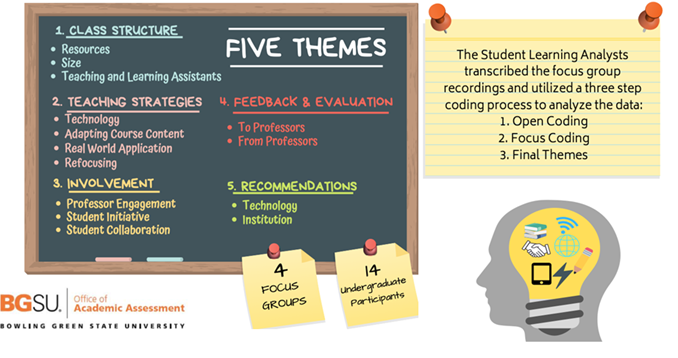
This project was a student-led assessment of Bowling Green State University undergraduate students. It was conducted by a team of students identified as Student Learning Analysts (SLAs) as part of the Office of Academic Assessment. The SLAs designed a focus group protocol exploring what students believe is innovation in their learning environments. There were four focus groups facilitated by the SLAs, with a total of 14 participants from varying class standings and majors. Audio recorders were used to ensure that all information was properly documented. These recordings were transcribed and analyzed. Transcriptions were open coded and then focus coded into themes by the SLAs. All codes were analyzed and narrowed to five main themes with subthemes listed below.
- Class Structure: Participants discussed how the organization of classes was considered innovative.
- Resources: Participants spoke about the physical and technological resources in the class that were innovative.
- Size: Participants felt that the number of students in the class contributed to innovation in the classroom.
- Teaching and Learning Assistants: Students discussed how supplemental instructors are a strategy for innovation.
One student described the structure of a class they attended, and how they thought in-class resources contributed to innovation in their learning: In [one] class... it’s in Olscamp, and it’s a really big room, it’s a lecture class, and then each table is kind of set up, like, where it’s tables of people, and you’re all facing each other, but there are two giant screens on every wall, so like the professor might be standing behind you, but you don’t have to turn around and like, look up and take notes, so like no matter where you are you can definitely see the board. (T2, L63-68)
- Teaching Strategies: Participants discussed innovative methods they have seen professors use to present material.
- Technology: Participants discussed how the integration of technology into the classroom can be an innovative teaching strategy.
- Adapting Course Content: Participants discussed the importance of professors keeping their curriculum and teaching strategies up-to-date and relevant.
- Real World Application: Students found it innovative when professors used real world examples to help explain the topic.
- Refocusing: Students shared experiences about professors who used class time to focus on something other than the material, which led to re-engaging with the class material.
One student expressed how professors should change one aspect of their course in an innovative way to reflect how students learn: I feel that like faculty should challenge themselves - like for each time that they teach whatever course it is - to change like one thing in the way that they do it. And if it works, it works, if it doesn’t, it doesn’t. Then next time change one more thing, so it is always like developing and always growing to reflect how different people learn at different levels. (T1, L211-215)
- Involvement: Students discussed that involvement in their education directly connects to the idea of what it is to be innovative in the classroom.
- Professor Engagement: Students shared that if their professors engaged with them during class time, it impacted their learning.
- Student Initiative: Participants felt that it was their responsibility to innovatively engage with the course material.
- Student Collaboration: Students felt that collaboration and group work led to innovative class discussion.
A student found that they are more engaged in the lesson when the professor is teaching with passion: ...If like the professor is engaging and passionate about what they are teaching, the students are engaged. So, I’m in a class right now and the professor is always like waving [their] hands around...it really keeps you engaged because you don’t know what [they are] going to say next...[they are] excited to give you all the information that [they] know. (T2, L576-585)
- Feedback and Evaluation: Students elaborated on innovative ways professors give and receive feedback.
- To Professors: Students describe how giving feedback to professors about teaching styles and course content was innovative.
- From Professors: Participants expressed the importance of getting feedback from their professors and how it improves their learning and personal study habits.
A student pointed out a specific example when their professor would take time to individualize feedback for important papers: Every time we would do a draft, they would go around the whole class and talk to us individually about what they think we can do better on our draft and just that... personal connection... was very beneficial because it makes us want to do better. (T3, L266-270)
- Recommendations: Students provided insight on how they would like to see innovation used at BGSU.
- Technology: Students identified what they would like to see improved in terms of technology throughout classrooms.
- Institution: Students expressed their own ideas of what they believed would be innovative in the classroom.
The following student has recognized the steps that have been taken to make the university more innovative: I definitely get the sense that like BG is trying harder and harder... each semester to bring more to the table. You know like we brought in the January session I think that’s super innovative you know like having that opportunity for accelerated learning. Anything that will further learning or understanding is really good. (T4, L196-200)
For more information about this assessment project, please contact Dr. Jessica M. Turos at the BGSU Office of Academic Assessment at jmturos@bgsu.edu.
Infographic
Updated: 03/19/2026 05:59PM