
Quantitative Literacy Executive Summary - Fall 2017
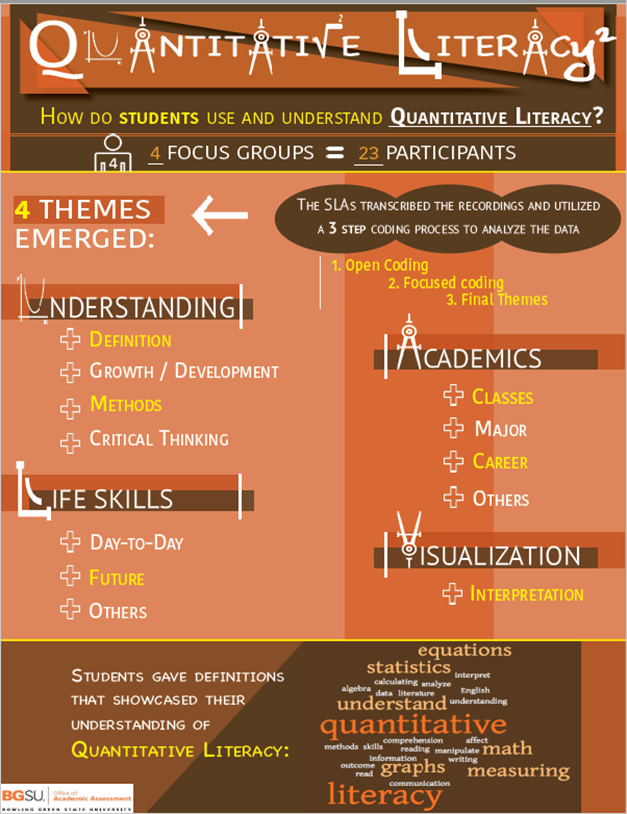
This project was a student-led assessment of students at Bowling Green State University. It was conducted by a team of four students identified as Student Learning Analysts (SLAs) as part of the Office of Academic Assessment. The SLAs designed a focus group protocol exploring students' understanding of Quantitative Literacy. There were four focus groups facilitated by the SLAs with a total of 23 participants from varying class standings and majors. Audio recorders were used to ensure that all information was properly documented. These recordings were transcribed and analyzed. Transcriptions were open coded and then focus coded into themes by the SLAs. All codes were analyzed and narrowed to four main themes with subthemes, listed below.
- Understanding: Participants identified how they defined Quantitative Literacy and explained how their definition and use of Quantitative Literacy has grown over time.
- Definition: Students' initial descriptions of Quantitative Literacy
- Growth/Development: Gaining an understanding of Quantitative Literacy over time
- Methods: How professors can effectively incorporate Quantitative Literacy
- Critical Thinking: A connection between Quantitative Literacy and Critical Thinking
One student explained how their understanding of Quantitative Literacy came to be:
Well, basically I had no clue [about] the definition of [Quantitative Literacy] ... before this class which I guess I gained knowledge of it and stuff which is helpful cause I use it day to day and I didn’t even realize it. (T4, L288-290)
- Visualization: Participants discussed how they draw inferences from graphs and visuals.
- Interpretation: What students take away from visual representations of data
A participant discussed how they viewed Quantitative Literacy:
I feel like visual representations is a lot, it’s the first thing you look at, and you start registering it. So, if it’s presented well you’re going to understand it better. And if it’s confusing you’re going to be like, I don’t know what I’m looking at. You’re not going to take the information in. (T3, L170-173)
- Academics: Students indicated that Quantitative Literacy was often exposed to them through their academics and explained how they used it in their classes now and how they will apply it to their careers post-graduation.
- Classes: Bowling Green Perspectives and specific courses.
- Major: How Quantitative Literacy is applied to their individual majors.
- Career: How Quantitative Literacy can be used in their future careers.
- Others: Roommates and Resident Advisors observed using Quantitative Literacy in education.
Quantitative Literacy was identified by students as being used in academics. One student specifically stated:
I use it a lot in my math class in methods with like teaching kids how to understand math and teaching them… how to make a graph or to solve an equation like where to begin. (T4, L52-54)
- Life Skills: Students recognized that they not only used Quantitative Literacy in their academics, but also in their lives through multiple avenues.
- Day-to-Day: Application of Quantitative Literacy in students' daily lives
- Future: Connections to Quantitative Literacy usage after graduation
- Others: How Quantitative Literacy can be used by other students
In addition to academics, students described Quantitative Literacy as being important in everyday life. One participant expressed this saying:
I think in general, day-to-day life would be difficult if you don’t…have basic Quantitative Literacy. (T2, L27-28)
For further information contact Dr. Jessica M. Turos at the Office of Academic Assessment at Bowling Green State University at jmturos@bgsu.edu.
Infographic
Updated: 03/19/2026 06:00PM