
Student Engagement in The Classroom Executive Summary - Fall 2016
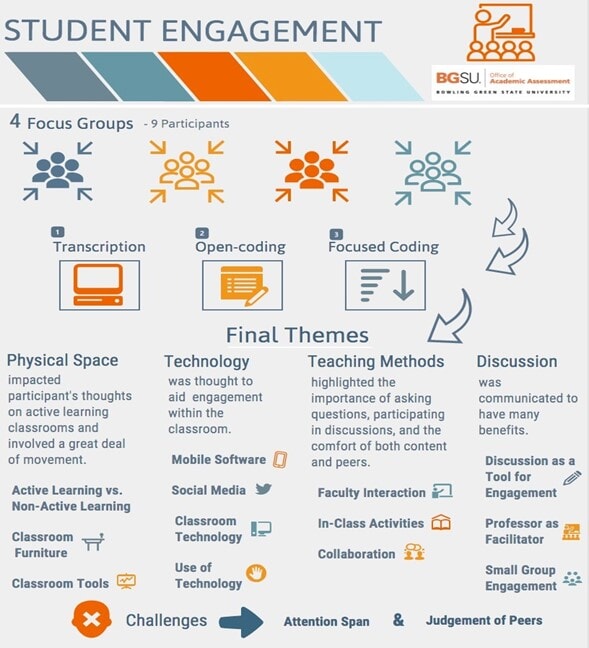
A group of four Student Learning Analysts (SLAs), comprised of undergraduate students from a wide variety of class standings and majors, explored the topic of student engagement in the classroom, through the lens of active learning. After being trained in assessing student engagement, the SLAs collaborated to develop questions for the focus group protocol. The SLAs tabled in the Bowen‐Thompson Student Union to recruit participants, along with sending participation requests via e‐mail. Four focus groups were facilitated by the SLAs with a total nine participants. Following the focus groups, the SLAs transcribed the focus groups and then went through a three‐step coding process. These steps included: 1) open coding, 2) focused coding, and 3) an analysis of the focused coding to identify major themes. After combining the codes from each individual SLA, a master code was created, and findings were brought to light. Five major themes emerged with subthemes and selected quotes were extracted to provide tangible examples.
- Physical Space
- Active Learning vs. Non‐Active Learning Classrooms
- Effects of Classroom Furniture
- Effects of Classroom Tools
“Some of those spaces that have the whiteboards on the desks or like the ones that you can move around and… you can engage with a group of peers as opposed to writing things down on a piece of paper.” (T3, L151‐153).
- Technology
- Utilization of Mobile Software
- Incorporating Social Media in the Classroom
- Effects of Classroom Technology
“Technology is pretty big because well it’s technology. It makes it a lot easier to discover new solutions, to facilitate your thoughts, to help you move more forward into your problem-solving abilities” (T1, L136‐138).
- Teaching Methods
- Faculty Interaction with Students
- In‐Class Activities
- Group Work and Collaboration
“…I got to work with other people rather than sitting there silently by myself. I was able to talk with others, get their ideas and things like that to improve my education, as well as show what I know to them” (T1, L37‐39).
- Discussion
- Discussion used as a Tool for Engagement
- Professor as a Facilitator, rather than a Lecturer
- Utilization of Small Groups
“So, I think that definitely when you’re creating ways to discuss material and talk about material that is more enjoyable and fun, you’re more motivated to participate and be engaged” (T3, L192‐194).
- Challenges & Potential Solutions
- Attention Span in the Classroom
- Judgment of Students’ Peers
Challenge: “…Even if I do know the answer, I’m quick to second guess myself because I don’t want to answer it the wrong way…so I kind of back away from it myself and I’m pretty sure that might be a reason why other people do it” (T4, L195‐200).
Solution: “I like the whole idea of smaller groups and then branching out into bigger groups, because maybe you’re nervous to talk in front of 30 people but in front of 5 it’s not as bad” (T4, L181‐183)
For a copy of the full report, please contact Dr. Jessica Turos, Associate Director, Office of Academic Assessment at jmturos@bgsu.edu.
Infographic
Updated: 03/19/2026 06:00PM