
Educational Technology Executive Summary - Fall 2023
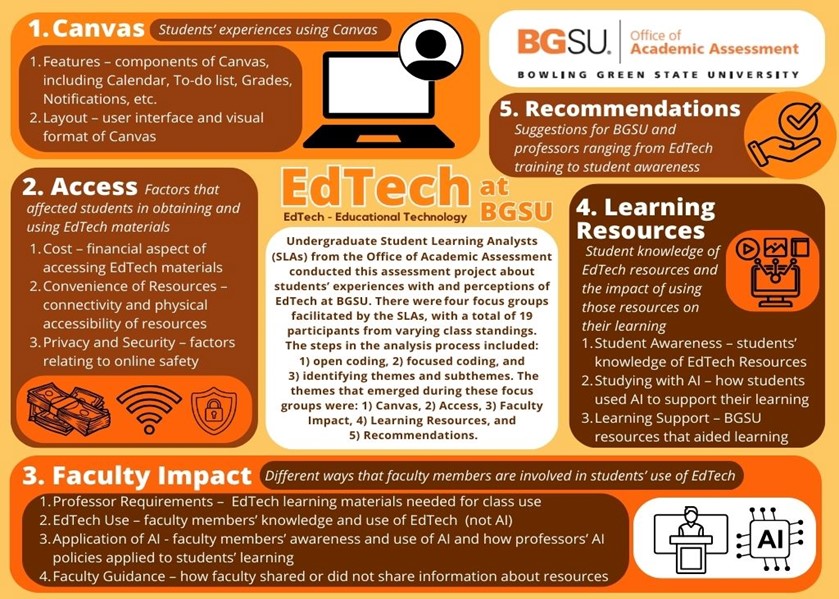
Bowling Green State University (BGSU) undergraduate Student Learning Analysts (SLAs) from the Office of Academic Assessment conducted this assessment project. The SLAs designed a focus group protocol to gain an understanding of students’ perceptions of educational technology (EdTech) and the impact on students’ learning experiences. The SLAs facilitated four focus groups with 19 participants from varying class standings and majors from five colleges. Out of the 19 participants, 63.16% (n = 12) self-identified as female, 26.32% (n = 5) self-identified as male, 5.26% (n = 1) self-identified as non-binary, and 5.26% (n = 1) self-identified as using she/her pronouns. From the race/ethnicity information the participants provided, 73.68% (n = 14) self-identified as White, 10.53% (n = 2) self-identified as African American/Black, 10.53% (n = 2) self-identified as Asian, and 5.26% (n = 1) self-identified as Biracial. Zoom was used as the online meeting platform, and the focus groups were recorded. These recordings were then transcribed and analyzed. The steps in the analysis process included: 1) open coding, 2) focused coding, and 3) identifying themes and subthemes. The themes and subthemes that emerged during these focus groups are detailed below:
- Canvas – Students shared their experiences using Canvas.
- Features – Students discussed how the components of Canvas, including Calendar, To-do list, Grades, Notification, etc., impacted their learning experiences.
- Layout – Students discussed the user interface and visual format of Canvas and how it affected them.
A participant talked about how Canvas has supported them:
For me, Canvas involves almost anything to help me during my time at BGSU so far. (T3, L373-374)
- Access - Students discussed the factors that affected them in obtaining and using EdTech materials.
- Cost – Students talked about the financial aspect of accessing EdTech materials.
- Convenience of Resources – Participants talked about how connectivity and physical accessibility of resources impacted students.
- Privacy and Security – Students discussed the factors relating to online safety concerns that affected their learning experience.
A student talked about how easy it was for them to access EdTech learning materials at BGSU:
It's been all good; I haven't had many notable issues. Everything's easy to access. That's about it. It's just been overly positive. (T2, L7-8)
- Faculty Impact - Participants commented on the different ways that faculty members are involved in the students’ use of EdTech.
- Professor Requirements – Participants discussed EdTech learning materials needed for class use.
- EdTech Use – Students talked about faculty members’ knowledge and use of EdTech other than AI.
- Application of AI - Students talked about faculty members’ awareness and use of AI and how professors’ AI policies applied to students’ learning.
- Faculty Guidance – Participants discussed how faculty shared or did not share information about helpful EdTech resources.
A student talked about how professors’ knowledge impacted their learning:
I think it's really nice when, like, faculty members are, like, knowledgeable about certain technology. Because I'm coming in as a freshman, I'm not really familiar with some of this, like, new technology that BG uses. So, it's really nice when they can actually answer my questions and know what they're talking about on that front. (T1, L176-179)
- Learning Resources - Students discussed their knowledge of EdTech resources and how the use of those resources impacted their learning.
- Student Awareness – Students discussed their knowledge of EdTech Resources.
- Studying with AI – Students talked about how they used AI to support their learning.
- Learning Support – Participants talked about BGSU resources that aided their learning.
A participant discussed the quality of the physical technology available to BGSU students:
...I think that BGSU [has] been really good at investing in technology, especially in newer buildings, and kind of updating stuff ...a lot of versatile spaces across campus that can be used to do a bunch of different things. (T4, L217-222)
- Recommendations – Students gave recommendations and suggestions for BGSU and professors.
This participant had a suggestion to increase student awareness:
I think one thing that could be beneficial is just to make students more aware of the things that BG offers, like ... the computer labs and the laptops and the printers. Because once I transferred here, I pretty much had no idea about any of that stuff, and, like, I still don't, so I think just kind of getting that information out there would be really beneficial to students. (T4, L382-385)
For more information about this assessment project, please contact Dr. Jessica M. Turos, Associate Director of the BGSU Office of Academic Assessment, at jmturos@bgsu.edu.
Infographic
Updated: 03/19/2026 09:38PM