
Connecting Course Curriculums Executive Summary - Fall 2021
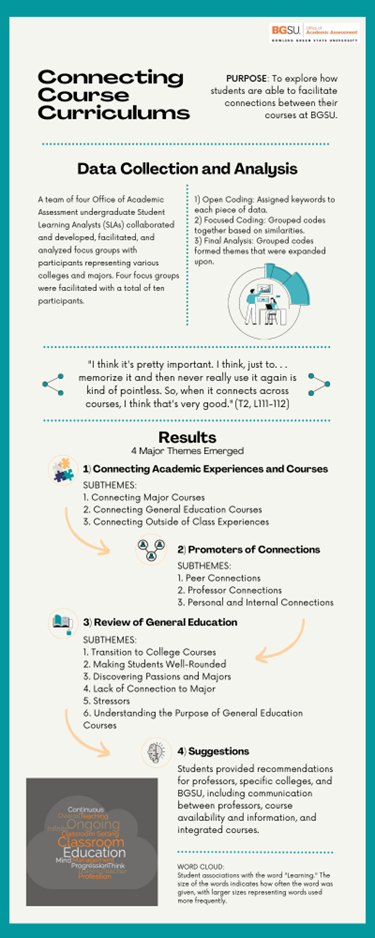
Four undergraduate Student Learning Analysts (SLAs) from the Bowling Green State University (BGSU) Office of Academic Assessment from various majors conducted focus groups to gather information on how students connect the curriculums of their different classes. The SLAs collaborated and developed questions and protocol, recruited participants, and facilitated four virtual focus groups with a total of 10 participants. Participant demographic data are as follows: 90% (n=9) self-identified as female and 10% (n=1) self-identified as male. Of the participants, 30% (n=3) self-identified as African American/Black, 10% (n=1) self-identified as Asian, and 10% (n=1) self-identified as Hispanic, and 50% (n=5) self-identified as White. Participants represented various colleges and majors. After the focus groups, the SLAs transcribed and coded the Zoom recordings. The steps in the analysis process included: 1) open coding, 2) focused coding, and 3) identifying themes and subthemes. Four major themes emerged, and the corresponding subthemes are detailed below.
- Connecting Academic Experiences and Courses: Students talked about the importance of integrating concepts, examples, and aspects across courses and/or experiences.
- Connecting Major Courses: Participants shared examples and the importance of integrating concepts, examples, and aspects from major courses to other courses and experiences.
- Connecting General Education Courses: Students discussed examples and the importance of integrating concepts, examples, and aspects from general education (i.e., BGP) and foundational courses to other courses and experiences.
- Connecting Outside of Class Experience: Participants shared examples and the importance of integrating concepts, examples, and aspects from outside-class experiences, including internships, part-time work, organizations, and research to courses.
One student shared how they think connecting course curriculum is important: I think it's pretty important. I think, just to. . . memorize it and then never really use it again is kind of pointless. So, when it connects across courses, I think that's very good. (T2, L111-112)
- Promoters of Connections: Participants mentioned people involved in creating or developing connections between courses and/or experiences.
- Peer Connections: Students talked about the ability of fellow students to help facilitate connections between courses and/or experiences.
- Professor Connections: Students discussed the ability of professors to help facilitate connections between courses and/or experiences.
- Personal and Internal Connections: Participants talked about the ability of students to make connections between courses and/or experiences.
One participant talked about recognizing when their peers are making connections throughout their major: Um, I would say that sometimes they are having class discussions. Like, people will reference, like, something that's going on in their major or another class that they're taking. And I always think that's kind of interesting how they, like, tie those things together. (T3, L131-133)
- Review of General Education: Students shared their overall view and understanding of their general education (gen. ed.) experience.
- Transition to College Courses: Students noted the positive views of their general education courses that helped them transition to college and learn valuable skills.
- Making Students Well-Rounded: Students expressed the benefit of taking a variety of general education courses that provided them with a more diverse skill set.
- Discovering Passions and Majors: Students discussed the identification of their desired major and ability to explore their interests by taking general education courses.
- Lack of Connection to Major: Students voiced their displeasure with their general education experience due to how courses did not connect to their major or appear relevant.
- Stressors: Students spoke about the various pressures of taking and scheduling general education courses.
- Understanding the Purpose of General Education Courses: Students articulated their overall understanding about why BGSU requires students to take general education courses.
One student shared the effect of discovering connections between general education courses on understanding why they are required by BGSU: ...I do know some kids will be like, ‘Oh, this gen. ed. is stupid. Why am I taking this class?’ And if you see that there's a connection between each class, it will be like, ‘Oh, I learned that in this class, and it can help you with something else’. And I feel like if I have that connection I’m just like, ‘Oh, I’m taking this class because I need it, not because it's stupid.’ (T4, L58-62)
- Suggestions: Students provided recommendations for professors, peers, specific colleges, and BGSU.
A student voiced their opinion on how general education and major courses should be more integrated:
I honestly feel like it should be integrated. Like, you should have gen. ed. throughout all four years and have your major. Because what if you don't like the major, like, once you start taking your major classes and you just wasted, like, two years. (T4, L97-99)
For more information on this assessment project, please contact Dr. Jessica M. Turos at the BGSU Office of Academic Assessment at jmturos@bgsu.edu.
Infographic
Updated: 03/19/2026 09:38PM